The Artificial Stakes of the Middleweight Title
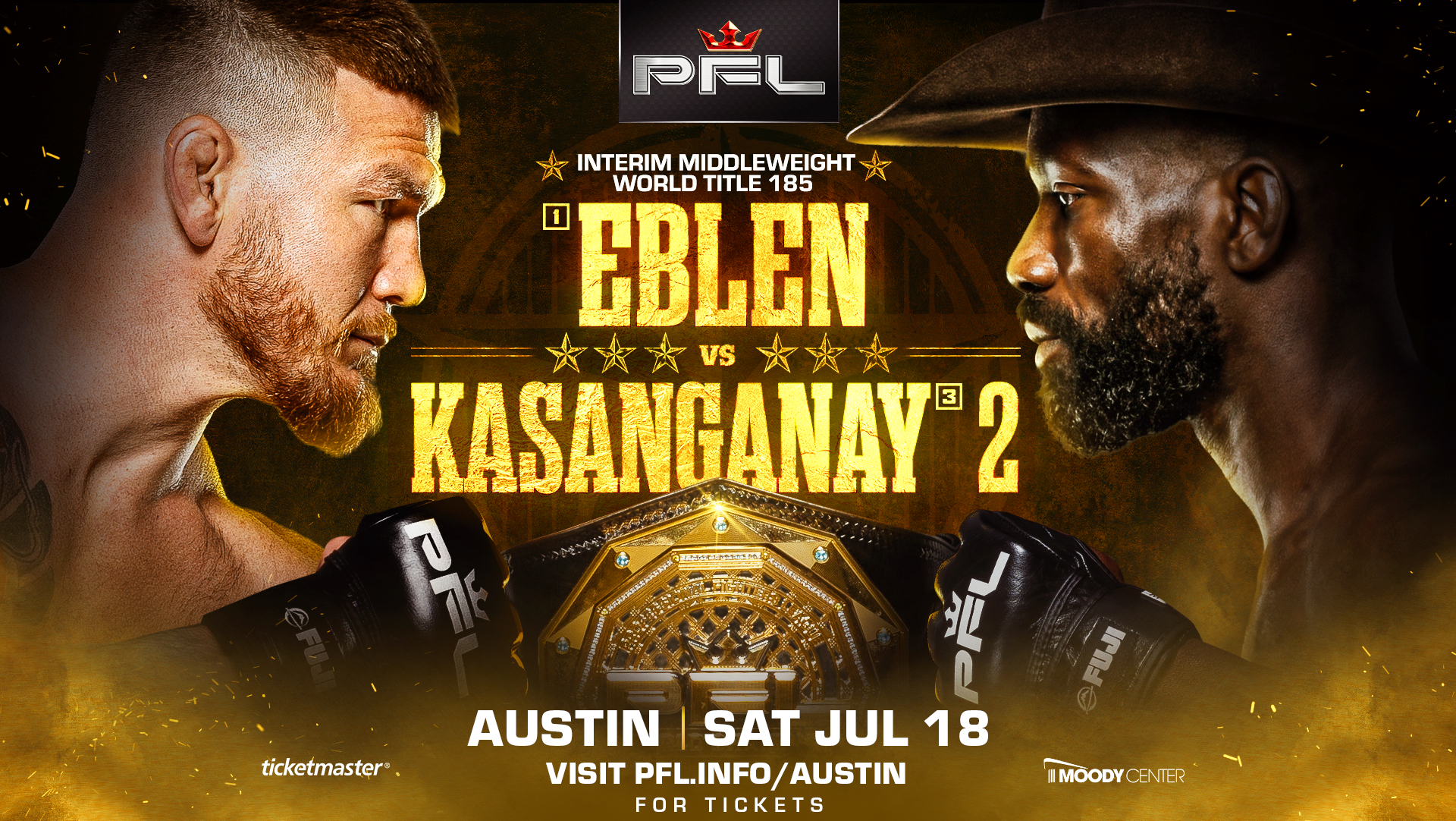
PFL Austin lands at the Moody Center in Austin, Texas, with the heavy scent of matchmaking damage control. The original main event between middleweight champion Costello van Steenis and former titleholder Johnny Eblen dissolved when the champion withdrew due to an undisclosed injury. Rather than waiting for a proper linear defense, the promotion immediately booked a rematch between Eblen and light heavyweight standout Impa Kasanganay for an interim belt.
This decision continues a pattern of short-term planning that dilutes the division's value. The middleweight division has struggled with consistency since the acquisition of Bellator's roster. The integration of two separate matchmaking philosophies has created a logjam at the top of the weight class.
Instead of a clear progression, fans are treated to constant interim titles that resolve nothing. Details of the final fight card and start times can be found in the PFL Austin preview on Bodyslam.net. Eblen enters the arena with a professional record of 17–1, his sole career loss coming via a fifth-round submission to van Steenis in July 2025. He got back on track with a win over Bryan Battle in March 2026, but the former champion's aura of invincibility is gone.
Kasanganay stands at 20–6, possessing the raw athleticism that troubled Eblen during their initial bout in February 2024. The stakes are artificial. However, the tactical matchup remains one of the most intriguing in the division.
Riyadh Mechanics: Deconstructing the First Fight
To understand this rematch, one must study the mechanics of their first meeting in Riyadh. That night ended in a split decision of 29–28, 29–28, 28–29 in favor of Eblen. The scorecards reflect a fight of narrow margins, decided by Eblen's ability to chain wrestling sequences when his striking defense failed.
At the 3:12 mark of the first round, Kasanganay connected with a looping overhand right that clean wobbly-legged the Bellator champion. Eblen did not panic. He immediately initiated a reactive double-leg takedown, using head position against the chest to drive Kasanganay to the fence and burn 85 seconds of control time to clear his head.
The second round exposed Eblen’s structural footwork flaws. When pressured laterally, Eblen has a habit of circling hard to his left while dropping his lead shoulder. Kasanganay capitalized at 2:45 of the second, cutting off Eblen’s exit route with a lead hook that landed flush.
Yet, Kasanganay failed to sustain this pressure because of his own tactical limitations. He remained flat-footed. This allowed Eblen to reset his distance and land his jab at a 42% connection rate.
By the third round, Eblen’s wrestling pacing took over. He completed 3 of 7 takedown attempts in that frame alone, racking up 3:42 of control time. Kasanganay's takedown defense collapsed not because of a lack of strength, but because of his hip positioning.
When Eblen entered on a single-leg, Kasanganay consistently over-rotated his pelvis to defend the lock. This action exposed his back. It allowed Eblen to drop his level for inside trips.
During clinch sequences along the fence, Eblen displays elite wrist control mechanics. He uses a dominant head-under-chin position to force his opponent's posture upward. This breaks the defensive posture needed to resist underhooks, allowing Eblen to slide his hips in for trips.
Kasanganay must counter this by utilizing an active whizzer and keeping his back off the cage. If he allows Eblen to flatten him against the fence, his explosive striking becomes completely neutralized. The battle for underhooks in the first two minutes of each round will dictate the pacing.
The rematch will be won or lost in the initial three steps of every exchange. Kasanganay fights out of a wide, low-slung stance designed to anchor his heavy counter-punches. It is a powerful base for defending standard double-legs, but it leaves his lead thigh static.
Eblen’s coaching staff at American Top Team undoubtedly noted this. Expect Eblen to start with low calf kicks to compromise Kasanganay’s spring before attempting any level changes. This tactic should slow the counter-striker down.
Eblen’s defensive striking posture remains his biggest liability. He relies on a tight high guard to absorb punches, but this blocks his peripheral vision during close-range exchanges. In Riyadh, Kasanganay exploited this by throwing hooks that loop around the guard rather than straight punches.
Eblen also has a bad habit of leaving his chin high when exiting combinations. This is a target that a fighter with Kasanganay's hand speed can easily find. If Kasanganay times the exit, a knockout is possible.
The Flawed Depth of PFL Austin and the Final Prediction
Beyond the main event, the PFL Austin card highlights the promotion's struggle with roster depth. The co-main event features a bantamweight clash between Lewis McGrillen (12-1) and Rafael do Nascimento (12-3). While the main card airs on ESPN 2, fans looking for broadcast details can consult the PFL Austin schedule.
McGrillen, fighting out of Manchester Top Team, is an explosive puncher who recently submitted Alan Philpott in May 2026. Nascimento is a ground specialist from X-Gym who excels at back-takes. Placing this on the co-main event of a major card shows a shallow talent pool.
The McGrillen vs. Nascimento matchup is a classic striker-versus-grappler equation. McGrillen relies on a snapping left hand and quick lateral shifts to create angles for his power shots. If Nascimento cannot secure early body locks, he will face a long night of defensive shell boxing.
The featherweight division also sees action with Caolan Loughran (11-3) facing veteran Julio Arce (21-7). Arce brings a wealth of veteran experience that could trouble Loughran. Arce's boxing is based on subtle shoulder rolls and counter-jabs that disrupt his opponent's rhythm.
Loughran must use high-volume kicking to prevent Arce from settling into a pocket boxing groove. Additionally, former champion Jesus Pinedo (25-8-1) faces Joey Ruquet in a match that lost its professional luster on the scales. Pinedo missed the featherweight limit yesterday by 0.8 pounds, a sloppy mistake that penalizes his purse and raises questions about his preparation.
When former champions cannot make weight for secondary matches, it reflects poorly on the event's competitive integrity. It exposes a lack of discipline. The promotion must address these weigh-in failures to maintain credibility.
Kasanganay has the tools to win if he keeps the fight in the center of the cage. His hand speed is superior. His sprawl is effective when he avoids over-rotating his hips.
However, Eblen's tactical discipline in clinches remains the deciding factor. Eblen is a master of grinding opponents down against the fence. He uses short knees to the thigh and constant wrist control to prevent escapes.
Expect a repeat of their first encounter, but with Eblen executing a more conservative game plan. He will avoid prolonged pocket exchanges. He will use low kicks and feints to set up safe double-leg entries.
Eblen will win a grinding, ugly unanimous decision by controlling the hips of Kasanganay for at least nine minutes of the fifteen-minute fight. This victory will secure the interim belt and set up a unification bout with van Steenis. The former champion will reclaim his spot at the top.