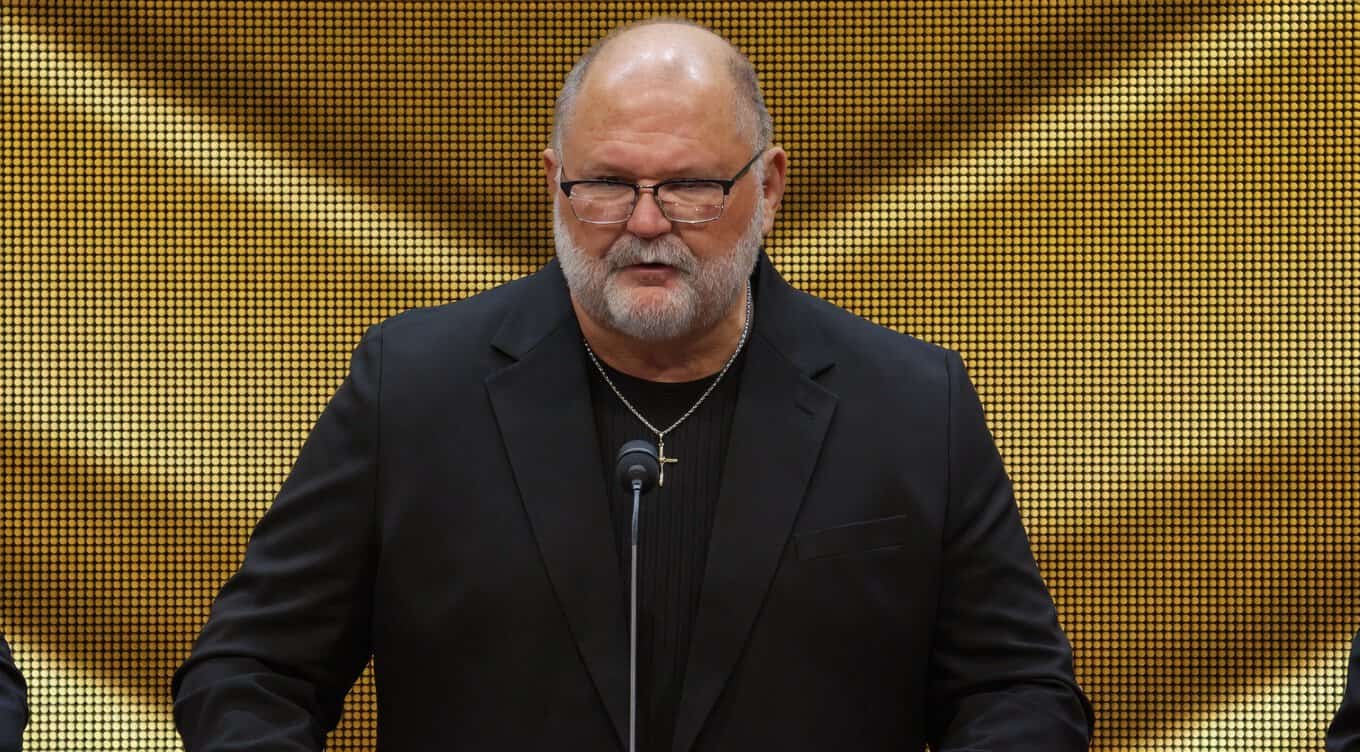
The Enforcer’s Stunning Admission
There are men who carry the championship, and there are men who carry the company. For forty years, Arn Anderson was the latter. He was the standard-bearer for credibility, the man whose presence alone told you the segment mattered. A methodical scowl, a perfectly timed stomp, and the sudden, definitive punctuation of a spinebuster. Arn was the fixer, the problem solver, The Enforcer. So when he admitted on his podcast that the recent A&E Biography was the first time in his entire career he truly felt like a “top guy,” the admission landed with the force of one of his own DDTs. It felt impossible.
For the millions who watched him, from the Crockett-era heyday to his elder statesman role in AEW, Anderson was always a top guy. He was the believable heart of the Four Horsemen, the man who made you believe Ric Flair’s flamboyant act was backed by genuine, bone-breaking menace. Yet, in his own mind, he was simply setting the table. In his own words, the story was never about him. This disconnect between the performer's internal reality and the audience's perception is a stunning revelation that forces a complete re-evaluation of his career and legacy.
The Art of the Foundation
To understand Arn Anderson’s career is to understand the architecture of professional wrestling. If Ric Flair was the penthouse suite, Arn was the load-bearing steel frame of the entire building. His primary role, especially during the Horsemen’s imperial phase, was to give the babyface challenger a brutal, but ultimately survivable, test. He had to rough up Dusty Rhodes, bloody up Sting, and ground Ricky Morton just enough to make their eventual, fiery comeback against Flair feel earned. Without Arn’s methodical dismantling of the hero, the hero’s journey means nothing.
His in-ring style was a masterclass in this philosophy. It was devoid of flash but packed with substance. Every move had a purpose, targeting a limb, cutting off the ring, shutting down a hot tag with a simple, brutal forearm. He was a tactician in a world of acrobats. The spinebuster, his most famous offensive move, is the perfect metaphor for his work. It isn’t a high-flying, crowd-popping maneuver. It is an act of total authority, a move that stops all momentum and asserts absolute control. It was the exclamation point on a paragraph of physical dominance.
He was the ultimate tag team partner, forming legendary duos with Tully Blanchard and later with Larry Zbyszko and Eaton. But his function remained the same: he was the strategist, the general on the field, the one who ensured the team’s victory through superior tactics and a willingness to do the dirty work. He made everyone around him better because he was so completely, terrifyingly believable.
The Paradox of the Perfect Number Two
Herein lies the central, critical irony of Arn Anderson’s career. The reason he never felt like “the guy” is likely because he was too damn good at being the guy behind the guy. Promoters from Jim Crockett to Eric Bischoff saw him as the most valuable asset on the board, but not as the king. He was the piece you used to make a king. His multiple reigns as the NWA and WCW World Television Champion underscore this point. The TV title was the workhorse belt, the championship defended weekly against all comers, a testament to a wrestler's skill and stamina, but it was rarely the main event.
Was a sustained run with the NWA or WCW World Heavyweight Championship ever a real possibility? It’s debatable. Anderson lacked the larger-than-life charisma of a Flair or a Hogan. His appeal was more subtle, more grounded. Placing the top title on him would have changed the entire tone of the promotion, shifting it from Flair’s rock-and-roll excess to something more gritty and severe. It’s a fascinating “what if,” but bookers consistently chose to keep their most reliable asset in the role he had perfected. His greatness in the supporting role became a cage, preventing him from ever being cast as the lead.
A Legacy of Moments, Not Mantles
While the top world title eluded him, his career is not defined by its absence. It is defined by a series of moments that are burned into the memory of every long-term fan. The vicious parking lot assault that left Dusty Rhodes with a broken arm. The iconic “This is the Four Horsemen” promo, delivered with a chilling seriousness that sold the group’s danger better than any brawl. The way he and Tully Blanchard operated as a single unit, cutting off the ring and dissecting the Rock 'n' Roll Express with surgical precision.
These moments are his legacy. They built a character that transcended championship belts. You didn't need to see Arn with the big gold belt to know he could win it on any given night. He carried an aura of legitimacy that no title could grant, and no absence of a title could diminish. He was the constant, the benchmark for toughness and professionalism in a notoriously chaotic business.
The Final, Deserved Spotlight
This is why the A&E Biography felt so different for him. For the first time, the narrative lens didn’t treat him as a supporting character in someone else’s story. The producers, in telling his life story, were forced to frame him as the protagonist. For two hours, there was no bigger star for Arn to elevate, no babyface to prepare for Flair. The spotlight he had spent a lifetime angling towards others was finally, and deservedly, fixed on him.
It was a validation of the highest order. It was the entire wrestling world, from the producers to the fans, telling him what we had known all along: that his story, on its own, was a main event. The experience, which he called both “humbling and flattering,” served as the external confirmation of a status he earned but never allowed himself to feel. It was the one piece of recognition that had eluded him—not from the fans, but from himself.
Prediction: A Foundational Re-Appraisal
My prediction is not about a future match, but about a legacy. This admission, this peek behind the curtain of one of wrestling’s great minds, will trigger a massive re-appreciation of his work. Analysts and fans will rewatch the archives of Jim Crockett Promotions and WCW, not to see Flair’s greatest hits, but to study the master at work in the background. Young wrestlers will be shown his matches as the definitive text on how to build credibility, not just for themselves, but for their entire storyline.
Arn Anderson's A&E Biography wasn't the epilogue to his career. It is the beginning of a new chapter in how he is understood. It proves that a wrestler's worth is not measured solely in world titles, but in their impact on the very fabric of the business. He was never just The Enforcer; he was the foundation upon which main events were built. And now, finally, he sees himself as the headline act we always knew he was.