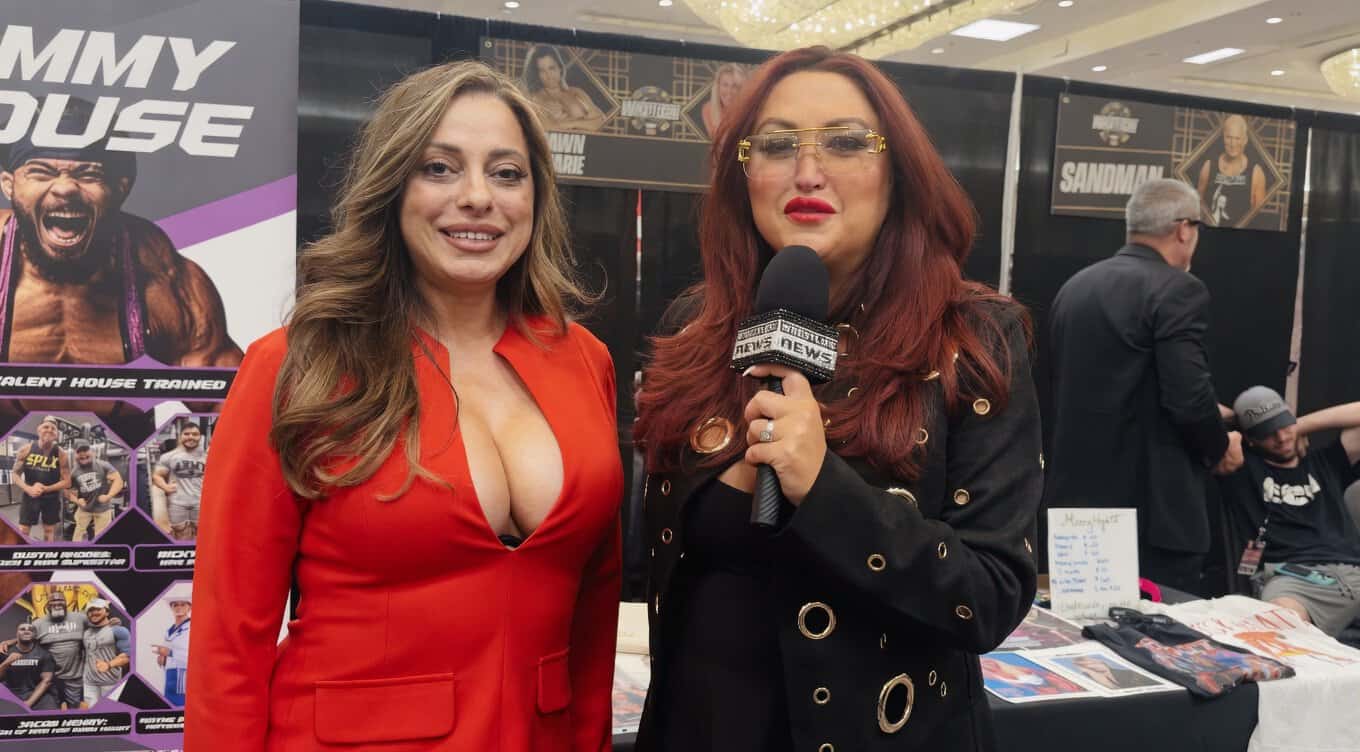
Dawn Marie popped up in the news cycle this week. She sat down for a brief interview with WrestlingNews.co to discuss her favorite WrestleMania moments. It is easy to gloss over these nostalgic retrospective pieces. Most fans read a quick headline about the early 2000s and move on. But seeing her name hit the feed nine days after WrestleMania 41 got me thinking about ring geometry. Specifically, it highlighted a massive tactical blind spot in how Paul Levesque is structuring his current cards.
We are living in an era of unprecedented athletic execution. You watch the product right now and the baseline workrate is absurdly high. The talent floor has never been higher. But we have completely lost the true ringside instigator.
I am not talking about a faction member standing at ringside wearing a track jacket. I am talking about the dedicated, heat-seeking manager. The Dawn Marie archetype. The person whose sole physical purpose in a 15-minute match is to dramatically alter the referee’s sightline and occasionally take a bump on the hardest part of the ring apron. Looking at the fallout from Allegiant Stadium, the lack of this role is hurting the mid-card.
My prediction is absolute. By SummerSlam this August, WWE will introduce a dedicated, non-wrestling manager into the women’s division. They have to. The current match structures are hitting a ceiling of diminishing returns.
The geometry of interference
Let’s look at the mechanics. A singles match is a line drawn between two competitors. The referee orbits that line. When you introduce a manager, that line becomes a triangle. It completely changes the spatial dynamics of the squared circle. The referee now has two points of failure to monitor.
Dawn Marie was exceptional at this in both ECW and WWE. She understood the precise distance required to pull focus. If you stand too close to the apron, the referee dismisses you immediately. If you stand back by the barricade, the live crowd ignores you. The sweet spot is the one-meter gap between the ring skirt and the floor mats.
In ECW, she was a masterclass in reading a room. The ECW Arena was a notoriously difficult crowd to manage. They wanted blood and high spots. But she could walk out with Lance Storm, grab a microphone, and bring the entire building to a grinding, furious halt. She understood that heat isn't just about insulting the local sports team. It is about denying the crowd what they want. She dictated the tempo. If the crowd wanted a fast-paced exchange, she would pull her client out of the ring and force the referee to start a slow ten-count.
It is a psychological manipulation tactic that is completely absent from modern wrestling television. When a heel is caught in a sustained babyface comeback today, we rarely see the manager release valve. The manager jumps on the apron. The referee turns 180 degrees. The heel gets a breath. It sounds basic, but modern WWE matches rarely use this pacing tool effectively anymore. Instead, we get endless sequences of heavy strikes and rolling reversals to break momentum. It exhausts the crowd.
The current women's division is packed with elite athletes. Rhea Ripley, Bianca Belair, Iyo Sky. They hit incredibly hard and work at an intense pace. But down in the mid-card, the feuds are stalling out. You watch an episode of SmackDown right now and the secondary women's angles consist entirely of backstage walk-and-talk segments ending in a challenge. There is no external heat source. The matches are technically sound but narratively hollow.
The failure of the modern tag division
This brings me to my biggest critique of Levesque’s current creative regime. The booking of the women’s tag team titles is a structural disaster.
They are constantly throwing two singles wrestlers together simply because they have nothing else for them to do. They get a cool mashed-up entrance theme. They wear matching gear for three weeks. Then they drop the belts on a random Monday night. There is zero narrative glue holding these teams together. The matches dissolve into chaotic spot-fests with broken rules because the referee cannot maintain control of four competitors with no clear story.
If you do not have a compelling story for two women, putting them in a tag match doesn't fix the problem. It just doubles the amount of people the crowd doesn't care about.
This is where a manager fixes the math. You take a struggling heel. Someone who hits their marks in the ring but cannot get the crowd to boo them during a promo. You attach a pure antagonist to them. Someone who dresses obnoxiously, talks constantly over the house microphone, and actively interferes in plain sight of the hard camera.
The SummerSlam pivot
WWE knows the current formula is getting stale. The Las Vegas crowds at WrestleMania 41 were loud for the main events. Cody Rhodes defending the WWE Championship felt massive. The CM Punk match felt historic. But the undercard matches suffered from long stretches of silence. The fans respect the athleticism, but they aren't angry. You need anger to sell mid-card pay-per-view matches.
Take a random mid-card match from the recent past. A brilliant showcase of holds and counters. But at the 14-minute mark, the heel is trapped in a submission. They have to rely on a generic eye-poke to break the hold. It feels cheap, but not in a way that generates sustained heat. It just feels like a script calling for a transition.
Imagine that exact same moment, but instead of an eye-poke, a manager slides a steel chair perfectly across the mat. The referee is forced to abandon the submission check to remove the weapon. The heel taps out while the referee’s back is turned. The hold is broken. The heat is nuclear. The crowd explodes because they saw the injustice happen in real time.
We are heading toward Backlash on May 9. The post-Mania rematches will carry the card. But once we hit the summer build, the roster needs new variables. They need someone to play the role Dawn Marie perfected twenty years ago. The heat magnet. The distraction. The person the crowd pays money to see get slapped in the face.
I predict we will see a female manager debut strictly in a valet or mouthpiece role before August. No in-ring aspirations. No storyline where she is secretly a trained wrestler waiting to turn on her client. Just pure, unadulterated ringside instigation.
Think about how much Paul Heyman elevated Roman Reigns simply by holding a title belt and looking terrified at ringside. That visual adds layers to the match without requiring a single bump. The women's division desperately needs that equivalent.
We do not need another five-star athletic exhibition on the kick-off show. We need a 12-minute match where the crowd spends 11 minutes screaming at a manager in a ridiculous outfit before the babyface finally gets their hands on them.
The blueprint is sitting right there in the archives. Dawn Marie wasn't just a character. She was a structural match component. She controlled the pacing from the floor. She manipulated the referee's sightlines. She gave the heels an unfair advantage that the crowd could visually understand. WWE has perfected the in-ring product. Now they need to relearn how to cheat. The manager is coming back, and it is going to alter the layout of the women's division for the rest of 2026.
Read Next
- Swerve Strickland's creative limbo and Carmella's looming return redefine the April medical report
- WWE rushing Roman Reigns into a Backlash title defense is a colossal mistake
- NXT is gambling its future on a massive post-WrestleMania international reset
- Triple H got his new deal, but his creative grip is slipping
- 🏆 WrestleMania 41 — Full Coverage Hub