The Myth of the Invincible Beast
Pro wrestling relies on the suspension of disbelief. With Brock Lesnar, fans rarely had to suspend anything. He looked like a tank and moved like a cruiserweight. But the version of Lesnar that WWE sold for the last decade—the smiling, bouncing, Suplex City mayor—was a carefully constructed mirage. It hid a fighter whose greatest actual combat moments were defined by catastrophic physical vulnerability.
Lesnar has been reflecting on his MMA run recently. He is looking backward, openly discussing his battle with diverticulitis, the devastating knockout loss to Cain Velasquez, and the brutal finish at the hands of Alistair Overeem. He even detailed the origins of his chest tattoo, crediting the ink to half a gallon of vodka & maybe a few Vicodin.
These are not the memories of an invincible conqueror. They are the scars of a man who realized his body was breaking down. This introspection is a massive signal. As we look toward WrestleMania 41 in Las Vegas, the booking geometry around Lesnar has to shift.
WWE can no longer run the standard Beast Incarnate playbook. The German suplex spam is tired. The F5 kickouts are meaningless. I am predicting right now: Lesnar’s next major WWE program will end with him being dismantled in under five minutes. He will be finished by a targeted strike to the midsection, mirroring the exact UFC losses he is currently reflecting on.
The Tactical Blueprint of Defeat
To understand where Lesnar is going in a scripted ring, you have to watch what happened to him in a real one. His UFC heavyweight title reign was spectacular but fundamentally flawed. He was a front-runner. When he could dictate the wrestling exchanges and force opponents against the fence, he was terrifying. Frank Mir learned this the hard way at UFC 100, where Lesnar used sheer mass to trap Mir's hips and land heavy ground-and-pound.
But when opponents forced Lesnar backward, the illusion shattered. Cain Velasquez wrote the blueprint at UFC 121. Velasquez did not try to out-muscle Lesnar. He used lateral movement and relentless striking volume to panic the champion. When Velasquez landed flush, Lesnar reacted terribly.
He turned away from the punches. He threw wild, unbalanced counter-strikes while backpedaling. Velasquez cornered him against the cage and unloaded a barrage of strikes that forced referee Herb Dean to step in. Lesnar was not just beaten; he was systematically disassembled by a faster, better-conditioned athlete.
Overeem perfected this strategy a year later at UFC 141. Overeem recently called that fight his masterpiece. He is right. It was a tactical execution of a wounded animal. Overeem knew Lesnar had undergone surgery to remove a foot of his colon due to diverticulitis.
Instead of head-hunting, Overeem utilized a classic Muay Thai plum clinch to control Lesnar's posture. He drove brutal knees directly into Lesnar's surgically repaired abdomen. A massive liver kick folded Lesnar in half, dropping him to the canvas and ending the fight at 2:26 of the first round.
These fights exposed a glaring weakness. Lesnar cannot handle sustained pressure to the body. He shrinks when his midsection is compromised. This is a massive psychological trigger that WWE has almost entirely ignored for a decade.
The Crutch of Suplex City
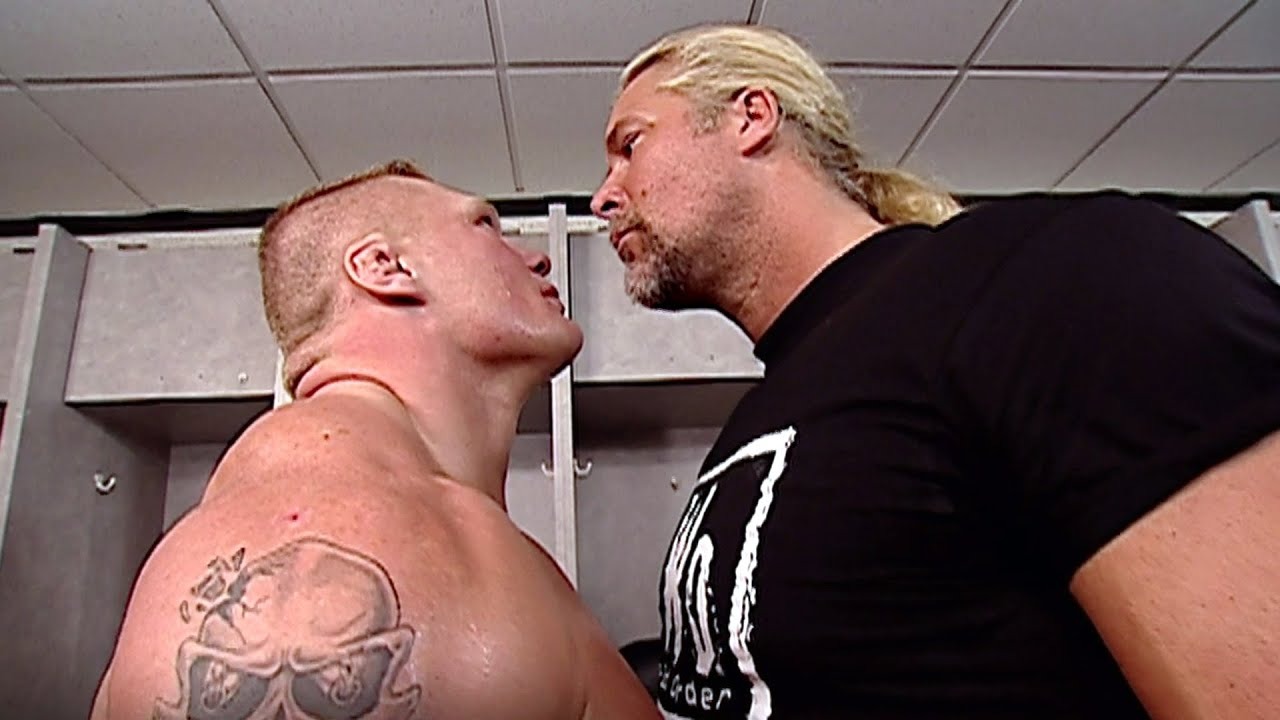
When Lesnar returned to WWE and eventually broke the Undertaker's streak at WrestleMania 30, the company pivoted his character. They realized his body could no longer handle grappling clinics like his legendary 2003 matches with Kurt Angle. His gas tank was heavily compromised, forcing WWE to keep his average match length under eight minutes.
So, they invented Suplex City. This was a booking crutch. It was a way to mask his physical limitations. By reducing his matches to short bursts of German suplexes and F5s, WWE protected him from having to sell sustained offense.
It was lazy booking. It worked for a while, generating massive crowd reactions against John Cena at SummerSlam 2014, but it eventually turned Lesnar into a one-dimensional cartoon character who rarely broke a sweat.
This is my biggest criticism of WWE's handling of Lesnar post-2015. They had a legitimate combat sports veteran with a documented history of overcoming a life-threatening illness. They had a fighter who lost his UFC title because his body failed him. Instead of telling that incredible, grounded story of an aging lion fighting his own physical decay, they booked him as an unstoppable video game boss.
It was a massive missed opportunity to create a deeply compelling, vulnerable character. Lesnar’s current reflective mood shows he understands his own history better than WWE creative does. He recently spoke about his mindset during his UFC run:
"I can be an a**hole when I want to be."
Vodka, Vicodin, and the Heel Persona
But that heel persona in the UFC wasn't just to sell pay-per-views. It was psychological armor. He was hyping up fights, talking trash to Frank Mir, and flipping off crowds because he needed to project absolute dominance while secretly battling a disease that was rotting his intestines.
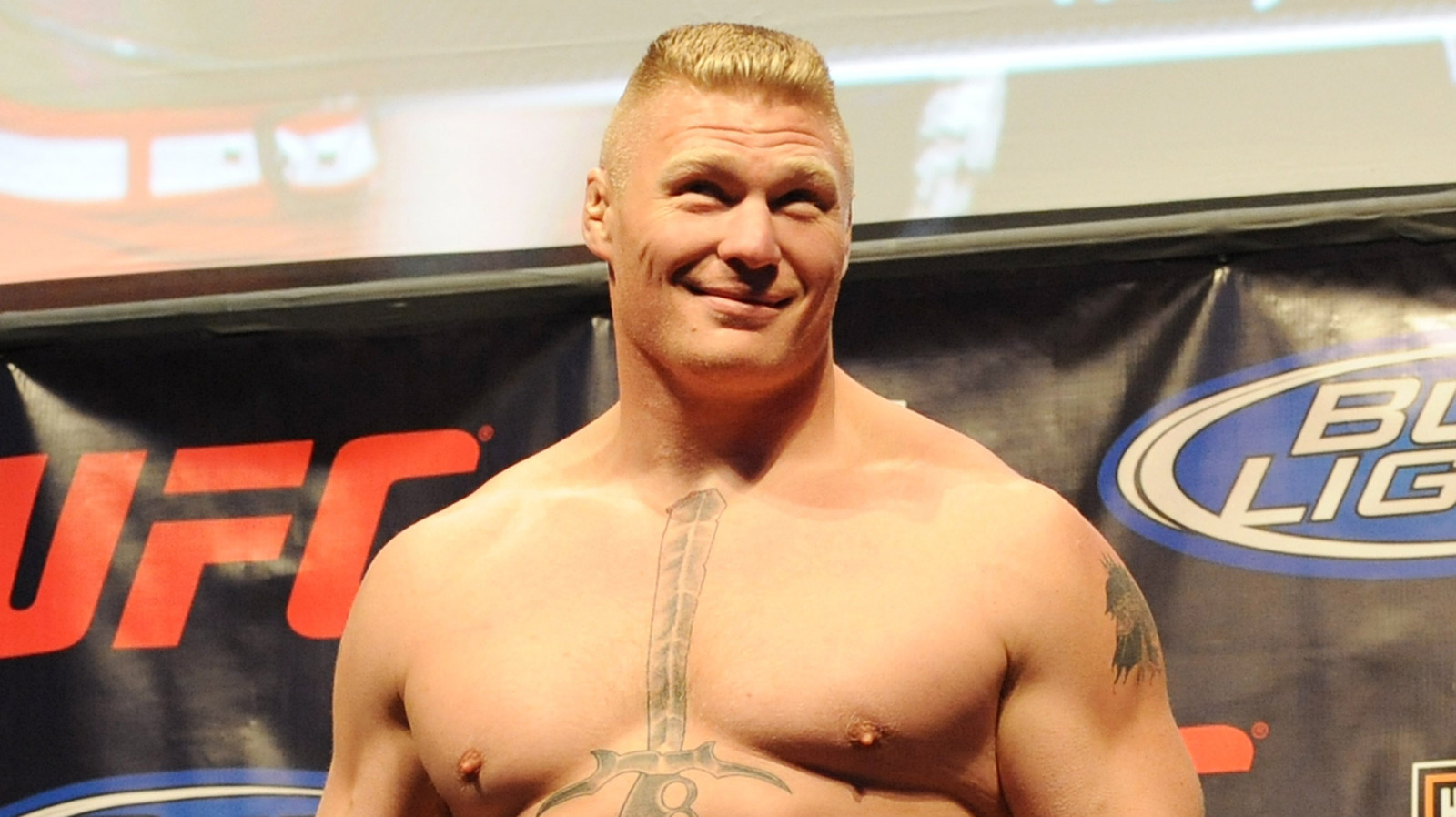
The sword tattoo is the ultimate proof of this dark period. A massive, jagged blade pointed right at his throat, conceived in a haze of vodka and painkillers. It is a violent, desperate piece of ink from a man who thought his career was over.
He was a man trying to convince the world—and himself—that he was still the baddest man on the planet, even as his body screamed otherwise. That is a brilliant wrestling angle. It is the story of a fake tough guy hiding real pain.
The Final Prediction
WrestleMania 41 is just 21 days away. Whether Lesnar returns in Las Vegas or later this summer, his final run is going to be completely different. He is clearly thinking about his mortality, his MMA losses, and the physical cost of his career.
Here is exactly how it will play out. WWE will book him against a rising, violent striker. Someone like Bron Breakker or a returning powerhouse who uses high-impact, sudden offense. For the first two minutes, Lesnar will try to play his old hits.
He will hit a belly-to-belly suplex. He will stalk the ring. He will try to establish dominance. But the opponent will not play along. They will scout the Velasquez and Overeem tape.
They will hit Lesnar flush in the mouth to force him backward. Then, they will target the midsection. A devastating spear or a brutal knee to the ribs will fold Lesnar instantly. He will drop to the mat, covering up in a fetal position, exactly like he did against Overeem in 2011.
The referee will call for the bell. A technical knockout in a professional wrestling ring. No dramatic kickouts at two-and-a-half. No trading finishers. Just a brutal, sudden stoppage that grounds the myth of the Beast in the harsh reality of combat sports.
This is the only logical conclusion for Lesnar. He cannot ride off into the sunset by hitting five F5s and pinning a legend. He has to go out on his shield, exposing the exact vulnerabilities that ended his real fighting career.
By embracing the reality of his diverticulitis and his UFC defeats, Lesnar will finally give us the most authentic performance of his career. It will be violent. It will be short. It will be conclusive.
Read Next
- Why Michael Cole will quietly define the WrestleMania 41 main event
- NXT's March 24 disaster demands a tactical reset before WrestleMania week
- Graves and Punk finally squash the beef, but nobody wants an in-ring return
- Top 10 Moments Sidelining The Competition Before WrestleMania 41
- 🏆 WrestleMania 41 — Full Coverage Hub