Oba Femi against Brock Lesnar is WWE's ultimate tactical stress test
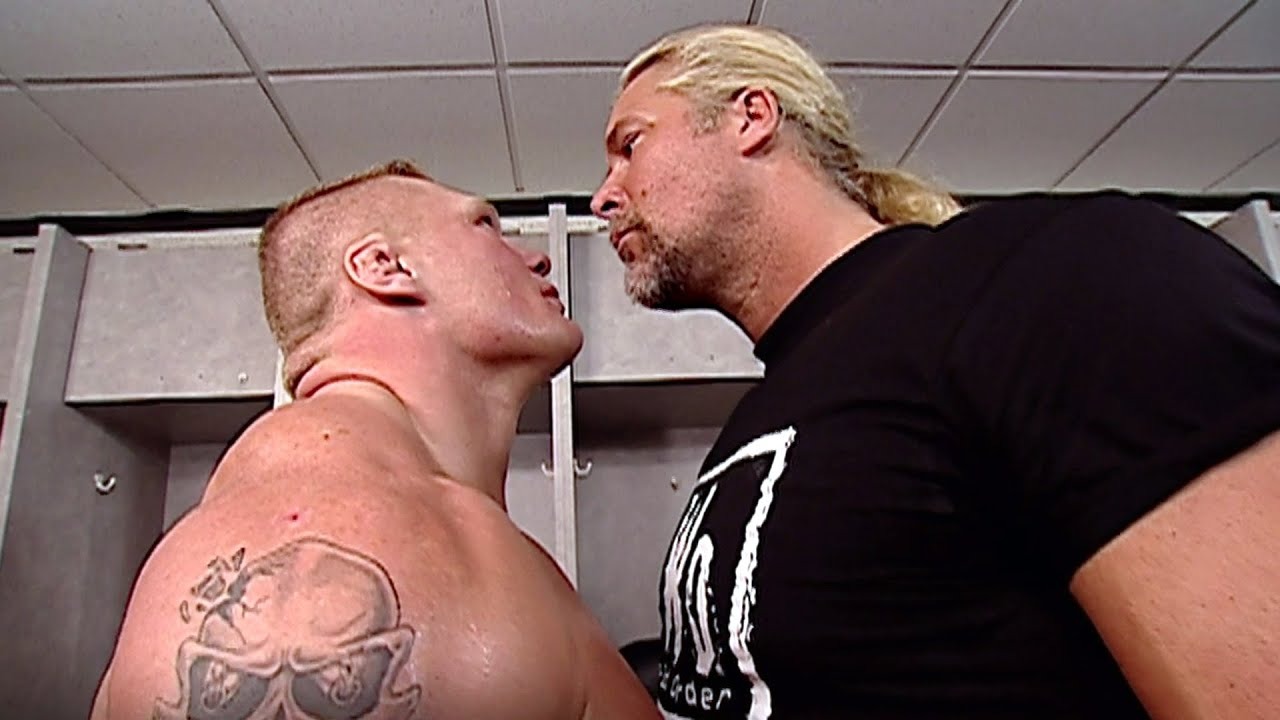
Brock Lesnar does not care about his legacy. He has made that abundantly clear in a string of recent media appearances, stating with jarring bluntness that his championships and accolades mean absolutely nothing to him. The man who conquered the UFC heavyweight division and held the WWE Championship captive for years views his career with the detachment of a regional manager reviewing quarterly earnings. His legacy, as he puts it, is his kids. He recently admitted he returned to WWE for a "short time" simply to "feed his kids."
It is a remarkably honest admission from a performer operating in an industry built on ego, insecurity, and manufactured mythology. Yet, this purely transactional mindset is exactly why his upcoming match against Oba Femi is the most tactically intriguing booking on the entire card.
When a veteran wrestler becomes obsessed with their historical standing, they become fiercely protective of their spot. They count their kickouts. They debate the visual impact of taking a finisher. They play backstage politics to ensure they look remarkably strong in defeat. Lesnar does not care about any of that. Because his ego is not tied to a scripted win-loss record, he operates with a freedom that few top-tier stars possess.
Kevin Nash recently peeled back the curtain on this dynamic, describing Lesnar as the "most giving motherf**ker on the planet." To the casual viewer, that might sound ridiculous. Lesnar’s on-screen persona is a ruthless, unstoppable conqueror who routinely squashes beloved underdogs in under five minutes. But if you watch the tape and analyze the mechanics of his matches, the truth is undeniable. Watch how Lesnar operates when he respects the person standing across from him.
When Lesnar wrestled AJ Styles at Survivor Series 2017, he did not just absorb Styles’ offense; he made Styles look like a legitimate physical threat to a much larger man. He staggered into the ropes, he gasped for air, his eyes glazed over, and he sold the Calf Crusher as if his ligaments were actively tearing. More importantly, Lesnar kept limping long after the bell rang, protecting the psychology of the match. He applies the same rigorous commitment to selling for smaller, technically sound workers like Daniel Bryan and Finn Bálor. Now, however, he is being tasked with something entirely different. He has to validate a fellow heavyweight monster.
The mechanics of a star-making powerbomb
WWE has a historically terrible track record when it comes to transitioning raw, hulking developmental talents into main event fixtures. It is a recurring, frustrating flaw in their corporate booking strategy. They rush a massive prospect to the main roster, feed them local enhancement talent for six months, and then inexplicably pair them with a protective veteran who refuses to bump. The matches crawl. The pacing completely falls apart. The mystique dies instantly. You can build up a physical anomaly for a year, but the second a veteran big-leagues them by sandbagging a suplex, the audience clocks the reality and the push is dead.
Oba Femi is walking into a completely different scenario. The visual of Femi hitting a massive powerbomb on Lesnar already sent shockwaves through the fanbase. Big E, a man who intimately understands the grueling mechanics of moving massive amounts of human weight, joked that he almost "soiled his couch" watching the spot unfold.
That reaction from Big E is incredibly telling because it highlights the sheer physics involved in the ring. You do not just effortlessly powerbomb a 280-pound collegiate wrestling champion unless he explicitly wants to go up. Lesnar is notoriously dense and maintains a significantly lower center of gravity than most heavyweights. If Lesnar drops his hips, posts his leg, and decides to sandbag a lift, absolutely nobody on the current roster is getting him off the canvas. The fact that Lesnar allowed a rookie like Femi to hoist him into the air and plant him cleanly in the middle of the ring is a massive, unspoken endorsement of the young star.
Booker T recently assessed this dynamic, noting that if anybody can teach Oba Femi what he needs to survive at the top of the card, "it is going to be somebody like Brock Lesnar." Booker is entirely correct, but the education Lesnar provides is not about complex submission holds or chain wrestling. It is about violence, spacing, and the illusion of legitimate danger.
Femi is a product of the modern WWE developmental pipeline. He is an undeniable athletic freak who has learned the trade in a highly sanitized, highly structured environment. He knows where the hard camera is located. He knows how to hit his timing cues. But the main roster requires a completely different gear. Lesnar brings a chaotic, unscripted energy to his matches. When Lesnar throws a clothesline or shoots for a takedown, he forces his opponent to fight for their survival. Femi needs to learn how to harness that level of visceral aggression, and there is absolutely no better teacher than the man who perfected it over the last twenty years.
The ghost of monsters past
To truly appreciate the tactical significance of Femi stepping into the ring with Lesnar, you have to look at how Lesnar has historically interacted with other super-heavyweights. The results are wildly inconsistent, usually heavily dependent on Lesnar’s perception of the opponent's readiness.
When Lesnar faced Braun Strowman at No Mercy 2017, the match was a clunky, disjointed affair. Strowman was incredibly over with the crowd, but his offensive timing was slightly off, and Lesnar gave him absolutely nothing extra. When Strowman accidentally caught Lesnar with a stiff knee to the face at the Royal Rumble a few months later, Lesnar immediately retaliated with a legitimate, flush right hand to Strowman’s temple that nearly dropped him. It was a brutal reminder that Lesnar controls the pacing, and if you step out of line, he will aggressively correct you on live television.
Contrast that with Lesnar's match against Samoa Joe at Great Balls of Fire in 2017. Joe is a super-heavyweight, but he possesses elite ring psychology and snug, believable striking. Because Lesnar respected Joe’s pedigree, he allowed Joe to jump him before the bell, put him through an announcer's table, and lock in the Coquina Clutch multiple times. Lesnar ultimately won, but he made Joe look like a genuine murderer in the process.
Femi’s challenge is to elicit the Samoa Joe response rather than the Braun Strowman response. He cannot afford to be a step slow. He cannot afford to look confused during transitions. When Lesnar shoots for a double-leg takedown or throws a German suplex, Femi must know exactly how to base out or bump cleanly. If Femi’s footwork is sloppy, Lesnar will not slow down to accommodate him. The match will simply become an uncomfortable, one-sided mauling.
This is where Booker T’s assessment rings truest. You cannot teach a developmental talent how to react to Lesnar’s speed and power; they simply have to experience it and survive it. The Performance Center can drill chain wrestling and camera awareness into a prospect for years, but it cannot replicate the sheer panic of seeing a massive collegiate champion sprinting at you from across the ring. Femi has the raw athleticism to keep up, but Allegiant Stadium will test his cognitive processing speed under extreme duress.
The death of the kangaroo court
The backstage environment awaiting Femi is drastically different from the one Lesnar successfully navigated when he debuted back in 2002. In a recent interview discussing his early career, Lesnar reflected on the culture shift within the company.
"Things have gotten a lot softer. No more kangaroo courts."
During the Attitude Era and the Ruthless Aggression era, the locker room was a political minefield governed by unwritten rules, paranoia, and physical intimidation. Mistakes were routinely punished physically in the ring. A blown spot, a perceived slight, or simply shaking someone's hand the wrong way could result in a veteran delivering a very real, very stiff receipt during a televised match. It was a grueling, trial-by-fire education that broke significantly more talents than it ever built.
Today’s NXT system purposefully shields prospects from that toxicity. They learn in a padded room, guided by coaches who prioritize safety, longevity, and brand integration. This softer environment means younger talents are completely protected from the brutal hazing of the past, which is undeniably a positive shift for the long-term health of the roster. However, it also means they occasionally lack the grit, the stiffness, and the improvisational survival skills that were constantly forged in those older, harsher locker rooms.
Lesnar is the ultimate bridge between those two distinct eras. He survived the kangaroo courts, won the undisputed title faster than anyone in history, and then left the company on his own terms to fight in the Octagon. He understands the old school deeply, but he operates effortlessly within the new parameters. He does not need to haze Femi backstage or test him with cheap shots in the ring. The true test will happen under the bright stadium lights, where Femi will have to match Lesnar's explosive intensity step for step.
The burden and expectation of WrestleMania 41
We are mere weeks away from WrestleMania 41. The April 19 and 20 dates at Allegiant Stadium are approaching rapidly, and the event card is starting to take its final, highly anticipated shape. Matt Hardy has gone on record stating he is "very confident" that WWE will ultimately do the right thing and have Oba Femi defeat Lesnar.
But the actual result of the match is almost secondary to how the match is tactically executed. A 15-minute grappling clinic serves neither man. This bout needs to be a high-speed car crash. It needs to be two massive athletes throwing heavy artillery until one of them simply cannot get back to their feet. Femi cannot throw loose, working punches. He has to lay it in, because if you hit Lesnar weak, the illusion immediately shatters. Lesnar implicitly demands a certain level of stiffness from his opponents to make the match credible, and Femi must answer that call.
Lesnar understands the immense weight of a WrestleMania moment better than anyone alive. He recently admitted that he still felt bad about breaking The Undertaker’s legendary WrestleMania streak back in 2014 at the Superdome. That admission is jarring coming from a man who famously claims to treat the wrestling business strictly as a financial transaction. It reveals a performer who, despite his constant protests, fundamentally understands the emotional currency of professional wrestling. He knew what the streak meant to the fans, he heard the dead silence in New Orleans, and he knew the intense gravity of ending it.
If Lesnar inherently knows the weight of ending a historic legacy, he surely knows the immense power of launching a new one. Breaking the streak gave Lesnar an unbeatable aura that he carried for an entire decade. Now, he has the unprecedented opportunity to cash in that accumulated aura and transfer it directly to Femi. He is acutely aware of exactly what a decisive, clean win over him at WrestleMania will do for Femi’s long-term career trajectory.
WWE absolutely cannot afford to miss this specific opportunity. They have a generational powerhouse prospect in Femi and a willing, incredibly giving veteran in Lesnar who is admittedly only around for a short time. The booking board is perfectly set.
If Lesnar’s sole motivation is to punch the clock, put on a highly compelling fight, and head back to his farm to feed his kids, then Femi is remarkably in the safest hands possible. He isn't dealing with a fragile ego or a highly protective veteran desperately clinging to a main event spot. He is stepping into the ring with a man who views the squared circle strictly as a workspace, and his current assigned job is to make the new guy look like an absolute killer.
The psychological warfare, the devastating powerbombs, the sheer mass of humanity colliding in Las Vegas — it all firmly points to a definitive passing of the torch. WWE's developmental system has undeniably produced a lot of complete duds over the past decade, but this time, they have the perfect final exam waiting at the very end of the semester. If Oba Femi can survive the sheer chaos Brock Lesnar brings, the entire heavyweight division will be his for the next ten years.
Read Next
- Brock Lesnar does not care about his legacy and that makes him dangerous
- Brock Lesnar just admitted what we all suspected about his WWE return
- Brock Lesnar returns but his focus is clearly elsewhere
- Tony Khan's excitement over Steven Borden points to a major AEW debut
- 🏆 WrestleMania 41 — Full Coverage Hub
Frequently Asked Questions
Why did Brock Lesnar return to WWE?
Who is Brock Lesnar wrestling at WrestleMania 41?
How does Brock Lesnar approach wrestling smaller opponents?
What did Kevin Nash say about Brock Lesnar's wrestling style?
Why is WWE's booking of heavyweight monsters often criticized?
More Coverage
Fatal Influence are testing the durability of WWE's tag team division
an hour ago
Sami Zayn’s title reign remains the flashpoint of modern WWE booking
an hour ago
Why nostalgia-heavy podcasting is failing the current wrestling product
an hour ago
Cody Rhodes and CM Punk are drifting toward a collision course
an hour agoSummerSlam's new match has the internet split right down the middle
an hour ago
Nick Aldis is stepping back into the ring for SummerSlam
an hour agoMore Analysis
Oba Femi is primed for a massive WrestleMania 41 breakout
3 months, 2 weeks ago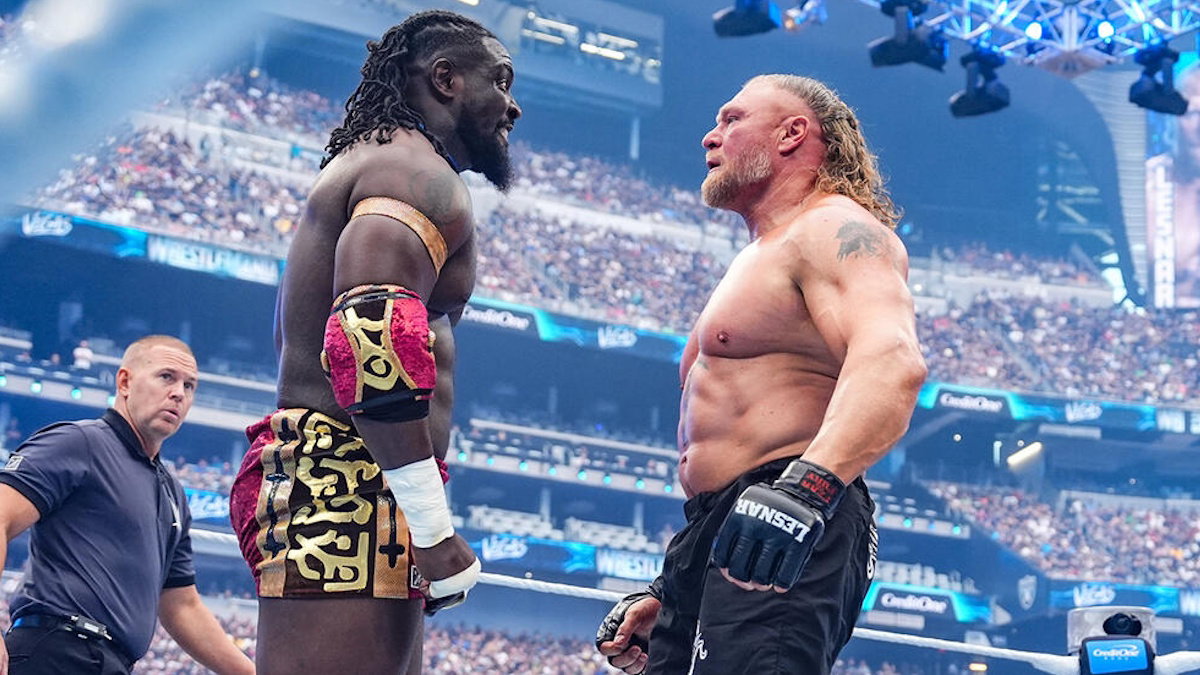
Oba Femi and Brock Lesnar are about to redefine heavyweight wrestling
2 months, 4 weeks ago
Brock Lesnar vs Oba Femi is the powerhouse clash WrestleMania needs
3 months agoBrock Lesnar returns but his focus is clearly elsewhere
3 months, 3 weeks ago