The night the backboard became a baseball bat
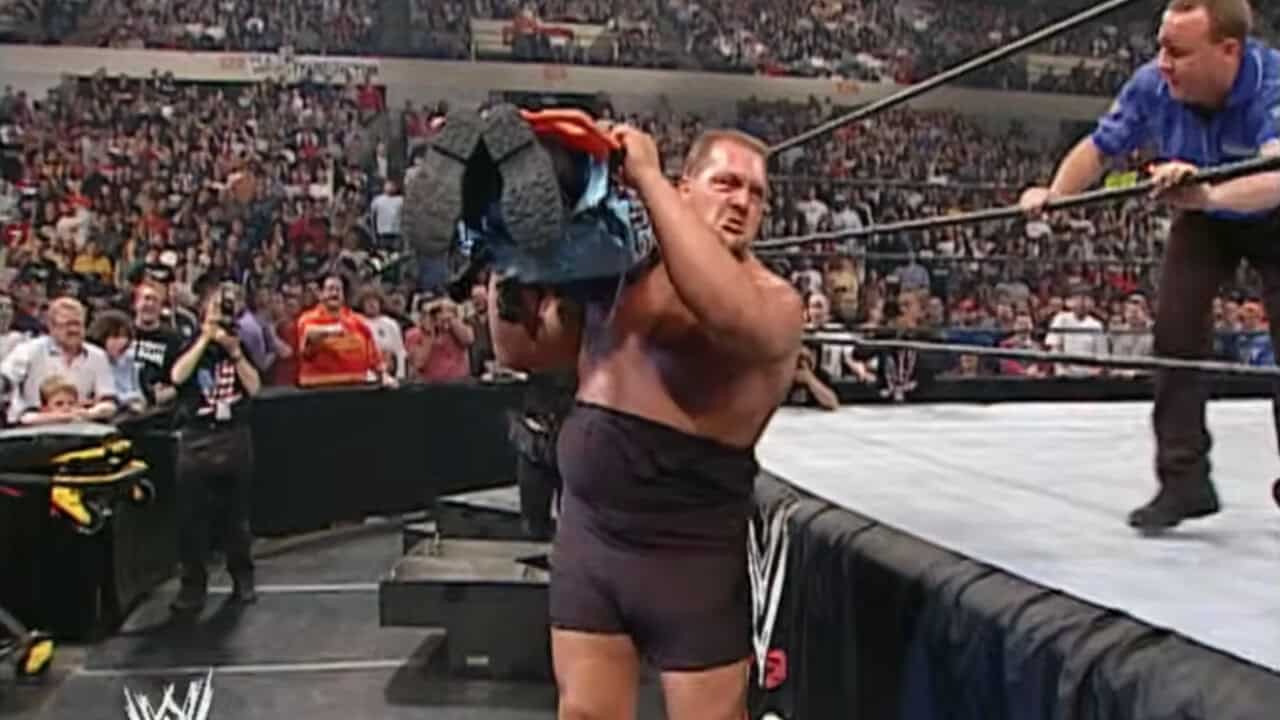
If you were watching WWE on April 27, 2003, you probably still have the same mental scar that I do. We were at Backlash, a show that was mostly famous for Goldberg making his debut against The Rock, but the most enduring image came from a giant and a luchador. Paul Wight, then known as The Big Show, decided that merely beating Rey Mysterio wasn't enough. He strapped the 175-pound legend to a hard plastic stretcher and swung him like a Louisville Slugger against the ring post. It was violent, it was visceral, and it looked like a physics experiment gone horribly wrong.
Fast forward nearly 23 years later, and Paul Wight is finally coming clean about it. He recently admitted that the spot gives him nightmares and that he absolutely hates it. Hearing a 500-pound giant admit he was terrified while doing his job is the kind of peak wrestling honesty we rarely get. It turns the 'Monster' we saw on screen into a guy who was legitimately worried he was about to paralyze one of the most beloved figures in the history of the business. The wrestling world, predictably, has spent the last 24 hours relitigating the entire era on every forum from Reddit to Discord.
The 'Holy Sh*t' nostalgia trip
There is a vocal segment of the fanbase that misses this level of unhinged aggression. To them, the Backlash 2003 spot represents the peak of the 'Ruthless Aggression' era where everything felt like it had real stakes. These are the fans who grew up on ECW and think modern wrestling has become a bit too choreographed. They see Wight's nightmare as a badge of honor for the industry.
“That spot is why Big Show was the most feared guy on the roster. You didn't need a five-star technical clinic; you just needed to see a giant treat a human being like a piece of luggage. It’s the most iconic 'Squash' ending of all time. I don't care if it was dangerous, that’s what we paid to see.”
This perspective is grounded in the idea that wrestling should look like a fight that spiraled out of control. When Wight swung that board, the sound of the plastic hitting the steel post was sickening. It wasn't a 'thud'—it was a 'crack' that echoed through the arena. For the enthusiasts, this was the moment Big Show finally lived up to the 'Andre the Giant' comparisons by showing he was capable of casual, effortless destruction. They argue that without these 'edge of your seat' moments, the product loses its grit.
The safety skeptics enter the chat
On the flip side, you have the modern fans and the safety-conscious critics who look at that footage and see a career-ending disaster waiting to happen. In 2026, we are much more aware of concussions and spinal trauma. Watching a man's head whip back against a rigid board while being swung by a giant feels less like 'entertainment' and more like 'negligence' to this crowd. They point to the fact that Wight himself is haunted by it as proof that the spot should have never been cleared by agents.
“Imagine if the strap had snapped. Or if Wight’s grip had slipped by an inch. Rey Mysterio is the greatest cruiserweight to ever live, and we almost saw his career end for a B-level pay-per-view shock moment. It was stupid then and it’s horrifying now. No wonder Paul has nightmares; he almost killed a coworker for a three-second pop.”
The skeptics have a point. The margin for error was effectively zero. If you watch the replay closely, you can see Rey’s arms are pinned. He has no way to brace himself. He is entirely at the mercy of Paul Wight’s grip strength and the structural integrity of a piece of medical equipment. In an era where we protect performers with stricter protocols, this spot looks like a relic of a time when 'toughness' was valued over 'longevity.' It’s the wrestling equivalent of a 1970s NFL highlight where a safety leads with his crown into a defenseless receiver’s chin.
The physics of a human pendulum
What makes this specific debate so interesting is the role of Rey Mysterio. Rey has always been the ultimate professional, the guy who will do whatever it takes to make the 'Big Man' look like a god. There is a subset of fans who aren't talking about Wight at all, but rather praising Rey’s insanity for agreeing to it. They argue that Rey knew exactly how much trust he was putting in Wight and that their friendship is the only reason the spot worked.
It’s a bizarre form of survivor bias. Because Rey didn't get hurt, we treat it as a legendary highlight. If Rey had spent six months in a neck brace, we would talk about Paul Wight the same way we talk about Mabel breaking Undertaker’s face. My take? The contrarians who say 'it wasn't that bad' are delusional. Momentum is a monster. When you take a 500-pound man’s arm strength and add the centrifugal force of a four-foot swing, that board is hitting the post with the force of a car crash. Wight isn't being dramatic when he says it gives him nightmares; he’s being a human being who understands he was playing with fire.
Why the nightmares matter now
The timing of this admission is fascinating. We are 11 days away from WrestleMania 41 in Las Vegas, a show where the 'Giant vs. Small Man' trope will undoubtedly be used again. By speaking out, Wight is pulling back the curtain on the mental toll of being the 'Monster.' We often forget that the guy doing the damage has to live with the possibility of a mistake forever. It’s a heavy burden to carry, especially when the person you're 'destroying' is a close friend.
Wrestling is better when the performers care about each other’s health more than the crowd’s reaction. The fact that this spot still bothers Wight in 2026 says more about his character than any title reign ever could. He was a guy who was told to go out there and be a beast, but he never lost his empathy. That’s the real story here. The 'swing' was a moment of television history, but the guilt is a lifetime of reality. We should probably listen when the guys who actually took the bumps—or delivered the hits—tell us where the line should have been drawn.
Ultimately, the enthusiasts will keep watching the GIF on Twitter because it looks incredible. The skeptics will keep using it as a cautionary tale for why we need better regulation. Both are right. It is a terrifyingly beautiful piece of professional wrestling that should never, ever be repeated. Let Paul Wight have his peace; he gave us a highlight that cost him a lot more than just a few minutes of work. He gave us a visual that defined an era, even if he had to hold his breath the entire time he was creating it.
Read Next
- Unforgettable Factions, Iconic Brawls: The Top 10 Wrestling Moments That Shaped Generations
- Raw ratings prove that even Roman Reigns can't fix the March doldrums
- Triple H playing it cool about Cody’s throne smash is the ultimate power move
- WWE's Italy expansion points to a major Francesco Akira pursuit