Why we should actually believe John Cena is walking away for good
The boy who cried retirement
The professional wrestling retirement is the least respected institution in sports.
Terry Funk first retired in 1983, kicking off a farewell tour that technically lasted until he was in his seventies. Ric Flair wept in the middle of the ring at WrestleMania 24, left his boots in the center of the mat, and was wrestling on pay-per-view in Orlando less than two years later. The Undertaker broke character, kissed his wife at ringside, and left his gear in the ring in 2017. He returned a year later to squash John Cena in under three minutes.
When a wrestler says they are done, you are supposed to nod, applaud, and quietly start the stopwatch until their inevitable return. It is an industry built on the lie that the show never ends.
But we are sitting just 96 hours away from WrestleMania 41. Allegiant Stadium is being loaded in. And the messaging around Cena's final match feels fundamentally different.
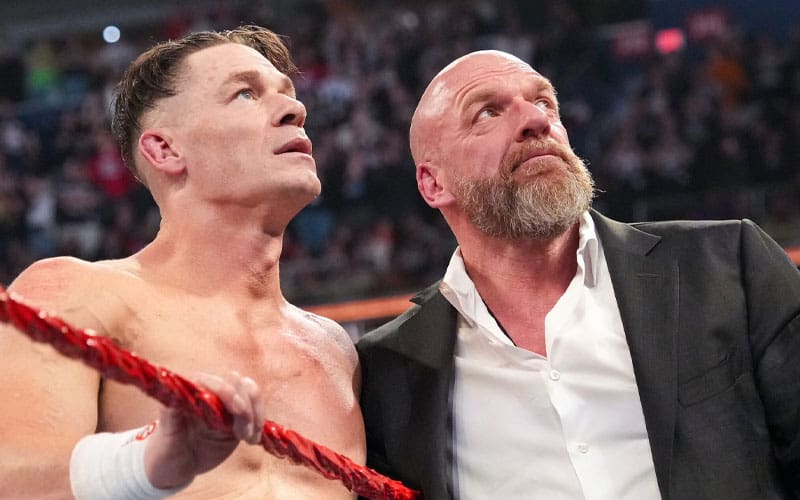
During a sit-down interview this week, Paul "Triple H" Levesque stripped away the usual carny ambiguity that surrounds WWE departures. As WrestlingNews.co reported, Levesque was direct.
"I do believe in his commitment that he will never wrestle again."
That statement matters. Levesque is not a promoter prone to definitive statements unless the merchandise has already been printed and the contracts are signed in blood.
The physical reality of the farewell
We have to be brutally honest about why this exit is happening now. The reality of Cena’s in-ring work over the last three years has been difficult to watch for anyone who remembers his peak.
The physical decline isn't just a talking point; it is glaringly obvious between the ropes. His timing, once impeccable during those legendary 2015 US Open Challenge matches, has evaporated. The springboard stunner, a move he added late in his career to keep up with the evolving work rate of the roster, now happens in slow motion. Opponents have to stand perfectly still, waiting for him to find his footing on the middle rope.
His STF has always been notoriously loose, but recently it has looked less like a submission hold and more like a gentle hug around the opponent's shin.
Watch his footwork when he attempts an Attitude Adjustment on heavier opponents today. Ten years ago, he would plant his feet, pop his hips, and drive the opponent into the canvas in one fluid, violent motion. Today, it is a multi-step process. He has to stabilize his base, heave the weight with visible effort, and essentially fall backward rather than driving the move downward. It is the wrestling equivalent of watching a legendary quarterback lose the velocity on his deep ball. The mind still sees the play, but the shoulder can no longer deliver the pass.
When he faced Solo Sikoa at Crown Jewel in late 2023, the match was a stark admission of his physical reality. Cena didn't dictate the pace. He barely survived it. He ate 11 Samoan Spikes in what was essentially a prolonged televised execution. It was a mercy killing disguised as a booking decision.
Look at how he hits the ropes today. He doesn't launch into them with the explosive velocity that defined his 2007 comeback sequences. He carefully steps into the turnbuckles, protecting his lower back and knees. The flying shoulder tackles have a lower arc. The impact is softer.
Cena knows this better than anyone. He is a meticulous student of audience reaction. He hears the difference between a crowd popping for a crisp wrestling sequence and a crowd popping out of pure nostalgia. Right now, he is entirely reliant on the latter. He is choosing to walk away before the nostalgia runs out completely.
Protecting the giant vs. protecting the legacy
To understand the weight of Cena’s decision, you have to look at the era he was trained in, and the era he ultimately rejected.
Consider a story that recently resurfaced regarding the old guard's mentality. Paul Wight, early in his career as The Giant, decided to show off his freakish athleticism. He climbed to the top turnbuckle and threw a dropkick. It was an astonishing visual for a man of his size.
The reaction backstage? As detailed in a recent interview, Hulk Hogan pulled Wight aside and threatened to never work with him again if he ever attempted the move a second time.
Hogan's reasoning was framed as protecting the business. Big men shouldn't do high spots. It breaks psychology. But underneath that lesson was a deeper, more cynical reality of 1990s wrestling politics. Hogan was protecting himself.
If a seven-foot rookie is executing top-rope dropkicks on national television, how does an aging veteran with bad hips follow that? Hogan’s entire offensive repertoire in WCW consisted of a clothesline, a back scratch, a body slam, and a leg drop. He survived by suppressing the work rate of everyone beneath him.
Hogan held onto his spot with a death grip. He wrestled long past his physical prime, manipulating booking and politicking to ensure he remained the focal point regardless of the match quality. He refused to step aside, forcing the industry to drag him out of the main event scene kicking and screaming.
Cena was groomed in a locker room still heavily influenced by that exact paranoia. He easily could have adopted the Hogan playbook. He possesses the backstage stroke to demand main events against younger talent where he goes over in five minutes. He could work twice a year, hit the Attitude Adjustment, collect a massive check, and leave.
Instead, he did the opposite. When the independent-style workers flooded the main roster in 2015, Cena didn't tell them to slow down. He sped up to match them. He took Kevin Owens' pop-up powerbomb clean. He stood in the pocket with AJ Styles for 25 minutes at the Royal Rumble. He elevated the entire midcard by proving he was willing to bleed for the match quality.
The Vegas finale
That willingness to elevate the product is exactly why his definitive retirement matters so much for the current state of WWE.
We are heading into Las Vegas this weekend. WrestleMania 41 Night 1 takes place on April 19. The card is loaded. We have Cody Rhodes defending the WWE Championship on Night 2. We have the Bloodline saga continuing to fracture and reform around Roman Reigns. The promotion simply does not need Cena to draw money anymore. They are selling out stadiums on the strength of long-term episodic storytelling and a hot, reliable daily roster.
Cena is smart enough to know that the machine no longer requires his engine. He is a luxury item on the WrestleMania 41 card, not the foundational pillar.
By explicitly stating that this is the absolute end, Cena and Levesque are doing a massive favor to the rest of the locker room. When the referee's hand hits the mat for the final time on Sunday, the story ends. There will be no lingering speculation. There will be no phantom shadow hanging over the SummerSlam main event.
If Cena were to leave the door open, even a crack, every major show would be plagued by rumors of his return. It would distract from Gunther's dominance. It would distract from Bron Breakker's rise. It would stifle the oxygen required to build the next decade of main eventers. Levesque knows this. His statement this week wasn't just an update on Cena's contract status. It was a directive to the audience. He is telling us to process our grief now, because there is no post-credits scene coming.
The rarest move in wrestling
The evolution of Cena’s ring work is a fascinating study in adaptation. If you break his career down tactically, it exists in three distinct phases:
- The Brawler (2002-2007): Heavy reliance on clotheslines, shoulder blocks, and sheer physical power. Matches were built around his ability to take a beating and fire up.
- The Main Event Architect (2007-2014): Working the classic WWE main event style. Slower pacing, massive near-falls, and heavy psychological storytelling. Matches with Edge and CM Punk defined this era, showcasing his ability to manipulate a crowd without relying on heavy bumps.
- The Workhorse (2015-2018): The peak of his technical output. Integrating complex sequences and working at a blistering pace to hang with the new generation of independent stars.
We are currently in an unofficial fourth phase. The Farewell Tour. And from a booking perspective, this phase only succeeds if the ending is real.
During his Main Event Architect phase, Cena was arguably the best in the world at structuring a 30-minute stadium match. His 2006 TLC match against Edge in Toronto was a masterclass in pacing and brutality. His 2011 classic against CM Punk at Money in the Bank is studied in wrestling schools today for its flawless crowd manipulation. Cena learned how to map out a match where every single breath mattered. He wasn't doing flip piledrivers; he was working the spaces between the moves better than anyone alive.
Wrestling is built on deception. We suspend our disbelief every time the bell rings. We buy into the feuds, the near-falls, and the manufactured drama, knowing full well that a production truck is orchestrating the chaos. Because of that inherent dishonesty, a true, permanent retirement is the hardest trick to pull off.
It requires an ego death that most performers are simply incapable of achieving. They crave the roar of a stadium crowd like an addict craves a fix. Cena might crave it too. But he clearly values his legacy more. He understands that a perfect ending is worth infinitely more than ten mediocre returns disguised as special attractions.
When he walks down the massive ramp in Las Vegas this Sunday, it will be the culmination of a twenty-two-year tactical masterclass in how to manage a career. He survived the ruthless aggression era. He carried the company on his back through its sterile PG era. He adapted seamlessly to the modern era.
And now, facing down the absolute limits of his own body, he is executing the rarest move in his entire arsenal. He is stopping before the audience has to ask him to.
Read Next
- John Cena is staying out of the ring for good
- NXT Revenge delivers a brutal reality check for the gold-brand locker room
- WWE locker room is a mess right now and WrestleMania is only five days away
- The CM Punk and Roman Reigns dynamic is the only story that matters for WM41
- 🏆 WrestleMania 41 — Full Coverage Hub
- 👴 John Cena Retirement Tour 2026
Mattel WWE Elite Collection Series 109 - Rey Mysterio Action Figure
Highly poseable, authentic gear, and ready for the ring.
More Coverage

Drew McIntyre sidelined following brutal SmackDown encounter
3 hours agoWWE's New York gamble is a calculated risk ahead of WrestleMania 42
4 hours ago
WWE's Saturday Night's Main Event math doesn't add up
4 hours agoWWE's return to New York changes the math on stadium attendance
4 hours ago
Top 10: Top Moments from MSG
5 hours ago
SmackDown is drifting into mid-summer malaise
5 hours agoMore Analysis
John Cena is finally slamming the door on his WrestleMania career
3 months, 1 week ago
John Cena is staying out of the ring for good
3 months ago
John Cena is gone from the ring, but his real WWE work just started
1 month, 4 weeks agoJohn Cena's final walk and the stakes of WrestleMania 41 Night 1
3 months, 1 week agoWe spent 20 years booing John Cena, but his retirement is going to break us
3 months, 3 weeks ago