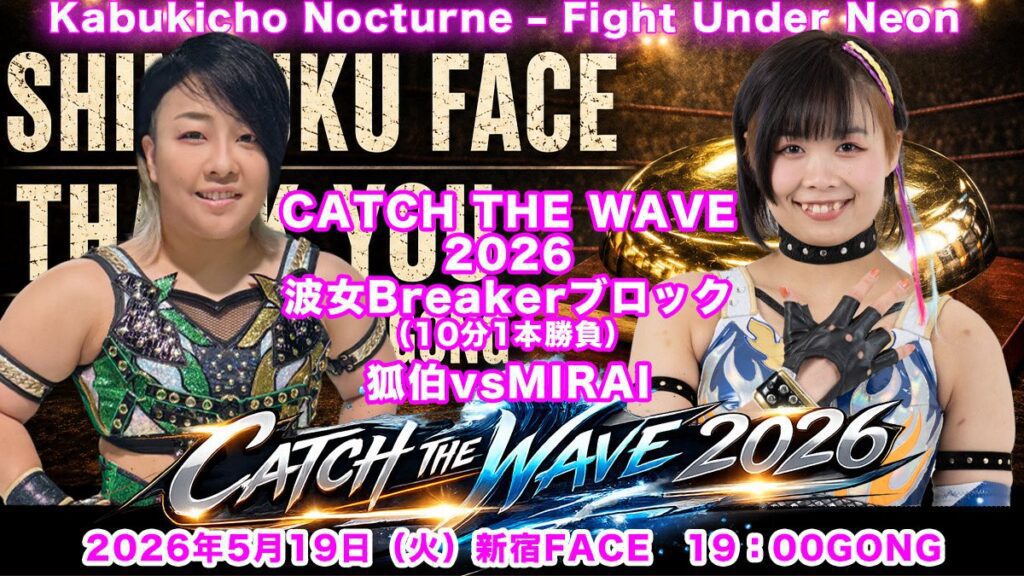
If you want to understand the true, unvarnished state of Japanese women's wrestling right now, you don't look at the main event of a pay-per-view in a massive arena. You look at a random Tuesday night in Kabukicho. You take the cramped, sketchy elevator up to the seventh floor of the Humax Pavilion. You pay your mandatory 500 yen for a drink coin, because Shinjuku Face is technically a bar that happens to have a wrestling ring in the middle of it. You walk in, smell the cheap beer and deep heat, and you sit down.
That is exactly where Pro Wrestling Wave set up shop on May 19 for their "Fight Under Neon" card.
Wave is fascinating. They exist in a weird pocket of the indy scene. They aren't trying to sell out the Tokyo Dome. They are unapologetically messy, aggressively physical, and deeply reliant on throwing veterans into the ring with absolute rookies and watching the car crash happen.
We need to talk about the eight-woman tag team match that anchored the undercard. It was exactly the kind of chaotic sprint that makes you love and hate this promotion simultaneously.
On one side, you had the team of Kaho Kobyashi, Rina Amikura, Arisa Shinose, and Maika Ozaki. On the other side stood Kakeru Sekiguchi, Haruka Umesaki, Honoka, and Saran.
Eight women. One ring. The official bell time was exactly 13:42.
That runtime is the entire problem with how mid-tier promotions book their cards right now.
The problem with the 13-minute car crash
Let’s do some basic math here. You have almost fourteen minutes of wrestling. You have eight competitors. Factor in the ring entrances, the initial standoff, the referee checking boots, the inevitable multi-person submission spot where everyone locks in a Boston Crab at the exact same time, and the post-match posing.
How much actual wrestling time does each woman get? A minute? Maybe ninety seconds if they are lucky?
This is a booking crutch. It is pure laziness. Wave uses these massive multi-person matches to cram as many names onto the poster as humanly possible. It guarantees ticket sales from eight different fanbases. But as an actual wrestling match, it completely falls apart.
Look at Haruka Umesaki. She is more than capable of wrestling a dramatic, main-event caliber singles bout. When she wrestles for Diana, she stretches people. She dictates the pace. Here? She gets relegated to breaking up pinfalls and hitting a single dive to the floor before disappearing onto the apron. It is a fundamental waste of top-tier talent.
It makes the match feel less like a competition and more like a choreographed parade. You know exactly how the beats will play out before the opening bell even rings. The heels will isolate the weakest member of the babyface team. The hot tag will lead to a parade of signature moves. Everyone hits a clothesline or a dropkick in sequence. The referee completely loses control of the legal tags.
It is loud. It is fast. It is ultimately empty calories.
The sacrificial lamb
If there is an actual purpose to these matches, it usually revolves around hazing the younger talent. This specific bout was heavily tied to the "Young Block" aspect of Wave's current scheduling. In Japanese wrestling, rookies are treated with ruthless aggression. They are expected to take the hardest hits, run the ropes the fastest, and ultimately, stare at the ceiling.
That duty fell to Saran.
She took the pin, which shocked absolutely nobody. When you are the youngest or least experienced person in an eight-person tag, you are wearing a massive bullseye on your back from the second you walk through the curtain.
But it wasn't just a simple roll-up or a standard suplex. The finish was brutal. According to the results over at BodySlam.net, Saran was put away with a Canadian Facebuster.
For those unfamiliar, the Canadian Facebuster is not a move you take lightly. It is blunt force trauma. The attacker hooks the opponent in a gutwrench position, lifts them high into the air, and drops them flat on their face. It offers zero protection. The person taking the move has to brace their own fall entirely with their forearms and chest. If you mistime it by even half a second, you are eating canvas with your nose.
Taking that move after thirteen minutes of non-stop running requires serious toughness. Saran took it like a champion, getting completely flattened for the three-count.
The missed opportunities
Let's look at the losing team again. Kakeru Sekiguchi deserved better than a chaotic multi-person tag.
Sekiguchi is fast. She has fantastic footwork. But speed means absolutely nothing when the ring is cluttered with seven other people. Every time she tried to build momentum, there was inevitably someone there to grab her hair or chop her in the throat.
This is the inherent flaw of the eight-woman format. You sacrifice individual brilliance for collective noise. Wave had the opportunity to book two compelling regular tag team matches with these eight women. They could have given us Kobyashi and Ozaki against Umesaki and Sekiguchi in a fifteen-minute war. Instead, they threw everyone into the same pot and turned the heat up too high.
The dynamic of Kaho Kobyashi
Let's look at the winning side for a second, because they deserve credit for navigating the mess. Kaho Kobyashi is exactly the type of wrestler you want anchoring a match like this.
She wrestles with a frantic, almost unhinged energy. She never walks across the ring; she sprints. When she hits the ropes, she hits them with absolute intent. In a match that suffers from too much traffic, Kobyashi knows how to make her moments count. She doesn't just wait on the apron for a tag. She is constantly yelling, banging on the turnbuckle, and keeping the crowd engaged.
Then you have someone like Maika Ozaki. She brings raw power. When the match breaks down into a brawl, Ozaki is the one throwing heavy forearms and dumping people with scoop slams. Rina Amikura and Arisa Shinose provided the connective tissue. Amikura can throw her weight around when necessary, and Shinose is still finding her footing but shows flashes of real aggression.
Together, they functioned as a cohesive unit. That is usually what determines the winner in these cluster-matches. The team that figures out how to actually work together instead of just waiting in line to hit their moves usually walks away with the victory.
Why we keep watching
I can complain about the structure of these eight-woman tags until I am blue in the face. I hate the rushed pacing. I hate that talented workers get lost in the shuffle. I hate the complete disregard for basic tag team rules.
But I also understand why they exist.
Pro Wrestling Wave is a working-class promotion. They do not have the massive corporate backing of Bushiroad. They are not signing massive television deals or streaming rights. They survive by putting on gritty, highly entertaining shows in venues exactly like Shinjuku Face.
Getting eight women into the ring at once is a spectacle. For the fans sitting in the front row, drinking from plastic cups and avoiding the sweat flying off the apron, it is incredibly fun. When eight people are brawling on the floor and Irish-whipping each other into the rows of folding chairs, you can't help but get swept up in the noise.
The May 19 show delivered exactly what it promised. It gave us a fight under neon lights.
Saran learned a very hard lesson about ring awareness. Kaho Kobyashi added another win to her resume. The fans got fourteen minutes of absolute madness.
Wave will likely run this exact same match layout again next month. They will throw eight different names into a blender, ring the bell, and let them figure it out. I will still criticize the lack of storytelling. I will still complain about the pacing.
And I will still read the results the next morning. Because as frustrating as it can be, this chaotic mid-card scene is the proving ground for the next generation of stars. If you can survive eating a Canadian Facebuster at Shinjuku Face on a random Tuesday, you can survive anywhere.