The reality behind the smoke
Jim Fullington was never going to out-wrestle Dean Malenko. He wasn't going to exchange intricate chain sequences with Eddie Guerrero, and he certainly wasn't going to fly like Rey Mysterio Jr. The Sandman was, by every traditional metric of professional wrestling, a severely limited worker.
Yet, he held the ECW World Heavyweight Championship five times. He was the emotional heartbeat of the Philadelphia promotion for its most vital years. How did a man with a handful of sloppy moves become an icon? The answer lies in a masterful, albeit destructive, blend of psychology, smoke, mirrors, and real-life excess.
The Sandman recently offered a jarring reminder of what fueled that run. As Wrestling Inc reported, the former champion reflected on his hard-partying days in ECW. He noted that his reckless behavior and even overdosing were actually "welcome in the promotion."
That single sentence is a terrifying indictment of the 1990s wrestling business. It provides the missing context for why his matches looked the way they did. The chaos wasn't a work. The exhaustion wasn't selling. The blood was all too real.
The entrance as a tactical weapon
To understand Sandman tactically, you have to look at the entrance. It remains one of the greatest spectacles in wrestling history, but from a booking perspective, it was an absolute necessity.
Paul Heyman knew he couldn't put Fullington in the ring for a twenty-minute technical clinic. The stamina wasn't there. The in-ring repertoire didn't exist. He threw sloppy, looping right hands. His suplexes were terrifyingly dangerous for the opponent taking the bump. His top rope leg drop was a crash landing rather than a calculated maneuver. So, Heyman booked the entrance to be the match.
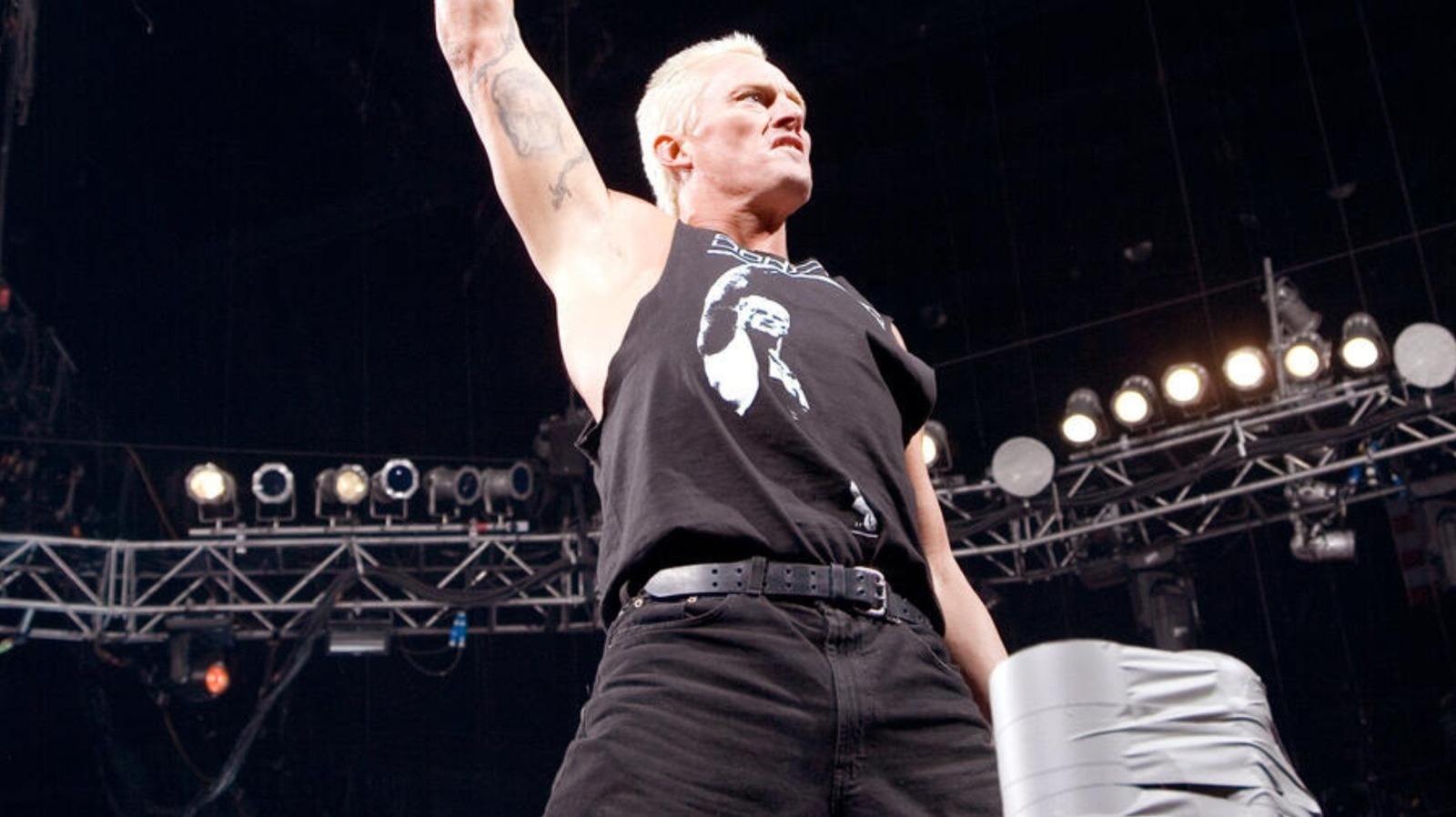
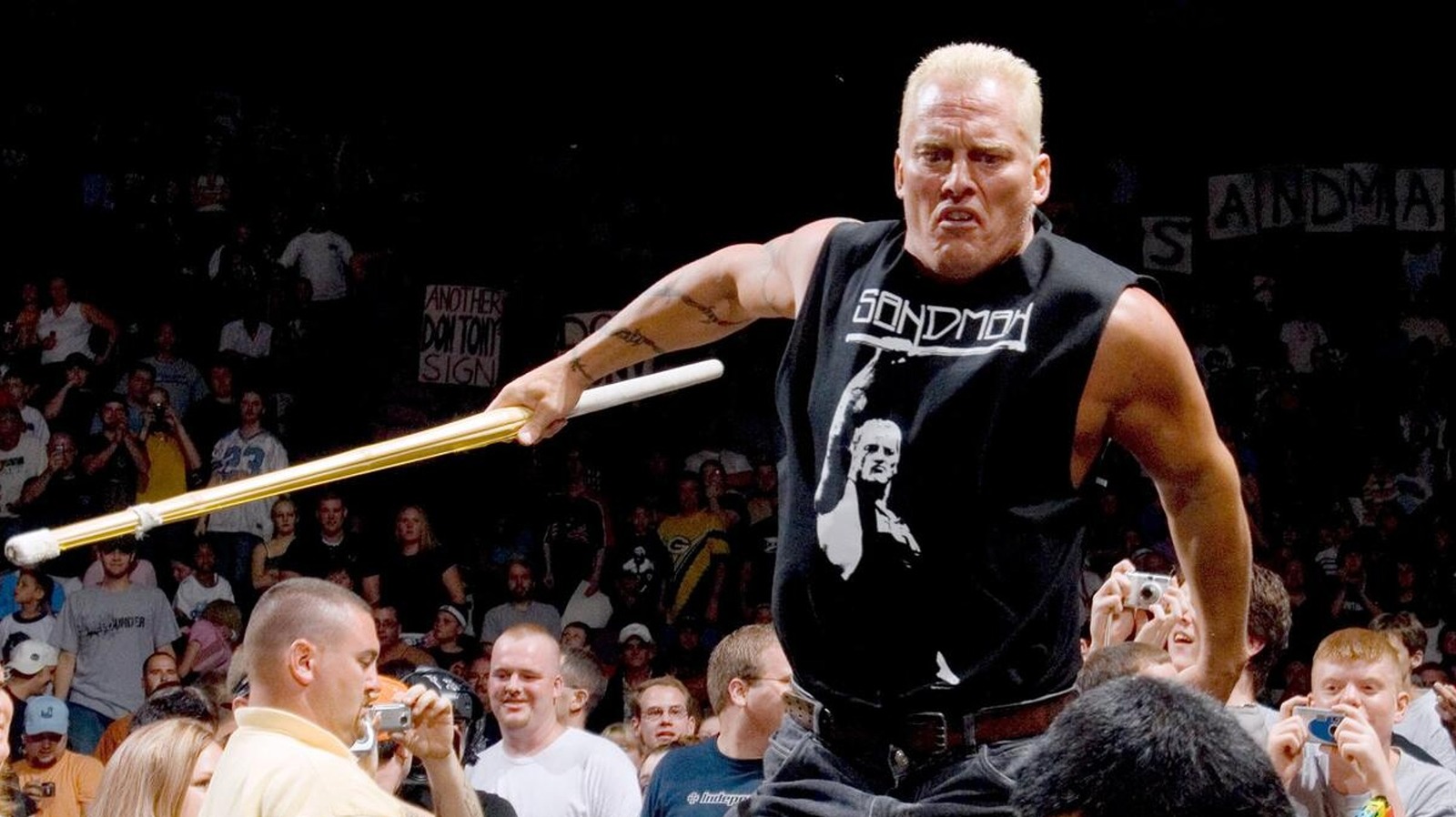
When Metallica's music hit the speakers at the ECW Arena, the clock started ticking. The Sandman would emerge in the crowd, a lit cigarette hanging from his lips, armed with a Singapore cane and a case of Pabst Blue Ribbon. He didn't walk to the ring. He waded through humanity.
He smashed beer cans against his own forehead until he bled. The entrance often lasted five to seven minutes. By the time he actually stepped through the ropes, the crowd was in an absolute frenzy. Their adrenaline was spiked to the ceiling.
This was brilliant pacing. Sandman didn't need to execute a complex opening sequence to get the fans invested. He had already given them what they paid for. The match itself was essentially the comedown. He only needed to hit a few brawling spots, swing the cane, and land the White Russian Leg Sweep.
Distance management and the cane
In the ring, his physical limitations forced a unique style of combat. He was a slow, heavy-footed brawler. If an opponent got inside his reach, his lack of defensive technique was immediately exposed.
To counter this, Sandman utilized the Singapore cane not just as a weapon, but as a tool for distance management. Think of it like a stiff jab in boxing. The cane kept faster, more agile opponents at bay.
Consider his 1995 clashes with Cactus Jack. Mick Foley was a master of the chaotic brawl, but even he struggled to navigate the reach advantage Sandman maintained with the stick. In their Texas Death Match at Double Tables, Sandman essentially stalled the pace to a crawl. He used the weapon to create physical barriers whenever Foley built momentum. It wasn't pretty, but it was highly effective self-preservation.
When a wrestler tried to close the gap, Sandman would swing wildly. This forced them to retreat or take a brutal shot to the ribs. It allowed him to dictate the pace of the match, dragging it down to a slow fight that favored his pain tolerance over technical skill.
The Raven feud and blurred lines
The peak of Sandman's career was his legendary feud with Raven in 1996 and 1997. This wasn't a battle over a championship. It was a psychological war that dragged Fullington's real-life family into the mud.
Raven manipulated Sandman's real-life ex-wife, Lori, and his young son, Tyler. He turned them against him. Tyler even began wearing Raven's signature grunge clothing and mocking his own father. Raven convinced the boy to quote Edgar Allan Poe and tell his father he hated him on live television. The sheer emotional abuse of the storyline was groundbreaking for the era, but it pushed the boundaries of taste.
The feud culminated in some of the most violent matches in ECW history. But it is hard to watch those bouts now without thinking about Sandman's recent comments. The promotion welcomed his hard-partying ways because it fed the on-screen narrative. The more wrecked Jim Fullington looked, the more believable The Sandman became.
Heyman exploited a man's real-life demons for ticket sales. Sandman wasn't playing a drunk. He was often legitimately inebriated. The overdoses weren't a storyline. They were a byproduct of a locker room culture that prioritized shock value over human life.
The WCW experiment exposes the flaws
When Sandman eventually left ECW for World Championship Wrestling in 1999, the stark reality of his limitations hit the national spotlight. Rebranded as Hardcore Hak, he lost the Metallica entrance and the intimate connection with the Philadelphia faithful. Placed in a massive corporate environment, he looked completely lost.
WCW tried to recreate the magic by pairing him with Raven and Bam Bam Bigelow. The sterile arenas quickly exposed the flaws in his game. Without the protective booking of the ECW Arena, fans just saw a sluggish brawler swinging a stick.
The experiment was a failure. It proved that Sandman's success was inextricably tied to the specific, enabling environment Heyman had cultivated. He simply could not function as a standard television wrestler.
It wasn't until WWE resurrected the brand for the One Night Stand pay-per-view in 2005 that he found his footing again. That night inside the Hammerstein Ballroom, the magic returned. WWE paid for the music rights. The crowd sang every single word of the song, completely drowning out the commentary team. He drank the beers and swung the cane.
But when WWE tried to incorporate him into their weekly television product on the Sci-Fi network, the same problems resurfaced. Placed in matches against younger, faster talent, his glaring gaps in ring psychology became impossible to hide. You cannot mask a lack of mobility when wrestling a crisp technician in a brightly lit arena.
A complicated legacy
It is impossible to praise Sandman's connection with the crowd without criticizing the environment that enabled his self-destruction. ECW was a revolution, but it was also a meat grinder. The promotion's willingness to look the other way shortened careers and ruined lives.
Sandman survived, which feels like a minor miracle today. But his in-ring legacy is complicated. He was a terrible professional wrestler who happened to be a brilliant sports entertainer. He understood his character perfectly. He gave the Philadelphia crowd exactly what they wanted, even if it meant destroying his own body.
Watching his matches back today is an exercise in frustration. The punches are loose. The footwork is non-existent. The reliance on weapons becomes repetitive fast. If you take away the music and the blood, there isn't much substance left.
The final bell
Sandman's honesty about his past is refreshing, even if the details are grim. It strips away the romanticized nostalgia of the 1990s extreme era. It forces us to reckon with the human cost of that entertainment.
As we look toward AEW Double or Nothing next week, the contrast is staggering. We will undoubtedly see bloody, violent spectacles in Las Vegas on May 24. But those matches will be meticulously choreographed, thoroughly rehearsed, and supervised by a full medical staff. The modern wrestler treats their body like a high-performance machine. Sandman treated his like a rental car.
Looking ahead, it is highly unlikely we will ever see Jim Fullington in a WWE Hall of Fame class. The current corporate structure is built on family-friendly sponsors and global partnerships. They cannot associate with a character whose core identity is built around binge drinking and admitted overdoses.
But he doesn't need a ring from Stamford. His legacy is permanently etched in the concrete floor of a bingo hall in South Philadelphia. My prediction? The Sandman will remain the ultimate cautionary tale. He got over not by learning how to wrestle, but by learning exactly how much punishment his body could endure before it quit. We will never see a run quite like it again, and frankly, we shouldn't want to.
Read Next
- MJF's bounty on Darby Allin turns Double or Nothing into a powder keg
- Layla El claims she saw the Cody Rhodes mega-push coming fifteen years ago
- Top 10: The Moments Defining the 2025-2026 Wrestling Season
- Why the numbers prove WWE actually needs Carmella back right now
- 🎲 AEW Double or Nothing 2026 — Full Coverage Hub