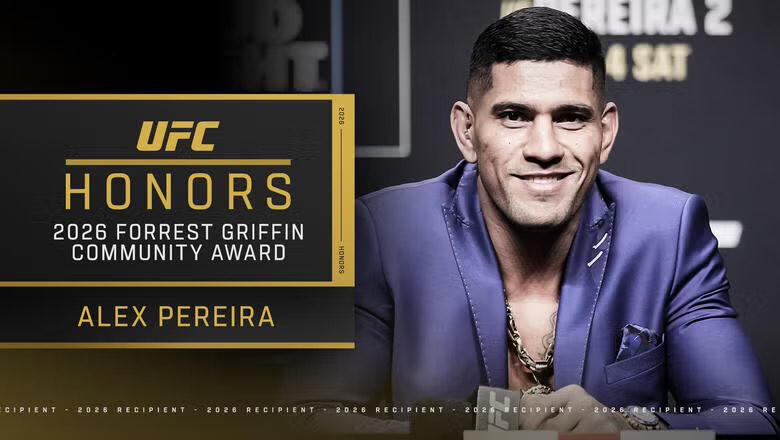
The scariest man alive gets a trophy for being nice
There was a deeply surreal moment during the UFC 327 broadcast. The commentary desk threw to a video package, and everyone expected the usual highlight reel of unmitigated violence.
We expected to see Jiri Prochazka falling backward, or Israel Adesanya flat on his back. Instead, we got Alex Pereira doing charity work.
The UFC officially announced that the former champion will receive the Forrest Griffin Community Award at this year's Hall of Fame induction ceremony. It is a massive honor. It is also completely hilarious when you step back and think about it.
Here is a man who makes his living hunting human beings inside a locked steel cage. He does not smile when he walks to the octagon, and he certainly does not smile when he knocks you unconscious.
He just pulls back his imaginary bow, fires an invisible arrow, and waits for his paycheck. Now, he is suddenly being recognized as a pillar of the community.
Dana White's personal selection process
The Forrest Griffin Community Award was created to highlight fighters who give back to their local neighborhoods and charities. It comes with a $25,000 donation to the charity of the winner's choice. Past winners include Max Holloway and Dustin Poirier, guys who are universally beloved and wear their hearts on their sleeves.
Pereira is a different breed entirely. He rarely speaks English on camera, and his entire public persona is built around being an emotionless stone golem.
But Dana White personally selects the recipient of this annual award. Unsurprisingly, White absolutely loves Alex Pereira.
This is where we need to be honest about how the UFC operates. The promotion heavily weaponizes these awards for corporate PR. White hand-picking Pereira feels less like an objective measurement of charitable impact and more like a massive thank-you note.
Whenever a main event fell apart, Pereira stepped in on short notice. He became the ultimate company man. Handing him the community award is the UFC's way of rewarding their favorite employee while softening the sport's brutal image for mainstream sponsors.
It is a smart business move. It also ignores the obvious irony of the situation. Giving a humanitarian award to a guy who gave Sean Strickland long-term brain trauma is fundamentally funny.
The anatomy of a charitable left hook
To really appreciate the contrast, you have to look at what Pereira actually does in the cage. His striking is not just effective; it is practically cruel.
He does not out-point his opponents or try to win rounds. He physically dismantles them until their bodies shut off.
It starts with the calf kick. Pereira throws his low kicks without pivoting his hip like a traditional Muay Thai practitioner.
He snaps the strike directly from the knee. This lack of tell makes it nearly impossible to check, allowing him to chip away at the nerve until the leg fails.
Once the mobility is gone, the left hook comes out. Pereira throws his hook from the hip. He does not cock his shoulder back, and there is no wind-up.
The punch just materializes in empty space and connects with the chin before the opponent's brain can register the incoming threat. It is a masterpiece of violent efficiency.
Watching him perform this sequence is like watching a nature documentary where the lion finally catches the gazelle. It is brutal, natural, and entirely without malice. He is just doing his job.
Apparently, outside of those fifteen minutes of sanctioned violence, his job includes helping underprivileged kids in Brazil.
The ghost of Forrest Griffin
It is worth taking a moment to appreciate the namesake of this award. Forrest Griffin is a legendary figure in MMA history. He is half of the reason the UFC exploded into the mainstream, thanks to his bloody brawl with Stephan Bonnar back in 2005 on basic cable.
Griffin was the ultimate everyman. He was a sarcastic, self-deprecating fighter who openly admitted he wasn't the most talented athlete in the room. He succeeded through sheer grit, insane cardio, and a willingness to take three punches just to land one.
Fans loved Griffin because they could see themselves in him. Alex Pereira is the exact opposite of that archetype. No fan watching from their couch thinks they could do what Pereira does.
He is not an everyman. He is a terrifying anomaly with a left hand that defies the laws of physics. Griffin had to go to absolute war to win decisions, while Pereira barely breaks a sweat before leaving his opponents staring at the referee.
Naming Pereira to an award honoring Griffin highlights just how much the sport has evolved. We have moved from the era of tough-guy brawlers to hyper-specialized assassins who operate like cyborgs. Yet, the human element remains the same.
The desire to give back to the community bridges the gap between the chaotic brawler from Georgia and the stone-faced kickboxer from Brazil.
The Adesanya shadow
You cannot talk about Pereira's legacy without mentioning his eternal rival, Israel Adesanya. Their intertwined history across two different sports is the stuff of combat sports mythology. Pereira followed Adesanya to the UFC, chased him up the rankings, and snatched his title in New York.
Even though Adesanya eventually got his revenge, the shadow Pereira cast over his career was absolute. Adesanya is famously brash, an anime fan who cuts elaborate promos and dances to the cage. Pereira simply walks out to indigenous chanting, stares straight ahead, and goes to work.
This stark contrast in personalities made their fights massive box office hits. The UFC profited immensely from Pereira's quiet, menacing aura. Now, they are trying to highlight the softer side of that aura.
The stoic champion's real impact
Despite the cynical corporate PR angle from the UFC brass, Pereira's actual charity work is legitimate. He has consistently used his platform to support indigenous communities in his native Brazil. He embraces his Pataxó heritage, often wearing traditional face paint to the weigh-ins.
He has funded food drives, supported local martial arts gyms in favelas, and provided resources for kids who grew up just as desperately poor as he did. Pereira dropped out of middle school to work in a tire shop. He struggled with severe alcoholism before he even turned twenty.
He found kickboxing as a literal lifeline to avoid drinking himself to death. He understands what it means to be at the absolute bottom. That kind of lived experience breeds a quiet, unflashy generosity.
He does not cut promo videos bragging about his charity work. He just quietly hands out food and pays gym dues for kids in Sao Paulo. He does it because he remembers being the kid with no shoes and no future.
This makes the Forrest Griffin Community Award genuinely well-deserved. The impact is real, even if Dana White's motivations for handing him the trophy are heavily wrapped up in promotional favoritism.
What happens at the Hall of Fame?
The UFC Hall of Fame ceremony takes place during International Fight Week, usually in late June or early July. Pereira will have to put on a suit, walk up to a podium, and accept a trophy that isn't a gold belt. It will undoubtedly be the quietest, most intimidating acceptance speech in the history of the award.
His longtime coach and translator, Plinio Cruz, will likely do most of the heavy lifting at the microphone. But the real question is what Pereira does next inside the cage. He is 38 years old, and the clock is ticking loudly on his athletic prime.
Every fight is a high-stakes gamble against Father Time. He has already conquered the middleweight and light heavyweight divisions. There is nothing left for him to prove at 205 pounds, as the division has been thoroughly cleared out.
The only logical step remaining is a move up to heavyweight to chase a historic third divisional title. Fans have been begging for this. The UFC knows it is the biggest fight they can make right now.
The final prediction
Putting him in the Hall of Fame for a community award during Fight Week perfectly sets up a massive fight announcement for late summer. You want to know exactly how this plays out? I will tell you.
Pereira will walk onto that stage in Las Vegas. He will take the award from Dana White with a completely blank expression. Plinio Cruz will give a heartfelt two-minute speech about community, resilience, and giving back to Brazil.
Then Pereira will lean into the microphone, utter his famous one-word catchphrase, and walk off the stage. Less than twenty-four hours later, the UFC will announce that he is fighting for the heavyweight championship. And he will probably knock that guy out in the second round, completely devoid of any charitable feelings whatsoever.