Why WWE's approach to the World Cup reveals their biggest booking flaw
The manufactured heat of international football
The 2026 FIFA World Cup kicks off on June 11, bringing a massive cultural shift to North America. With 48 teams competing across the continent, the tournament offers an unprecedented promotional window. WWE knows this.
Their roster is the most geographically diverse in the company's history. The locker room is split into distinctly defined football camps, and the tribalism is already bleeding onto television. But there is a glaring disconnect between how wrestlers experience football and how WWE books it.
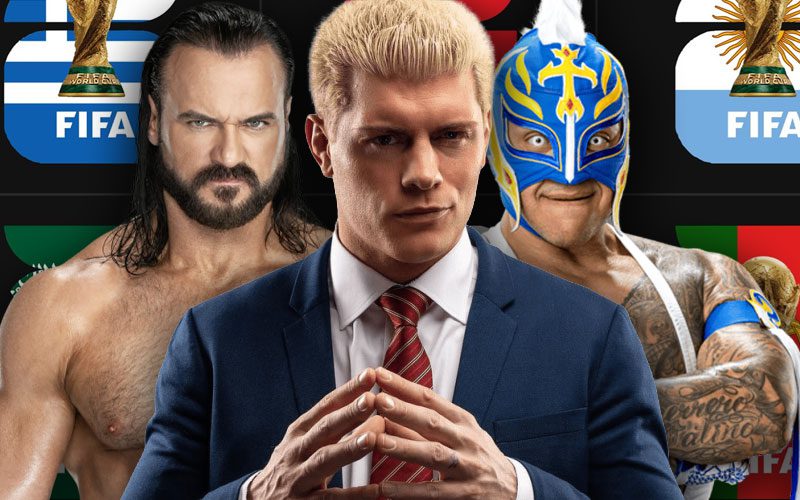
Look at the reporting coming out this week regarding who the locker room is pulling for. You have the obvious loyalties. Drew McIntyre is aggressively Scottish. Gunther aligns with Austria. The Mysterios are deeply tied to Mexico.
Yet, when WWE attempts to integrate these allegiances, the execution is painfully shallow. It almost always devolves into a performer wearing a rival team's jersey to get a cheap chorus of boos. It is the booking equivalent of a long ball lumped forward to a target man—effective in the 1980s, entirely predictable today.
The tactical mirror of Gunther and Austrian Gegenpressing
To understand what WWE is leaving on the table, you have to look at how certain wrestlers naturally mirror the tactical philosophies of their home nations. Take Gunther.
The Ring General's entire in-ring style is a physical manifestation of Ralf Rangnick's Austrian national team. Rangnick employs a suffocating, high-intensity pressing system. He demands control of space, limiting the opponent's options until they make a fatal error.
Watch Gunther's matches against Sami Zayn or Chad Gable. He does not wrestle; he presses. He cuts off the ring with methodical footwork, trapping his opponents in the corners.
When the opponent tries to break the lines with speed, Gunther steps up and delivers a brutal chop that acts as a tactical foul. He disrupts the rhythm. He forces the match into a half-court game where his physical superiority dictates the tempo.
WWE acknowledges Gunther's Austrian heritage, but they frame it purely as a generic European threat. They miss the nuance. The reason Gunther is terrifying isn't just because he hits hard. It is because his ring psychology is mathematically designed to neutralize chaos, much like a well-drilled double pivot in midfield.
Drew McIntyre's grievance and the Rangers influence
Then there is Drew McIntyre. His character arc over the past two years is fascinating when viewed through the lens of Scottish football.
McIntyre is a vocal supporter of Rangers. He understands the deeply ingrained, generational grievances of the Old Firm rivalry. His recent character work is built entirely on perceived injustices.
He constantly complains about the officials, the management, and the system being rigged against him. He sounds exactly like a football manager in a post-match press conference dissecting a controversial VAR decision.
When McIntyre steps into the ring, his offense is direct. There is no wasted movement, no elaborate setups. It is the equivalent of a rigid 4-4-2 low block transitioning into a vicious counter-attack.
He absorbs pressure, complains to the referee to buy time, and then hits the Claymore out of nowhere, often ending matches under the 12-minute mark. It is a smash-and-grab victory away from home. But again, WWE rarely leans into this psychological depth.
Instead of letting McIntyre's natural football tribalism inform his character's motivations, they reduce him to pointing at a screen or mocking a local sports team. It is a massive missed opportunity to build a uniquely compelling, sports-centric villain.
Sheamus, Balor, and the Premier League psychology
If you want a masterclass in how football allegiance informs ring psychology, look at the Irish contingent. Sheamus is notoriously a die-hard Liverpool supporter. Finn Balor is a long-suffering Tottenham Hotspur fan.
Their respective careers map onto these clubs with almost frightening accuracy. Sheamus, much like Jurgen Klopp's best Liverpool sides, is heavy-metal wrestling.
He does not care about looking pretty. He wants to drag you into a brawl, hit you with the Ten Beats of the Bodhrán, and break your will through sheer physical attrition. It is high-octane, chaotic, and relentlessly forward-thinking.
Contrast that with Balor. Tottenham's historical identity is built on flowing, attractive football that often falls short when the pressure is highest. Spurs are brilliant but fragile.
Balor's in-ring work is sleek, precise, and aesthetically flawless. Yet, for years on the main roster, his booking reflected that exact same Spurs-like fragility.
He would string together beautiful sequences, hit the Coup de Grace, and then somehow lose the decisive match. It is only recently, through the structured environment of The Judgment Day, that Balor has found a ruthless edge.
The Judgment Day functions like a dark arts team under Jose Mourinho. They cynically manipulate the referee, crowd the apron, and win ugly. It is a fascinating evolution that directly mirrors the tactical cynicism required to survive in the Premier League.
Pete Dunne and the Championship grind
You cannot talk about football tribalism without looking at the English talent. Pete Dunne is the perfect case study. He operates with the cynical, bruising mentality of a center-back fighting against relegation in the English Championship.
There is nothing flashy about Dunne. He isolates a joint, bends fingers back, and grinds his opponent down. It is the wrestling equivalent of a wet Tuesday night away at Stoke.
When you watch a Pete Dunne match, you are not waiting for a spectacular high spot. You are watching a battle of attrition. He constantly breaks the flow of the match with tactical fouls, targeting the smaller joints to completely neutralize an opponent's speed.
This is where WWE's presentation actually aligns well with the in-ring work. They present Dunne as a miserable, hard-nosed fighter who despises the pageantry of modern wrestling. He is the antithesis of the highly-produced sports entertainment style.
But imagine if WWE took this a step further during the World Cup. Instead of just letting him scowl, explicitly align his character's frustration with the perennial disappointment of the English national team.
The mentality of an English football fan is a fascinating psychological complex of arrogant expectation masking deep, historical insecurity. Embedding that specific neurosis into a British heel's character arc would be incredible television.
The structural discipline of Japanese wrestling
Japan is consistently one of the most structurally disciplined teams at the World Cup. They defend in compact shapes, transition with blinding speed, and rarely make unforced errors.
This mirrors the fundamental philosophy of Japanese strong style, brought to WWE by talents like Shinsuke Nakamura and Asuka. Nakamura's striking is not just about impact; it is about finding the exact right angle to exploit an opening.
When Nakamura is motivated, his matches look like a perfectly executed counter-attacking masterclass. He absorbs pressure, creates a trap, and then strikes with the Kinshasa before the opponent even realizes they are out of position.
Asuka operates on a similar wavelength. Her transitions from strikes into submissions are fluid and instantaneous. There is no hesitation. It looks like a team that has drilled a passing sequence a thousand times on the training ground.
However, WWE frequently misuses this discipline. They often book Nakamura in sluggish, plodding matches that completely neutralize his timing. It is like asking a fast, counter-attacking winger to play as a traditional target man.
The tactical mismatch is glaring. If WWE wants to capitalize on the international flavor of their roster this summer, they need to let these wrestlers play their natural positions.
The North American triangle
With the World Cup hosted across three nations, the North American talent is inevitably going to be dragged into the promotional machine. Sami Zayn and Kevin Owens represent Canada. Rey and Dominik Mysterio represent Mexico. Cody Rhodes is the quintessential American babyface.
Zayn's connection to the crowd is perhaps the most interesting. In the ring, Zayn functions like a modern false nine. He rarely stays in one position.
He drops deep to absorb punishment, dragging the heel out of their comfort zone. Then he exploits the vacated space with sudden bursts of offense like the Blue Thunder Bomb or the Helluva Kick.
His connection with the Canadian audience is organic and chaotic. Yet, when WWE books Canadian talent on home soil, they default to the hometown hero trope without exploring what actually makes that connection work.
Conversely, look at Dominik Mysterio. He is generating the most organic heat in the industry. If WWE were smart, they would align him with the opposing factions of the US-Mexico football rivalry.
Imagine Dominik casually wearing a USMNT jersey in the Azteca. The reaction would be deafening. It would be genuine, visceral anger, not the polite boos generated by insulting a local hockey team.
Cody Rhodes and the American tactical naivety
Then we have the face of the company. Cody Rhodes is the undisputed champion and the ultimate American babyface. His presentation is pristine.
He wears the suits, kisses the babies, and gives impassioned speeches about finishing the story. He is the professional wrestling equivalent of the United States Men's National Team.
The USMNT historically operates with a distinct, slightly naive brand of optimism. They believe that hard work, athleticism, and sheer willpower can overcome superior tactical setups.
Rhodes wrestles the exact same way. When faced with the Bloodline—a faction that operated with the ruthless, coordinated precision of a prime Italian Catenaccio defense—Rhodes didn't try to out-tactic them.
He just kept running at the wall, absorbing punishment, and relying on his resilience. It makes for incredible drama, but it is tactically absurd.
A smarter wrestler would have dismantled the Bloodline's numbers game quietly over months. Rhodes just demanded a fight in the center of the ring.
This is why European fans often react differently to Rhodes than American crowds do. An American audience sees a hero overcoming the odds.
A European audience sees a tactically flawed striker relying on moments of individual brilliance to bail out a bad game plan. It is a subtle disconnect, but it explains why the international crowds at recent premium live events have occasionally pushed back against the standard WWE babyface script.
The corporate sanitization of tribalism
This brings us to the core issue. WWE's booking philosophy fundamentally misunderstands how modern sports fans consume tribalism. The company views sports cross-promotion as a marketing exercise.
They want the social media engagement of a WWE Champion holding a custom title belt next to a World Cup winner. They want the pristine, corporate-friendly photo op. They do not want the raw, ugly, passionate tribalism that actually drives football culture.
Real football tribalism is petty. It is obsessive. It is holding a grudge over a bad tackle from six years ago. That is exactly what professional wrestling is supposed to be.
When CM Punk and Drew McIntyre feud, it works because it feels like two rival ultras who genuinely despise each other's existence. The hatred feels lived-in. But when WWE tries to explicitly invoke football, they sanitize it.
They script promos where wrestlers make forced references to penalty shootouts or yellow cards. It sounds like an executive who just learned what the sport is trying to write dialogue for a working-class fan.
This is where the criticism lands hardest. WWE has access to a locker room full of performers who genuinely understand the mechanics of football fandom. Sheamus breathes Liverpool. Finn Balor follows Tottenham.
They know how fans think. Yet, the creative direction forces them into sanitized boxes. The resulting television feels distinctly plastic.
The graveyard of cross-promotional failures
WWE's history of integrating football into its programming is, frankly, embarrassing. The company has a terrible habit of treating the world's most popular sport like a novelty act.
Remember when Wade Barrett brought Wayne Rooney into a storyline? Rooney slapped Barrett at ringside. It was a massive media moment, plastered across the back pages of British tabloids.
But it meant absolutely nothing. Barrett, a legitimate tough guy and a Preston North End supporter, was humiliated for a cheap PR stunt. It damaged his credibility permanently.
The booking team sacrificed long-term heat for a quick clip on Sky Sports. This is the exact trap they need to avoid over the next month.
As the World Cup hype builds, the temptation will be to stick a football under someone's arm and have them cut a generic promo about scoring goals. It is lazy writing.
Real crossover appeal happens when the audience respects the authenticity. Look at how Bad Bunny integrated into WWE. He didn't just show up and sing; he learned the mechanics of a wrestling match.
He respected the space. Football requires that same level of respect from WWE creative. You cannot just slap an Inter Miami jersey on a mid-card heel and expect the crowd to care.
The audience is smarter than that. They watch 90 minutes of tactical adjustments every weekend. They can spot a cheap gimmick from a mile away.
The missed tactical translation
The best wrestling, much like the best football, relies on contrasting styles. A high-flying luchador against a grounded submission specialist is the equivalent of a possession-heavy team trying to break down a low block.
When you map these concepts onto each other, the matches make more sense. The audience understands the stakes without needing a twenty-minute exposition promo.
Instead, WWE often strips away the stylistic differences in favor of the standard television style. It is a homogenized rhythm of near-falls and trading strikes. It is the equivalent of every team in a league playing the exact same 4-2-3-1 formation with identical instructions.
It becomes predictable. You know exactly when the commercial break dive to the outside is happening, just like you know exactly when a team playing a rigid system is going to recycle the ball backward.
If Triple H truly wants to elevate the in-ring product, he should look at how these international stars consume their favorite sport. Let Gunther be the relentless pressing machine.
Let McIntyre be the aggrieved, direct counter-attacker. Let Sami Zayn roam the ring with the chaotic freedom of a creative midfielder. And let their real-world football allegiances inform their character work, rather than just serving as a prop for a cheap pop.
The final whistle
As the World Cup dominates the global conversation next month, WWE will inevitably attempt to ride the wave. We will see custom belts. We will see wrestlers visiting training camps.
But unless the booking philosophy shifts, it will remain a superficial crossover. Wrestling and football share the exact same DNA: working-class entertainment built on regional pride, stylistic clashes, and bitter rivalries.
Right now, WWE is only tapping into the corporate surface. They have the talent to execute something much deeper. They just need to trust the locker room to play the game.
CM Punk "Best in The World" Official WWE Ringer T-Shirt
The iconic tee from the one and only Best in the World.
More Coverage
Andre Chase pulls back the curtain on the Shawn Michaels era at NXT
an hour ago
The Andre Chase effect: Why Shawn Michaels is the ultimate NXT headmaster
an hour ago
Drew McIntyre sidelined following brutal SmackDown encounter
5 hours agoWWE's New York gamble is a calculated risk ahead of WrestleMania 42
5 hours ago
WWE's Saturday Night's Main Event math doesn't add up
5 hours agoWWE's return to New York changes the math on stadium attendance
5 hours agoMore Analysis
WWE's World Cup Problem: A Roster of Nations, A Fandom of One
2 months ago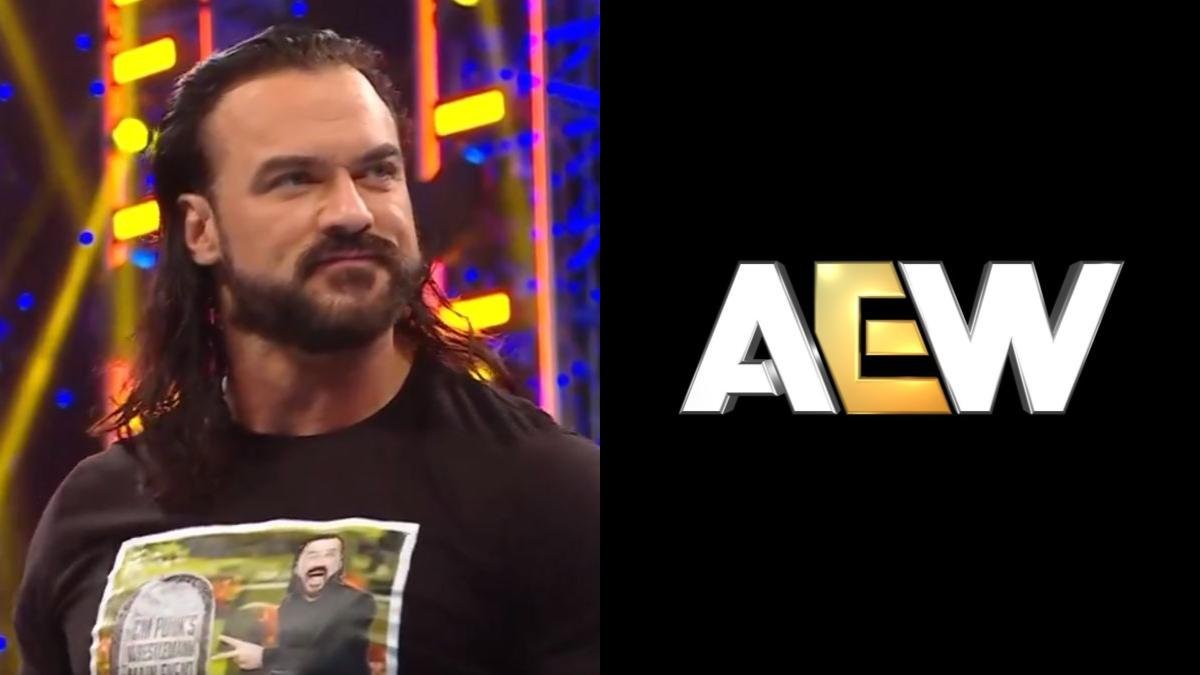
WWE is repeating the same mistake with Drew McIntyre in Europe
3 months, 3 weeks ago