Why AEW's TikTok pre-show is a necessary, terrifying broadcast experiment
The mechanical realities of a vertical feed
AEW and Warner Bros. Discovery are adding a dedicated Dynamite pre-show to their rotation. It will air live on TikTok under the banner of AEW Advance. On the surface, this looks like standard corporate cross-promotion. Another digital property to feed the social media beast.
But look closely at the mechanical realities of modern sports broadcasting. This move reveals a lot about AEW's current strategic anxieties. It also exposes their evolving relationship with WBD ahead of an impending television rights renewal.
AEW has a complicated history with digital shoulder programming. The early days brought us AEW Dark, a pandemic-era necessity that eventually ballooned into a multi-hour weekly endurance test. Then came Elevation. Both served a purpose for talent development, but neither moved the needle on mainstream engagement.
They were legacy formats mapped onto a digital platform. YouTube is a search-and-intent engine. Viewers had to actively choose to watch a two-hour tertiary show. TikTok operates on an entirely different set of physics.
It is a discovery engine. You don't search for AEW Advance; it interrupts your doomscroll. This fundamentally changes how a wrestling promotion has to structure a broadcast.
The traditional desk segment—Renee Paquette and RJ City running down a card—dies instantly in a vertical feed. Retention drops to zero within three seconds if there isn't immediate kinetic movement.
The historical precedent of the lead-in
Let us analyze the historical precedent for the wrestling lead-in broadcast. The WWF Free For All in the late 1990s and Sunday Night Heat were mechanical tools designed to catch casual channel surfers. Crucially, they existed on the exact same medium as the product they were attempting to sell.
You watched the hour-long lead-in, and the transition to the pay-per-view was a push of a button on the same remote control. The friction was nearly nonexistent. The viewer was already in a passive, lean-back viewing posture in their living room.
The transition AEW is attempting with Advance is fundamentally disjointed. They are trying to bridge two distinct broadcast environments. A viewer on TikTok is in a lean-forward posture, physically holding a device, likely with headphones in, engaged in rapid-fire, low-commitment consumption.
A television viewer is typically passive, sitting away from the screen, committed to a longer narrative block. Bridging that physical and psychological gap is the hardest problem in modern media.
There is a glaring mechanical flaw in relying on TikTok as a lead-in for a linear cable broadcast. The platforms are structurally hostile to each other. The goal of AEW Advance is ostensibly to drive viewers to TBS for Dynamite. But TikTok's entire architectural design is built to prevent users from leaving the app.
If a user is engaged enough to watch a wrestling pre-show on their phone, asking them to put down the phone, find a remote, and tune to a specific cable channel at exactly 8:00 PM is a massive friction point. The conversion rate from vertical digital scroll to horizontal linear viewing is historically abysmal.
The framing problem and ring geometry
Wrestling is inherently horizontal. The squared circle was designed for arenas, and later adapted perfectly for the 16:9 horizontal television screen. When you shoot wrestling vertically for a 9:16 aspect ratio, you lose the ropes. You lose the referee's positioning. You lose the context of the opponent's placement.
Consider a classic suicide dive. The visual impact of the move comes from the horizontal distance traveled—the wrestler sprinting across the ring, bursting through the ropes, and crashing into the barricade.
On a vertical screen, the camera operator has to pan violently to track the movement, often creating a motion-blur effect that dilutes the impact. The viewer cannot see the recipient of the dive until the absolute last millisecond.
Conversely, vertical video aggressively favors vertical movement. A Swerve Strickland top-rope stomp or a PAC Black Arrow looks monumental because the vertical frame captures the entire ascent and descent without needing to cut. The framing forces AEW's producers to rethink entirely which talent they feature on this pre-show.
Ground-based technicians like Bryan Danielson or Zack Sabre Jr. rely on intricate joint manipulation and spatial control, which reads as static noise on a phone screen. The high-flyers will dominate this format by mechanical necessity.
This puts immense pressure on AEW's formatting agents and the talent themselves. A typical professional wrestling match builds. There is a collar-and-elbow tie-up, a feeling-out process, a steady escalation of violence.
TikTok actively punishes the feeling-out process. If a live viewer drops into AEW Advance and sees a side headlock, they will swipe up immediately. The matches booked for this platform have to start in fourth gear. This completely upends the traditional ring psychology that veteran workers are taught.
The WBD data harvest
The timing of AEW Advance is not a coincidence. AEW is currently navigating the most important television rights negotiation of its existence. WBD holds the keys. Traditional television viewership is eroding across the board, and WBD executives are demanding cross-platform engagement metrics.
We cannot ignore the broader sports media context surrounding Warner Bros. Discovery. David Zaslav and the WBD brass have spent the last two years ruthlessly evaluating their sports portfolio. With the NBA rights situation historically volatile, WBD is desperately searching for cost-effective, high-engagement live programming.
AEW is significantly cheaper per hour than traditional tier-one sports, but it must prove it can deliver the social metrics that advertisers demand in 2026. The traditional P2+ Nielsen rating is no longer the sole metric of success. Advertisers want verified, active digital engagement.
They want to know that a brand logo plastered on the ring mat will be seen by a demographic that hasn't paid for a cable box in a decade. By launching AEW Advance directly in partnership with TikTok, WBD is bypassing the traditional cable interface entirely to capture that data.
It is a direct-to-consumer data harvest masked as a wrestling show. If the show features a sponsored match or a branded integration, WBD gets immediate, granular metrics on how many users tapped the screen, how long they lingered, and what the demographic breakdown was. That data is arguably more valuable in their upcoming upfront presentations than a slight bump in the Dynamite quarter-hour ratings.
The live broadcast tightrope
If AEW treats this merely as a commercial for Dynamite, it will fail. Users swipe past commercials. To survive on TikTok, AEW Advance has to exist as a self-contained product. It has to offer narrative progression or match outcomes that matter, independent of the television broadcast.
And that creates a booking nightmare. How do you give away something valuable enough to stop a scroll, without cannibalizing the pay-per-view or television product? Consider the upcoming Double or Nothing event on May 24. If AEW utilizes Advance to build toward that show, how do they measure success? Is it a spike in last-minute Bleacher Report buys, or just raw stream views?
Broadcasting live on TikTok also removes the safety net of post-production. When things go wrong in a live arena environment—a blown spot, a missed cue, an awkward silence—it gets clipped, memed, and weaponized by tribal fans within minutes.
A controlled YouTube upload can edit around the rough edges. A live vertical stream cannot. Furthermore, the audio mix on TikTok is notoriously difficult to balance for live events. Arena acoustics sound muddy compressed through a phone speaker.
If the commentary sounds distant or the crowd noise washes out the promos, the production will look amateurish. AEW has historically struggled with audio consistency on its flagship shows; moving to a mobile-first platform amplifies those technical challenges.
A necessary, flawed experiment
If AEW Advance manages to consistently draw 40,000 concurrent viewers on a random Wednesday evening, that is a data point WBD can sell. It proves AEW has a sticky audience.
But the risk of brand dilution is severe. AEW has built its identity as the alternative for the hardcore wrestling fan. It is the promotion of the bloody Texas Death Match, the 60-minute Broadway, the deep, intricate lore referencing decades of global wrestling history.
TikTok is the antithesis of deep history. It is the platform of the immediate present. By catering to this format, AEW risks alienating the older, affluent viewer base that actually buys their premium events.
Despite the structural risks, AEW Advance is a move Tony Khan had to make. Sticking entirely to traditional cable and pay-per-view models in 2026 is an exercise in managed decline. The audience is migrating, and wrestling promotions have to follow them into the friction-heavy, chaotic environment of short-form social video.
WBD is clearly pushing for this integration. The fact that the network is publicly attached to the launch indicates this is a joint corporate strategy, not just a rogue digital experiment by AEW's social media manager.
Whether that pipeline actually converts TikTok scrollers into paying ticket buyers or Dynamite viewers is highly doubtful. The viewing habits are simply too disconnected. But as a mechanism to satisfy network executives, generate immediate engagement data, and force AEW's production team to modernize their visual approach, it is a fascinating shift.
It forces a wrestling company to stop thinking like a television producer and start thinking like a digital native. The growing pains will be highly visible, vertically oriented, and completely live.
Read Next
WWE Cody Rhodes Signature "American Nightmare" Weight Belt Replica
The ultimate fan accessory to complete your American Nightmare look.
Frequently Asked Questions
What is AEW Advance?
Why is AEW launching a pre-show on TikTok?
How does the TikTok pre-show differ from past lead-ins?
What makes moving viewers from TikTok to TBS difficult?
How does the TikTok format change the broadcast style?
More Coverage
WWE is using streamer reaction clips while banning the creators who make them
2 weeks, 6 days ago
The brutal math and broken geometry behind AEW's new TikTok pre-show
1 month, 4 weeks agoAEW's TikTok pre-show in Philly is a brilliant, desperate broadcast experiment
1 month, 4 weeks agoAEW and WBD gamble on a TikTok pre-show for the Double or Nothing fallout
1 month, 4 weeks ago
Ted Turner is dead at 87, and modern wrestling owes him everything
2 months, 1 week ago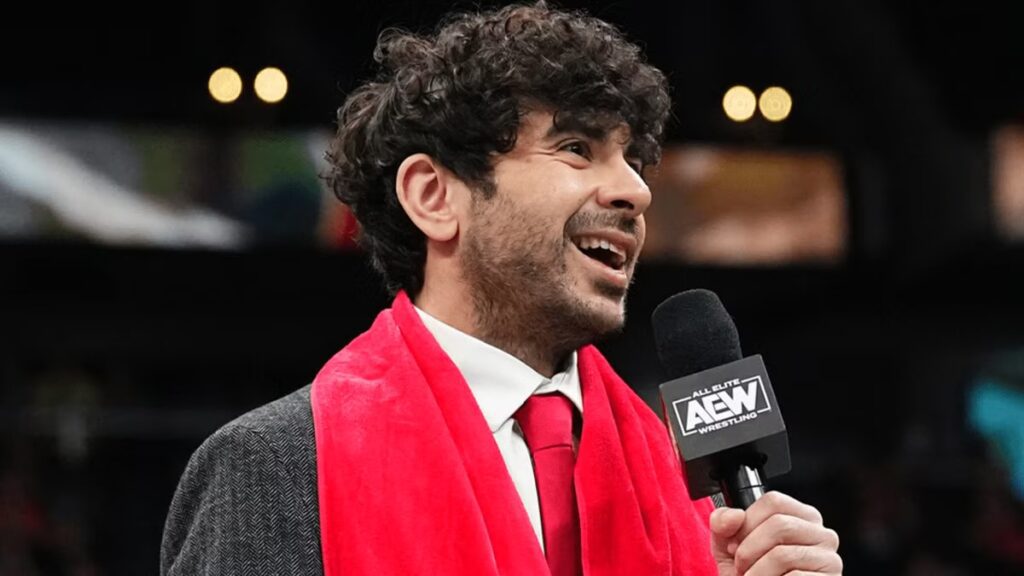
Tony Khan finally stopped playing GM Mode on easy and started booking for real
2 months, 2 weeks agoMore Analysis
AEW's TikTok pre-show in Philly is a brilliant, desperate broadcast experiment
1 month, 4 weeks ago
The brutal math and broken geometry behind AEW's new TikTok pre-show
1 month, 4 weeks agoAEW and WBD gamble on a TikTok pre-show for the Double or Nothing fallout
1 month, 4 weeks agoAEW's HBO Max shift signals a content volume strategy
1 month, 3 weeks ago