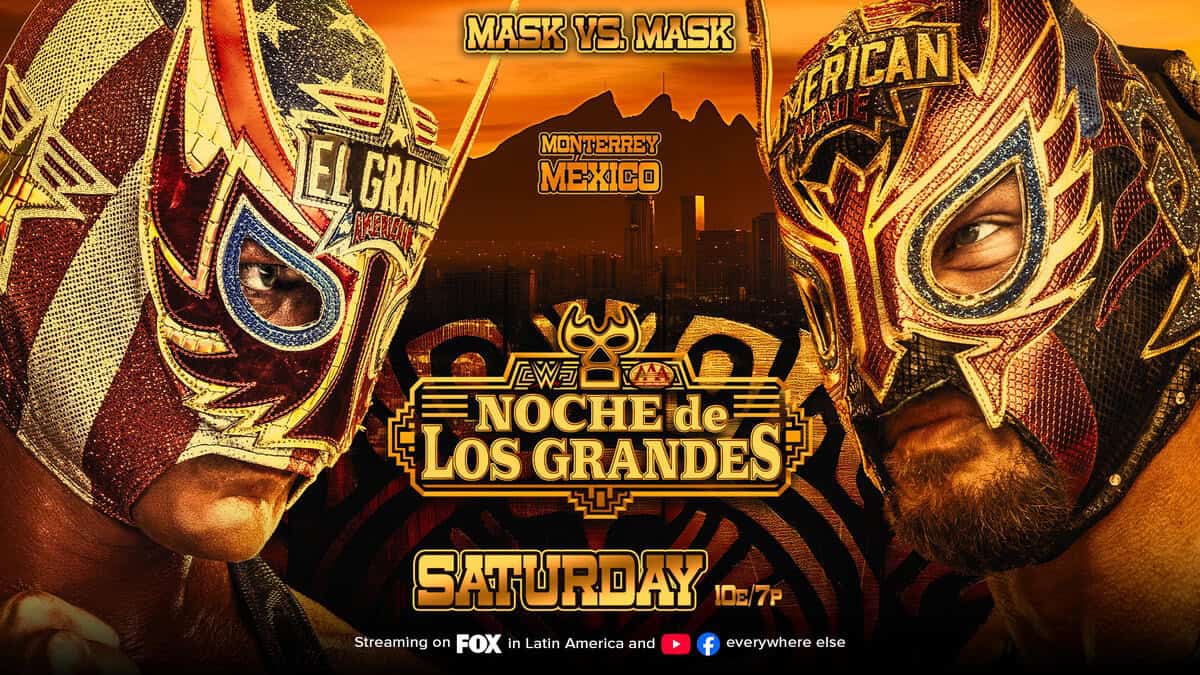
Verde Americano's big moment exposes AAA's bizarre pacing

The messy reality of the Rey de Reyes fallout
Saturday night offered a perfect laboratory for studying ring psychology. Three promotions ran significant cards simultaneously. You had AAA wrapping up their tournament fallout, CMLL executing their rigid traditions, and House of Glory trying to stand out in the American indie scene.
You can learn a lot by watching how different companies handle pacing. Most fans focus on the high spots. Analysts look at the transitions.
Let us start with AAA. The promotion has always operated on a different frequency. As noted in the Rey de Reyes coverage on Ringside News, the March 21 show was built around Verde Americano receiving his long-awaited reward after winning last week's tournament.
This should have been a straightforward coronation. Instead, it highlighted the structural rot at the heart of AAA's main event booking.
When a wrestler wins a major tournament, the follow-up needs to establish a clear hierarchy. Verde Americano needed a segment that cemented him as an apex predator. What he got was a messy, overbooked segment that relied entirely on chaotic brawling rather than a focused narrative.
The mechanics of the segment were entirely disjointed. In a proper angle, the spacing matters. You need distance between the protagonist and the antagonists to let the crowd anticipate the physical contact. AAA rarely allows for negative space.
They rush the angles. They crowd the ring. They dilute the impact of the Rey de Reyes victory by immediately surrounding the winner with secondary characters who steal the focus.
The mechanics of an indie supercard
Contrast AAA's chaos with the approach taken in New York. The House of Glory SuperClash event operated on a completely different tactical premise.
HOG books for the live building. Their pacing is designed to generate immediate, visceral reactions from a vocal local crowd. This means their match structures are heavily front-loaded.
If you watch the work-rate on a typical HOG card, you will notice a distinct lack of heat segments. The traditional American structure dictates a shine, a cut-off, a heat segment, a comeback, and a finish.
HOG frequently bypasses the heat segment entirely. The wrestlers trade high-impact offense from the opening bell. It is an arms race of moves.
This creates an exciting live experience, but it damages the long-term psychology of the card. When the opening match features multiple superkicks and a top-rope Canadian Destroyer, the main event has nowhere to go. You cannot escalate the violence if you start at maximum capacity.
This is a tactical failure. It betrays a lack of trust in the audience's attention span. The wrestlers are working hard, but they are working inefficiently. They are burning calories without generating sustained emotional investment.
CMLL and the power of rigid structure
This brings us to Arena Coliseo. The contrast is staggering.
The CMLL Sabado De Coliseo results read like a transmission from a different era. But do not confuse traditionalism with laziness.
CMLL is the most structurally disciplined wrestling promotion on the planet.
Their adherence to the traditional two-out-of-three falls trios match is not just a quirky aesthetic choice. It is a highly effective tactical framework. It forces wrestlers to pace themselves.
The first fall in a CMLL trios match is almost entirely built around mat work and establishing the base. The rudos isolate a single tecnico. They attack the joints. They establish the physical geometry of the match.
They rarely leave their feet in the first five minutes.
This is where AAA and HOG fail. By skipping the foundational work, they rob their high spots of meaning. When a CMLL tecnico finally hits a basic suicide dive in the third fall, the crowd erupts. Why? Because the move was protected.
It was withheld until the exact right moment.
The lost art of the cutoff
The most important moment in any wrestling match is the cutoff. It is the exact second the heel stops the babyface's momentum.
If you watch the Verde Americano footage from AAA, the cutoffs are sloppy. They rely on outside interference or low blows. It feels cheap.
In CMLL, a cutoff is usually executed via a superior technical counter. A rudo will catch a flying attack and seamlessly transition into a submission hold. It reinforces the idea that these are elite athletes competing in a sport, rather than actors reciting lines.
The spacing is immaculate. The timing is precise.
There is a specific reason why CMLL matches look like a struggle, while many indie matches look like a synchronized dance. It comes down to how the wrestlers distribute their weight during tie-ups.
In a properly worked match, the wrestlers should be fighting for leverage. You should see the strain in their shoulders. In HOG, too often, the wrestlers are simply light on their feet, waiting to transition into the next sequence.
The verdict on March 21
When you evaluate these three very different products, a clear picture emerges regarding the state of modern booking.
AAA is coasting on brand recognition and the sheer chaotic energy of its roster. The Verde Americano presentation proves they have lost the thread on how to build a singular, dominant star. They book everything at 100 miles per hour, leaving no room for a narrative to breathe.
It is exhausting to watch as an analyst.
House of Glory is trapped in the indie work-rate arms race. They are putting on spectacular athletic exhibitions, but they are failing to tell coherent stories across a two-hour card.
CMLL remains the gold standard for structural discipline. They are stubborn. They are repetitive. But their pacing is flawless.
They understand that a wristlock applied in the first minute is what makes a superplex matter in the fifteenth minute.
Looking ahead
Wrestling is evolving. The physical capabilities of the performers have never been higher. But the tactical understanding of how to construct a match is regressing.
Promoters need to stop looking at the highlight reels and start looking at the transitions.
The promotions that figure out how to combine modern athleticism with classic structural pacing will dominate the next decade. Right now, nobody is hitting that sweet spot.
AAA is too chaotic. CMLL is too rigid. The indies are too eager to please.
The blueprint is out there. Someone just needs to read it.
Until then, we will keep seeing tournament winners like Verde Americano get lost in the shuffle of their own coronation. And that is a massive failure of booking.
You can have all the talent in the world. If you do not know how to space them out, you have nothing.
Frequently Asked Questions
Why was Verde Americano's AAA segment considered a booking failure?
How does House of Glory approach pacing differently than traditional styles?
What are the risks of front-loading a wrestling match with high-impact moves?
How does the article characterize AAA's approach to main event booking?
What distinguishes CMLL's booking style from the other promotions mentioned?
More Coverage
Why AAA's NYC involvement signals a major shift for WWE's international strategy
16 seconds agoAAA is hitting a wall with its current booking strategy
an hour ago
Chik Tormenta hits free agency exodus after AAA exit
15 hours ago
Top 10: Defining Moments in Modern Professional Wrestling
1 day, 6 hours agoAAA’s Verano de Escandalo is a beautiful mess we can’t look away from
1 day, 7 hours agoAAA’s Verano de Escandalo card is a chaotic fever dream
1 day, 8 hours agoMore Analysis

AAA Rey de Reyes week three exposes the tactical flaws of modern lucha
3 months, 2 weeks ago
Verde Americano finally gets his moment at AAA Rey de Reyes
3 months, 4 weeks agoAAA needs a tactical shift beyond the highlight reel
1 month ago
AAA faces a critical moment on the road to mid-summer
1 month ago