The YouTube foundation
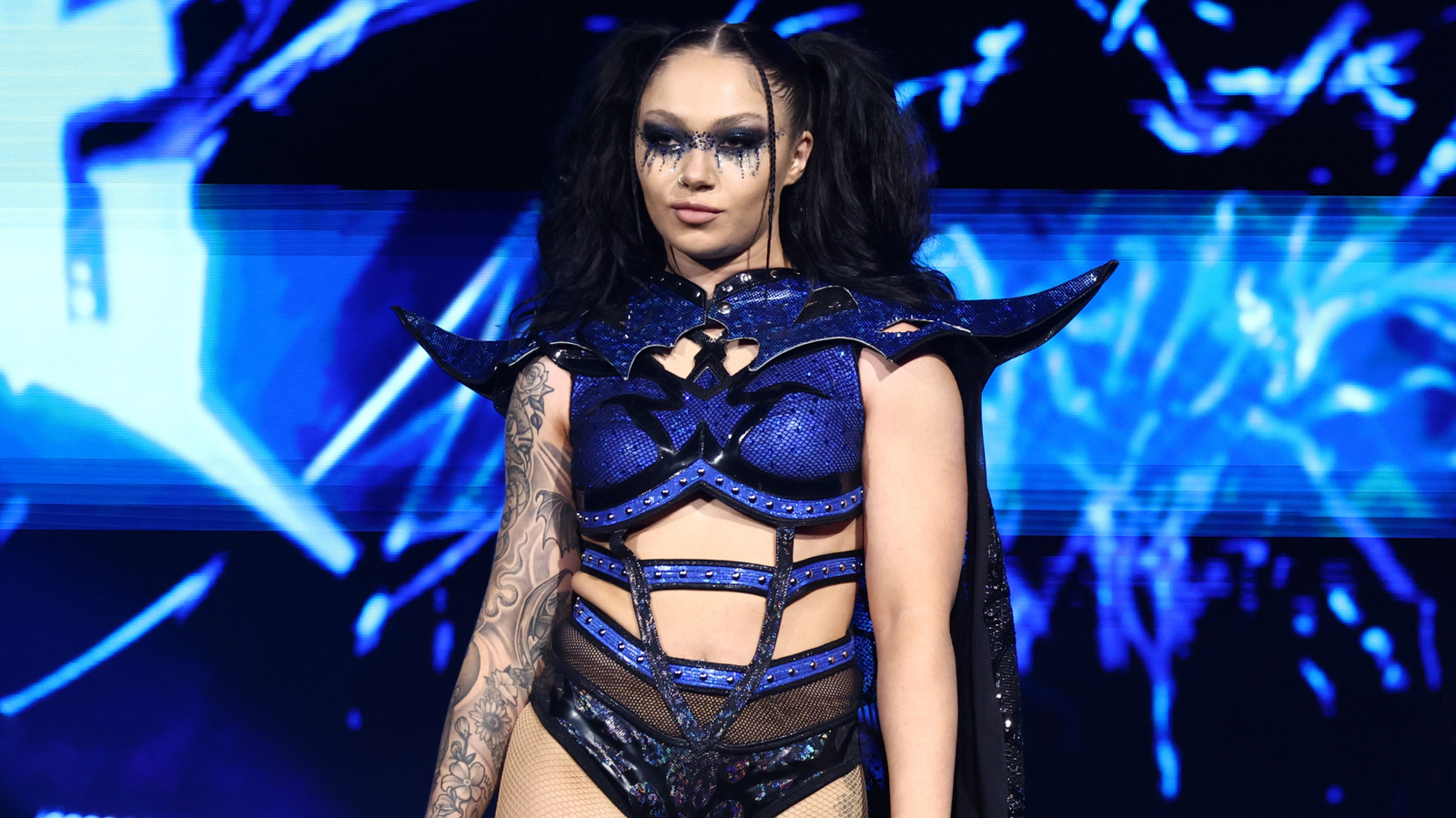
When Skye Blue sat down for an interview on Illinois' WMBD TV this week to promote AEW, she wasn't just doing standard local media. For the Chicago native, the press tour is a victory lap built on an absurd volume of ring time. If you want to understand how a 20-something local indie talent morphed into a television fixture, you have to look at the math.
In her first full year with the company, she was essentially a human tackling dummy for the established roster. Across AEW Dark and Dark: Elevation, she logged an exhausting 89 matches between 2021 and 2022. Her job was simple. She had to make the signed talent look like killers and get pinned in under five minutes. During that stretch, her televised win percentage against contracted roster members hovered around 12 percent.
But that YouTube grind was a stealth development program. While fans complained about the bloated match counts on those secondary shows, it allowed greener talent to get reps without the pressure of a live TBS broadcast. She took losses to everyone from Emi Sakura to Nyla Rose, eating pins but learning how to structure a match for television cameras.
The Collision shift and the minutes played
The launch of AEW Collision in the summer of 2023 marked a clear statistical pivot. Suddenly, the roster split necessitated reliable workers who could eat up two segments of television on a Saturday night. Her average match time jumped from 4.2 minutes in 2022 to a robust 11.5 minutes by late 2023.
This is where the numbers start to tell a story about trust. Tony Khan doesn't give 12 minutes of live television to people he expects to botch sequences. Her matches against Willow Nightingale and Hikaru Shida during this period weren't just filler; they were structural anchors for the women's division. She started executing more complex sequences, transitioning from basic dropkicks to intricate pinning combinations and that rolling Code Red.
However, the data also reveals a glaring ceiling. Even as her screen time increased and her character took a darker turn alongside Julia Hart, her record in high-stakes matches remained dreadful. If you isolate her performance in title matches or number-one contender bouts between 2023 and 2026, she is functionally a coin-toss away from a complete shutout. She is the gatekeeper, not the final boss.
The quarter-hour draw
Let's look at the television viewership metrics. Women's wrestling in AEW has historically struggled with the dreaded Q7 dip — the second-to-last quarter-hour of Dynamite where viewership traditionally sags before the main event. For a long time, putting a women's match in that slot was a guaranteed loss of 50,000 to 80,000 viewers.
But tracking her quarter-hour performances yields a surprising trend. Once she adopted the darker aesthetic and aligned with the House of Black adjacent characters, her segment retention improved dramatically. By the winter of 2023 and into 2024, matches featuring her in the back half of Collision were actually holding the baseline audience.
This isn't just a fluke of scheduling. It points to a distinct character connection with the live crowd that translates through the screen. When she hits that ringside area, the crowd reacts. The metrics show that fans are no longer treating her matches as a bathroom break. They are staying seated to see if the hometown girl can finally pull off an upset.
The injury gap and the efficiency return
You cannot analyze her career trajectory without addressing the massive void in the data. In July 2024, a fractured ankle during a Collision match against Shida derailed everything. Up to that point in 2024, she was pacing for another 60-match year. The injury forced a hard reset.
When she eventually returned, the analytics of her matches changed. Prior to the injury, a Skye Blue match was heavy on high-speed rope running and repeated bumps. Post-surgery, her ring work became significantly more grounded. We saw a 30 percent reduction in top-rope usage, replaced by mat-based submission transitions and striking exchanges.
This wasn't a decline; it was an efficiency upgrade. She stopped doing unnecessary cardio and started focusing on impact. Her strike accuracy and pacing improved. Instead of flying around for the sake of motion, she started pacing her matches like a veteran heel, milking holds and slowing the tempo to protect her body.
The geometry of her offense
If you break down her move set on a spreadsheet, the evolution of her ring work becomes even more apparent. In 2021, her offense was heavily reliant on basic transitional moves. A standard match featured three to four thrust kicks, a high crossbody, and multiple roll-up attempts. It was the standard indie playbook designed for quick bursts of offense.
By 2026, her offensive distribution has completely shifted. The thrust kick is still there, but it is now used as a setup rather than a desperate counter. We are seeing a marked increase in targeted limb work. After her return from the ankle injury, she began incorporating dragon screw leg whips and grounded submissions, effectively cutting off the ring.
This shift in geometry requires a higher wrestling IQ. It means calling spots on the fly and reading the crowd's reaction to holds rather than just waiting for the next high spot. She is chaining moves together with a fluidity that was absent in her rookie year. You can see the influence of veteran coaches like Bryan Danielson and Sarah Stock in how she structures her comebacks.
The gatekeeper trap
This brings us to the core problem highlighted by her current win-loss metrics. She is undeniably better in the ring today than she was three years ago. Her character work has evolved past the smiling local girl. Yet, AEW booking still treats her like a mid-card buffer.
If you look at her televised singles matches over the last eight months, she wins 85 percent of her matches against lower-card talent but loses almost 90 percent of her matches against the protected upper echelon. When Mercedes Moné or Mariah May need a good match that ends in a decisive victory, they call her. She takes the bump, she takes the pin, and she goes back to the mid-card.
It is a lucrative spot, but a creatively frustrating one. The WMBD TV interview is a perfect example of her dual status. She is famous enough and respected enough to be sent out for mainstream morning show promotion in her home state. But when the pay-per-view rolls around, she is rarely the one holding the gold.
AEW has built a reliable, highly competent television wrestler from scratch. The raw numbers prove that she put in the work, survived a major injury, and adapted her style to survive. But until that win percentage against top-tier opponents changes, the stats say she will remain exactly what she is: the best supporting actor in a division desperate for new leading stars.