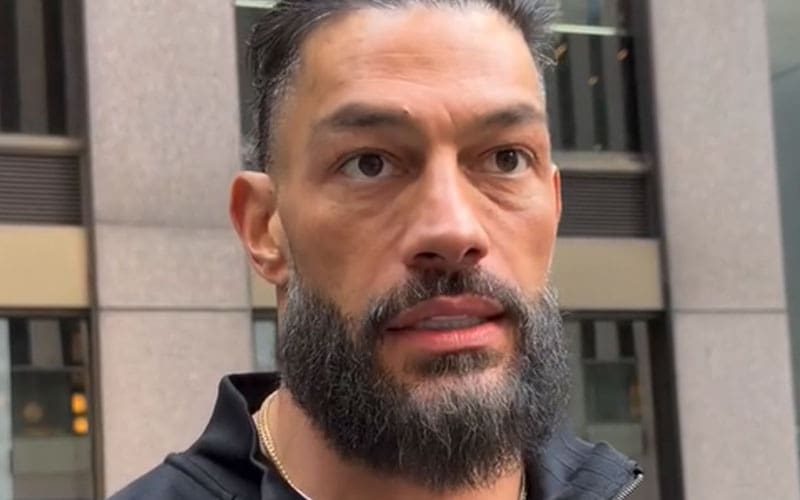
It is remarkably easy to get comfortable at the top of the mountain. For the better part of four years, Roman Reigns dictated the pace of professional wrestling.
He walked slower. He talked slower. He wrestled slower.
Every main event he anchored followed a familiar, highly structured script. A fifteen-minute feeling-out process. Prolonged headlocks disguised as deep psychological warfare. Monologues delivered directly to the hard camera while his opponent lay motionless on the mat.
It was incredibly effective. More importantly, it was highly energy-efficient.
Reigns rarely had to leave second gear to retain his championship. The system was designed to protect the man, and the man perfected the system.
That era is completely over.
According to a recent report from Ringside News, Reigns has adopted a grueling three-a-day training regimen ahead of WrestleMania 41. He is entirely overhauling his diet. He is treating his April 20 showdown in Las Vegas less like a standard title bout and more like a triathlon.
Why the sudden shift in preparation? Because the underlying math of his career has drastically changed.
Reigns is no longer the immovable object waiting for challengers to exhaust themselves against his defenses. He is walking into Allegiant Stadium in exactly 24 days with something entirely new to prove. Cody Rhodes holds the WWE Championship. The Bloodline dynamic, once the most formidable safety net in modern wrestling history, is fractured beyond repair.
For the first time in a half-decade, Reigns is truly operating without a safety net.
The Tactical Stagnation of the Tribal Chief
Let’s be brutally honest about the tail-end of Reigns' historic title run. It got incredibly stale.
The main event formula that produced dramatic masterclasses against Jey Uso and Edge eventually devolved into a predictable crutch. By the time Reigns was defending against LA Knight or Sami Zayn, the matches were copy-and-paste jobs.
We all knew the beats. The referee bump. The sudden Solo Sikoa interference. The Samoan Spike behind the official's back. The Spear. The 1-2-3.
Reigns stopped pushing his cardiovascular limits simply because he didn't have to. The booking heavily protected his physical output. He could rely on theatrical pauses to catch his breath, utilizing his natural charisma to mask the fact that he was working a surprisingly low-impact style for a world champion.
He became a master of doing more with less, but the actual in-ring product suffered. Matches dragged. The tension evaporated when fans realized the finish was always going to involve outside interference.
This new, punishing training camp suggests Reigns knows he cannot get away with that against Rhodes in Nevada. Rhodes wrestles at a frantic, relentlessly southern-style pace. He relies on quick transitions, rapid-fire strikes, and chaining multiple high-impact moves together in rapid succession.
Rhodes does not do prolonged rest holds.
To keep up with Rhodes for 40 minutes without the Bloodline running interference to buy him time, Reigns needs a gas tank he hasn't required since his days as the "Big Dog" in 2019.
Deconstructing the Three-A-Day Routine
When a 38-year-old heavyweight shifts to three-a-days, it is usually a glaring sign of two things. He is either cutting mass to drastically improve agility, or attempting to completely rebuild a depleted V02 max.
Reigns has always been an exceptionally explosive athlete. The mechanics of the Spear require immense fast-twitch muscle fiber activation and perfect timing. But an explosive burst of violence is very different from sustained aerobic output over a near-hour.
If Reigns is prioritizing multi-session days—likely splitting his time between in-ring drilling, heavy compound lifting, and steady-state cardio—he is preparing for a track meet. He is not preparing for a brawl.
Expect a match layout that looks nothing like their previous encounters.
Rhodes will likely force the issue from the opening bell. He will attempt to drag Reigns into the deep waters of a high-workrate sprint. If Reigns is carrying too much bulk, the sheer physical exertion required to counter the Cody Cutter or escape the Cross Rhodes setup will drain his legs by the 20-minute mark.
This strict diet plan is a direct, calculated countermeasure against Rhodes' pacing.
The Biomechanics of the Rematch
Look closely at how Rhodes defends the championship. He absorbs punishment, yes, but he constantly forces uncomfortable scrambles.
He turns simple wrist-locks into complex counter-wrestling exchanges. He utilizes the ring ropes better than almost anyone on the roster, using the Disaster Kick not just as offense, but as a way to abruptly change the spatial dynamic of the ring. Rhodes is a master of creating angles.
Reigns usually shuts this down with raw, overwhelming power. A sudden lifting powerbomb to halt momentum. A stiff, decapitating clothesline to reset the geometry of the match.
But static power fades rapidly when the lungs begin to burn. When a wrestler gets tired, their footwork gets sloppy. If Reigns is half a step slow, Rhodes will exploit that gap immediately.
If Reigns is leaning down and focusing heavily on cardiovascular conditioning, we might see the return of a much more mobile offensive suite. We might see more running strikes, quicker lateral movement to avoid the Cody Cutter, and a reliance on speed over static power.
It is a strictly necessary evolution. The slow-plodding, methodical Tribal Chief would get picked apart by the 2026 version of Cody Rhodes.
Furthermore, Reigns has to account for the physical toll of his submission game. Applying the Guillotine choke correctly takes massive upper-body endurance and core stability.
If his arms and core are blown out from simply trying to keep up with Rhodes' frenetic pace, the Guillotine becomes entirely ineffective. Rhodes will simply post up and power out of it. Reigns is training specifically to ensure his grip strength remains terrifying even in the 38th minute of a grueling main event.
The Psychology of Frustration
There is also a profound mental aspect to this physical preparation. Historically, when Reigns gets frustrated in the ring, he leans heavily on his temper.
He abandons technique for wild, looping strikes. He yells at the crowd. He wastes energy.
Rhodes is built to frustrate opponents. His kickouts at two-and-a-half are designed to demoralize. He has an uncanny ability to survive a barrage of finishing moves, dragging his opponent into a psychological deep end.
In the past, Reigns used Bloodline interference as a release valve for that frustration. If he couldn't put an opponent away, Solo Sikoa or Jimmy Uso would solve the problem for him. Now, that release valve is gone.
If Rhodes kicks out of a Spear at the 25-minute mark, Reigns has to immediately transition to a backup plan. He cannot afford to waste a single ounce of oxygen screaming at the referee.
The three-a-day workouts build mental callousness just as much as they build physical endurance. When your body is screaming at you to quit during a brutal morning cardio session, you learn to quiet your mind. Reigns is going to need that exact mental discipline when Rhodes inevitably refuses to stay down.
The Burden of Las Vegas
There is an external factor here that cannot be ignored. WrestleMania 41 Night 1 belongs to John Cena. His farewell match will suck all the emotional oxygen out of Allegiant Stadium on April 19.
When Reigns and Rhodes walk down the aisle on April 20, they are not just fighting each other. They are fighting the emotional hangover of the previous night.
They have to deliver a performance so physically compelling, so violent, and so technically sound that it forces a drained Las Vegas crowd to invest all over again.
You simply cannot do that with rest holds. You cannot do that with a slow, grinding pace. You have to hit the ring at 100 miles per hour and refuse to slow down.
This changes the ring psychology completely. When you know help is not coming, and you know the crowd demands a masterpiece, your defensive posture changes. Reigns cannot take calculated risks. He cannot willingly absorb a finisher knowing a cornerman will break up the pin.
He has to be both the hammer and the anvil for the entire duration of the match.
The Final Verdict
WrestleMania 41 Night 2 is rapidly shaping up to be the most fascinating tactical matchup WWE has booked in years.
You have a champion in Rhodes who has completely figured out the main event formula, blending classic NWA pacing with modern athletic spectacle. You have a challenger in Reigns who is fundamentally rebuilding his engine to compensate for the loss of his faction and the aging curve of his own body.
The three-a-day workouts detailed by Ringside News are not just standard pre-WrestleMania PR spin. They are a glaring, fascinating admission from Reigns that the old way simply isn't going to work anymore.
He has recognized the fundamental flaw in his own armor before Rhodes could exploit it on the biggest stage possible.
It will be brutal. It will be exhausting. It will almost certainly bleed well past the 35-minute mark, testing the physical limits of both men in the Nevada desert.
But I am backing the challenger. When a generational talent strips away his own hubris, admits his physical shortcomings, and rebuilds himself from the ground up, you do not bet against the result.
Reigns wins the marathon, reclaims the WWE Championship, and finally proves to the world that he never needed the interference to begin with.
Read Next
- Roman Reigns is playing a different game than Cody Rhodes on the road to Vegas
- Roman Reigns is treating the road to WrestleMania 41 like a victory lap
- Vegas is about to host the most predictable main event in WrestleMania history
- The Rock's New Disney Armor Makes Him WrestleMania's Ultimate Wildcard
- 🏆 WrestleMania 41 — Full Coverage Hub
- 💥 WWE Backlash 2026 — Full Coverage Hub
- 👑 Roman Reigns Return 2026 — The Tribal Chief