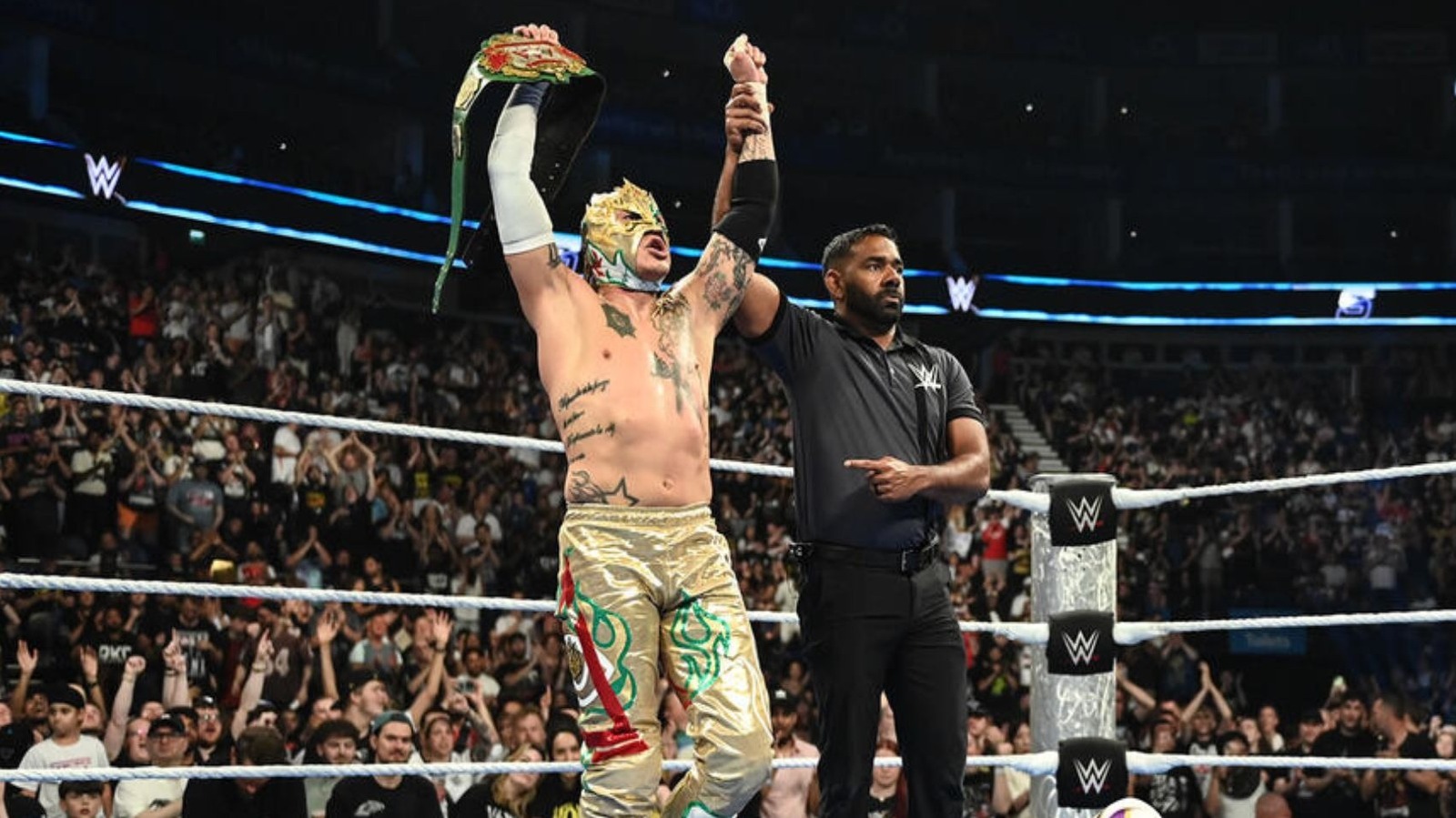
The geometry of chaotic motion
Rey Fenix operates on a frequency that most opponents never figure out. They try to match his speed, which is a massive mistake. They try to anticipate his springboard angles, which is physically impossible.
Fenix does not run the ropes. He uses them as a launchpad for controlled chaos. When he faces someone like Laredo Kid for the AAA Cruiserweight Championship, highlighted in recent industry dispatches, we aren't just getting a high-speed exhibition. We are getting a fascinating clash of spatial awareness versus explosive unpredictability.
Fenix bases his entire offensive structure on misdirection. Watch his footwork when he sets up the tightrope walk. Most luchadores take a distinct gather-step before mounting the turnbuckle.
Fenix completely skips the gather. He seamlessly transitions from a dead sprint into vertical elevation. He cuts the setup time drastically, and that lost second is where opponents panic.
They freeze in the center of the ring, waiting for a traditional crossbody. Instead, they receive a twisting heel kick to the jaw from an angle that shouldn't mathematically exist. It is brilliant, but it is also reckless.
Laredo Kid is not most opponents. If Fenix is the chaotic variable, Laredo Kid is the grounding force. Over the last few years, Laredo has developed into one of the most reliable bases in all of lucha libre.
A base in lucha isn't just the guy catching the flyer. It is the anchor of the match. Laredo understands exactly where he needs to stand to absorb Fenix's impact safely.
He simultaneously positions himself to transition immediately into a counter-offensive. That mechanical efficiency is what makes this pairing so tactically compelling.
The counter-attack strategy
If you break down the tape on Laredo Kid, his defensive spacing is exceptional. He rarely overcommits to a corner trap. When Fenix inevitably creates distance to set up a springboard, Laredo does something very subtle.
He takes a half-step toward the ropes, effectively cutting off the angle. He forces Fenix to adjust his trajectory mid-air. It is a tiny adjustment, but it forces the flyer to expend more energy calculating the landing.
Laredo's objective here isn't to ground Fenix completely. Nobody grounds Fenix for long. The goal is to force him into high-risk, low-reward situations.
Laredo will gladly eat a hurricanrana if it means Fenix lands awkwardly on his knee. The accumulated damage of those landings is what slows the pace down by the 15-minute mark.
Once the speed drops, Laredo can start working his submissions and targeting the lower back. He slowly strips away Fenix's explosive burst.
There is a glaring flaw in Fenix's approach, and it is born of arrogance. He knows he is the best athlete in the room. He relies on his recovery speed to bail him out of bad situations.
Laredo Kid has to exploit that tendency. If Fenix whiffs on a spinning kick, Laredo cannot wait for him to reset. He has to attack the plant leg immediately.
If Laredo hesitates for even a second, Fenix will simply backflip out of danger and reset the distance. The margins for error are incredibly slim for both men.
Lizzie Rain and the NXT transition
While the AAA Cruiserweight scene gives us pure mechanical brilliance, over in NXT, Lizzie Rain is facing her biggest test to date. The transition from the independent circuit to the WWE Performance Center is notoriously difficult.
It rarely has anything to do with move execution. It is entirely about camera awareness, pacing, and working the hard cam. Rain's indie work was characterized by a relentless motor.
She moved from sequence to sequence without taking a breath. It was impressive live, but it simply does not translate to television. Television requires distinct moments to breathe.
The audience needs to see the exhaustion on your face when a near-fall doesn't go your way. In her recent NXT outings, we are finally starting to see that adjustment.
She is slowing down between spots. She takes an extra two seconds before climbing the turnbuckle to let the crowd react. This upcoming match is her proving ground.
The opponent almost doesn't matter. What matters is whether Rain can maintain her intensity while working within the structured WWE house style.
Can she hit her signature sequences without making them look overly choreographed? Can she bump and feed effectively for the comeback?
If she tries to wrestle an indie-style sprint on an NXT stage, she will get lost in the shuffle. The problem with Rain's current presentation is her defensive selling.
When she takes heavy offense, she tends to recover too cleanly. She takes a suplex, rolls to the corner, and looks ready to sprint again.
You have to show the damage. If you don't sell the cumulative effect of the match, the audience won't invest in the near-falls. This is a massive weakness she needs to correct if she wants to move up the card.
The tactical brilliance of Flair versus Savage
With Saturday Night's Main Event rumors dominating the news cycle, classic tape from the era has re-entered the conversation. Everyone talks about the spectacle of the old Flair versus Savage rivalry.
Very few actually analyze the mechanics of how they structured their matches. Flair was a master of defensive ring positioning. He spent a massive portion of his matches moving backward.
That wasn't just character work. It was a tactical decision to dictate the geography of the ring. By constantly retreating, he forced his opponents to overextend.
Savage was the perfect foil because he was relentlessly aggressive but never sloppy. He attacked in bursts. He didn't just throw punches; he threw combinations designed to push Flair into a specific corner.
Savage understood that you couldn't beat Flair in the center of the ring. Flair could easily drop down for a low blow or a single-leg takedown out there.
You had to trap Flair against the ropes to neutralize his lateral movement. Watch how Savage uses his left hand to check Flair's shoulder during lockups. It is brilliant technical wrestling.
He actively prevents Flair from pivoting out of the collar-and-elbow tie-up. Modern wrestlers could learn a lot from this tape.
We see too many sequences today where both competitors are just waiting for their turn to hit a move. Flair and Savage were always fighting for superior positioning.
Even in a rest hold, Savage was grinding his forearm into the side of Flair's neck. He forced Flair to expend energy just to breathe.
That level of micro-aggression is what made the audience buy into the hatred. The animosity was written into the physical mechanics of the match.
The final verdict
Looking back at the AAA Cruiserweight title picture, this match comes down to execution under pressure. Fenix will undoubtedly hit something that makes the highlight reels. He always does.
But a highlight reel doesn't win a 20-minute championship match. Laredo Kid's fundamental soundness is his greatest asset. He doesn't make mistakes in the center of the ring, and he doesn't waste motion.
Fenix is prone to moments of reckless abandon. He will attempt a dive to the floor when a simple baseball slide would suffice. That is the exact opening Laredo needs.
Laredo will survive the initial onslaught and absorb the aerial damage. He will wait for Fenix to over-rotate on a high-risk attempt.
I am backing Laredo Kid to control the pace and walk out with the AAA Cruiserweight Championship. Fenix's aerial brilliance is captivating, but Laredo's tactical spacing will dictate the terms of engagement.
Look for Laredo to catch Fenix out of mid-air with a desperation counter late in the match. It will lead to a sudden and definitive finish.