Fabian Aichner is the physical reality check Cedric Alexander needs
The Speed Trap of the X-Division
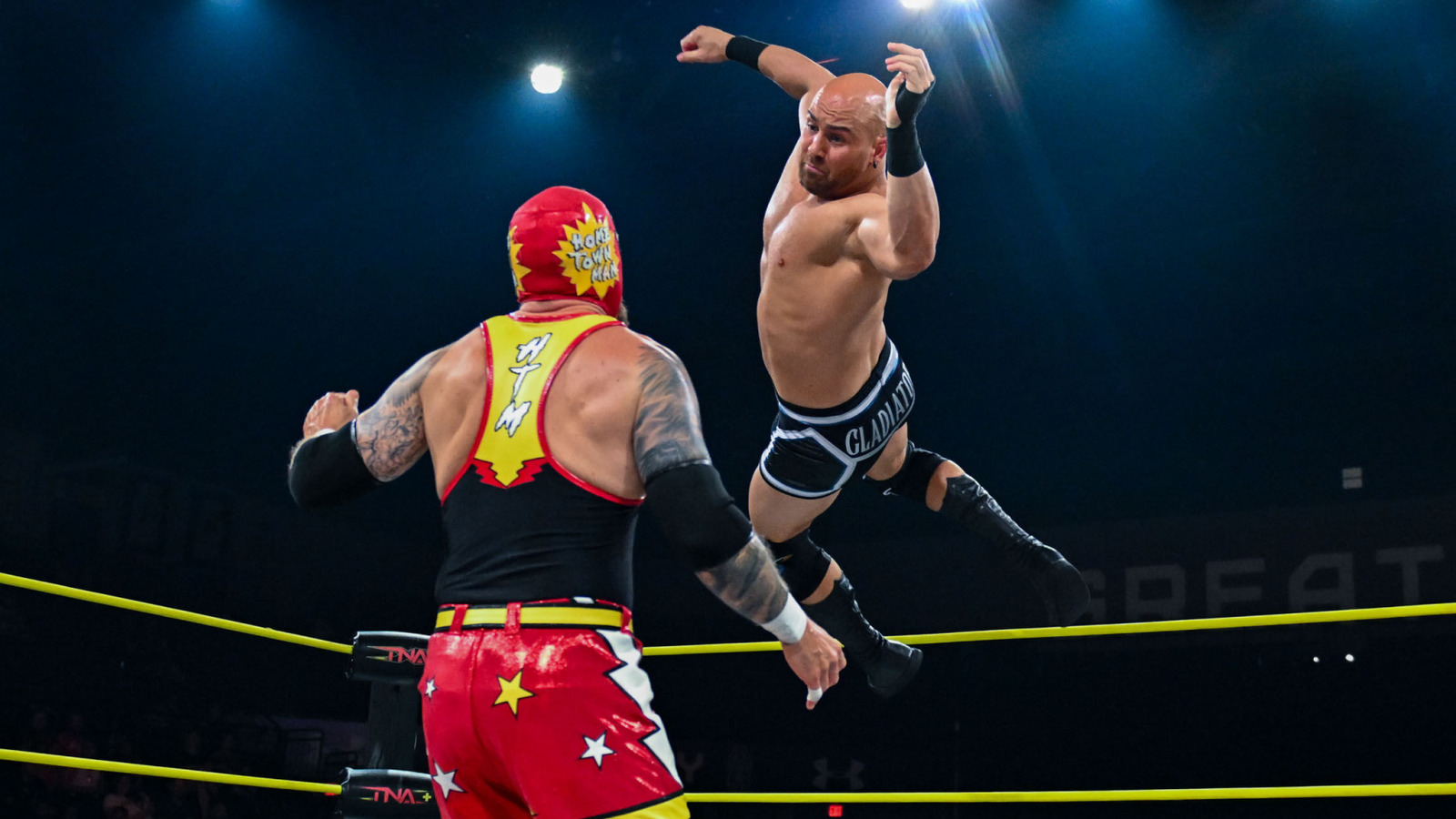
The TNA X-Division has long existed as a haven for gravity-defying flyers. For decades, the division built its reputation on triple-jump springboards, corkscrew planchas, and frantic, breath-free sequences. Yet, the physical reality of the modern game demands something sturdier.
Cedric Alexander currently sits atop this division, representing the peak of athletic fluidness. He moves with a grace that makes complex aerial maneuvers look effortless. But his reign now faces a structural threat that cannot be outflown.
On the July 2 broadcast of TNA Impact, Fabian Aichner secured a shot at Alexander’s title by outlasting five other competitors in a grueling scramble. The Italian powerhouse brings a completely different physical profile to the title picture. He does not seek to fly over his opponents; he prefers to run straight through them.
This transition marks a fascinating tactical evolution for TNA. Instead of pitting two similar speedsters against each other, the promotion is setting up a classic clash of styles. It is a collision between speed and kinetic force.
Deconstructing the Six-Way Scramble
Multi-man scramble matches are notoriously difficult to control. They lack the linear structure of singles contests, often devolving into a sequence of isolated stunts. To survive, a wrestler must possess exceptional spatial awareness and tactical patience.
Aichner demonstrated these traits perfectly during the scramble. While younger competitors exhausted themselves with high-risk dives to the floor, Aichner anchored the center of the ring. He cut off angles and conserved his energy for high-impact interventions.
His positioning was highly disciplined. Every time an opponent attempted to build momentum off the ropes, Aichner was there to disrupt the line of running. He neutralized speed with simple, brutal body checks and short-arm clotheslines.
The final sequence showed his tactical efficiency. Rather than chasing a flashy finish, he capitalized on a collision between two other competitors to isolate his target and execute a thunderous powerbomb. It was a masterclass in economy of movement.
The Mechanics of Ring Control
Watch Aichner during multi-man matches. He rarely wanders to the apron or climbs the turnbuckles unless it is to deliver a finishing blow. He understands that the center of the ring offers the shortest distance to intercept any run.
By occupying this central space, he forces the other five competitors to work around him. This effectively shrinks the canvas for everyone else. They are forced to take wider paths, which increases their transit time and makes their attacks predictable.
During the match on TNA Impact, this ring-generalship was highly evident. While others flew, Aichner stood firm, waiting for the inevitable descent. His win was not a matter of luck, but of superior ring geometry.
Aichner’s Hybrid Offensive Profile
To label Aichner as a mere powerhouse is to misunderstand his arsenal. He weighs a solid 220 pounds, but he possesses the agility of a cruiserweight. This combination makes him uniquely dangerous in a division built on speed.
His offensive system is built around explosive vertical power. He can transition from a deadlift German suplex straight into a running corner dropkick. This sudden acceleration catches opponents off guard, especially those used to predictable aerial trajectories.
He also utilizes a devastating springboard moonsault. Unlike lighter wrestlers who use the ropes to float, Aichner uses them to launch his mass with terrifying velocity. The impact is heavy, crushing the wind out of anyone underneath.
This hybrid style was honed during his years in the European independent scene. He understands how to pace a match to maximize the impact of his power moves. He does not waste motion.
However, Aichner's career has not been without its tactical flaws. During his run in NXT as Giovanni Vinci, his style occasionally became too mechanical, constrained by the rigid TV formatting of the performance center. He sometimes prioritized presentation over raw competitive urgency, a habit he must shed in TNA.
The Math of the Powerbomb
Aichner’s signature powerbomb is not just an exclamation point; it is a tactical weapon. When he catches an opponent mid-air, he is converting their forward momentum into downward force. The physics are simple and devastating.
In his EVOLVE matches, Aichner frequently used this counter against high-flying champions. By catching a crossbody and stepping into a fallaway slam or powerbomb, he neutralizes the opponent's main offensive tool. The psychological damage is as severe as the physical impact.
Against Alexander, this counter will be the central focus of the match. If Alexander cannot launch safely, his entire offensive gameplan collapses. Aichner knows this and will be baiting the champion to take flight.
The Evolution of X-Division Style
Historically, the X-Division was defined by the slogan that it was not about weight limits, it was about no limits. Yet, over the years, the division drifted into a repetitive cycle of cruiserweight spot-fests. The physical diversity that once defined its golden era began to disappear.
When Samoa Joe held the title, he brought a lethal blend of kickboxing and heavyweight power that forced flyers to change their approach. He did not match their speed; he punished their mistakes with bone-breaking submissions. This is the blueprint Aichner must follow.
Aichner’s presence at the top of the card is a reminder of those classic Samoa Joe and AJ Styles wars. He provides the necessary physical resistance that makes the flyers' offense look heroic. Without a credible threat of violence, high-flying wrestling becomes a choreographed dance.
Rebuilding the Division’s Identity
In recent months, TNA has struggled to maintain the X-Division's prestige, often booking short, chaotic matches that fail to tell a coherent story. The matches have felt less like athletic contests and more like exhibitions of stunt work. This lack of structure has hurt the division's drawing power.
A long, physical program between Alexander and Aichner can correct this course. It gives the title a narrative anchor that has been missing. It forces the audience to invest in the struggle for control, rather than just waiting for the next dive.
The success of this program depends entirely on how Aichner is presented. If he is booked as a generic heel who stalls and cheats, the opportunity will be wasted. He must be presented as a legitimate athletic threat whose style is simply more efficient.
Where Cedric Alexander Drifts
Cedric Alexander is a spectacular champion, but his defensive habits contain visible flaws. He relies heavily on his agility to escape trouble. When faced with a relentless press, he tends to retreat to the ropes, looking for a springboard counter.
This reliance on the ropes is a dangerous habit against Aichner. The challenger excels at cutting off the ring and trapping opponents in the corners. If Alexander attempts his signature Neuralizer, he risks being caught mid-air and driven into the canvas.
Alexander also struggles when his pace is forced down. In his recent title defenses, he has looked most vulnerable when opponents ground him with submission holds. He has a habit of letting his focus drift during slower, mat-based segments.
By applying pressure to Alexander’s ribs and lower back, Aichner can strip away the champion's launch power. A wrestler cannot execute a Lumbar Check if his own spine is battered. The tactical blueprint for Aichner is simple: ground the flyer and break the base.
We saw this vulnerability in Alexander’s past matches against technical specialists. When his opponent refuses to run, Alexander’s output drops. He becomes passive, waiting for a transition that may never come.
Analyzing the Springboard Success Rate
Statistically, Alexander relies on springboard attacks for nearly 30 percent of his offensive transitions. When those attacks are shut down, his win rate drops significantly. He becomes reliant on desperate roll-ups or high-risk counters.
Aichner's primary defensive goal will be to contest the ropes. By occupying the apron or staying within arm's reach of the ropes, Aichner can prevent Alexander from finding his footing. This forces the champion to wrestle a flat-footed match.
A flat-footed Cedric Alexander is a beatable Cedric Alexander. Without the momentum of the ropes, his strikes lose their snap and his evasive maneuvers become sluggish. Aichner has the wrestling IQ to force this scenario.
The Booking Risk for TNA
While this matchup promises excellent in-ring quality, TNA must avoid a common booking pitfall. Powerhouse versus flyer dynamics can easily become formulaic. If the match degenerates into a basic heat segment with Aichner slowly grinding Alexander down for ten minutes, the crowd will lose interest.
The pace must remain high. Aichner’s power is most impressive when it is dynamic, not static. The contest needs to feel like a high-speed chase where the hunter is just as fast as the prey.
There is also the question of post-match momentum. The X-Division has occasionally suffered from short-term booking decisions that fail to build long-term stars. Whoever wins this clash must carry the division forward with a clear, defined identity.
Aichner represents a chance to redefine what the division means in 2026. He offers a bridge between the high-flying past and a more physical, athletic future. The championship match must reflect this potential.
The risk is that TNA plays it too safe. They might write a standard outside-interference finish to protect both men. That would be a booking error that leaves fans unsatisfied.
The Blueprint for the Title Clash
For Aichner to capture the title, he must dictate the physical terms of the engagement immediately. He cannot allow Alexander to find a rhythm. Early European uppercuts and hard Irish whips into the turnbuckles will set the tone.
Alexander, conversely, must use lateral movement. He cannot engage Aichner in a test of strength. He must use low kicks to target Aichner's knees, slowly chipping away at the challenger’s vertical base.
The match will likely be decided in the air, but not in the way fans expect. The decisive moment will come when Alexander attempts a high-risk maneuver and Aichner counters with pure, raw power. That split-second collision will determine the future of the X-Division.
Aichner has earned his spot through survival. As reported on Wrestling Inc, he must now prove that his physical style can dominate the most athletic division in wrestling. The stage is set for a classic encounter.
Funko Pop! WWE: Roman Reigns (Wreck Everyone) Amazon Exclusive
Acknowledge your Tribal Chief in vinyl form.
Frequently Asked Questions
How did Fabian Aichner earn a shot at Cedric Alexander's title?
What wrestling style does Cedric Alexander represent in the X-Division?
How did Fabian Aichner control the ring during the TNA Impact scramble?
When did Fabian Aichner secure his title shot against Cedric Alexander?
What move did Fabian Aichner use to win the scramble match?
More Coverage

TNA is rushing Xia Brookside and Lei Ying Lee into a No DQ rematch
2 hours agoTNA's post-Slammiversary fallout is proof they still can't help themselves
2 hours ago
Top 10: Top Moments
5 hours agoTNA's new Knockouts tournament is already drowning in bad booking
6 hours ago
Why Jeff Jarrett's TNA defense is facing a major television test
12 hours ago
Mike Santana is heading to WWE, but the main roster is a different beast
14 hours agoMore Analysis
Marty Jannetty's amputation shows the true cost of the Rockers style
2 hours ago
Top 10: Top Moments
2 hours ago
TNA is rushing Xia Brookside and Lei Ying Lee into a No DQ rematch
2 hours agoSami Zayn's Undisputed Championship reign can't just be a feel-good fluke
2 hours ago