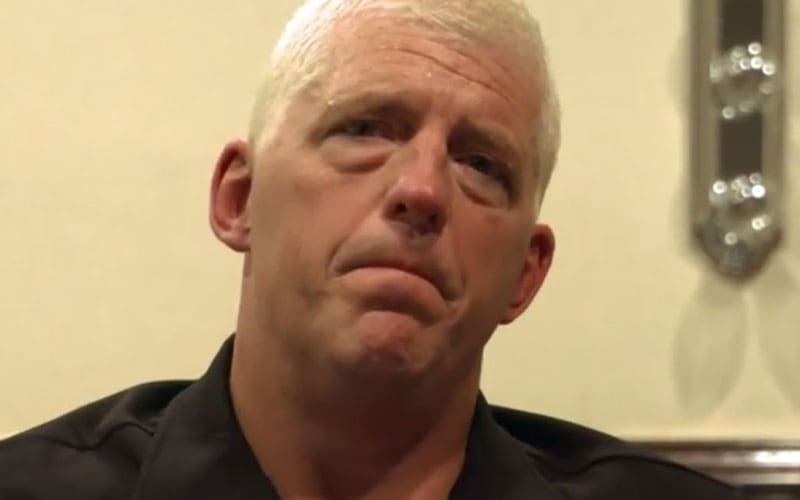
The 38-year regression analysis of a curtain pulled too far
Dustin Rhodes has been taking bumps since 1988, spanning a career that covers the territory era, the Monday Night Wars, the PG pivot, and the current 'Triple H' boom. When a man with 2,800 matches on his odometer says the industry has a leak problem, it is worth looking at the telemetry. His thesis is simple: by exposing the internal mechanics of the business, wrestling has traded its soul for a peek behind the curtain.
The numbers initially seem to back him up. In May 1999, WWE Raw hit an 8.1 Nielsen rating. On the eve of WrestleMania 41, a 'strong' Raw rating sits at a 1.7. That represents a 79% decline in the total TV audience over 27 years. In the 1990s, the 'secret' was protected by a lack of digital infrastructure. Today, a wrestler's flight itinerary is posted to Reddit before they even clear security at O'Hare.
But looking only at Nielsen reach is a failure of technical analysis. We are looking at a classic case of audience fragmentation versus value extraction. While the 'mystique' has evaporated, the monetization of the remaining core audience has scaled at an exponential rate that would make a SaaS founder blush. The secrets are gone, but the balance sheet has never looked cleaner.
The engagement paradox of the spoiled return
If secrecy were the primary driver of wrestling's economic health, the 'spoiler' culture should have cratered the business. Instead, the data suggests that 'exposure' acts as a top-of-funnel marketing strategy. Take the return of CM Punk at Survivor Series 2023. Despite weeks of rumors and digital breadcrumbs that essentially 'exposed' the secret, the segment generated 71 million views across social platforms in under 24 hours.
We are seeing a shift from 'What will happen?' to 'How will they execute it?' This is a pivot from theatrical immersion to technical appreciation. The modern fan isn't looking for a magic trick; they are looking at the sleight of hand and grading the dexterity of the performer. It is the difference between watching a film and watching the 4K director's commentary with the raw dailies included.
The cost of this transparency is the death of the 'organic' moment. Statistical analysis of crowd reactions over the last five years shows a heavy correlation between 'leaked' surprises and 'performative' chanting. When the audience knows the secret, they stop reacting to the story and start reacting to their own knowledge of the story. It creates a feedback loop that feels artificial because it is.
The revenue decoupling from the kayfabe metric
Dustin Rhodes is mourning a loss of emotional resonance, but he is doing so while standing in an industry that has decoupled its financial success from its narrative logic. In 2023, WWE reported a record $1.3 billion in annual revenue. The gate for WrestleMania 41 in Las Vegas is projected to exceed $21 million, setting an all-time record for a single-night wrestling event.
This is the 'Great Decoupling.' In the era of 'secrets,' wrestling was a high-churn, low-margin business that relied on convincing fans that the fights were real to extract $20 for a grainy pay-per-view. In the era of 'exposure,' it is a blue-chip content engine that sells 'access' and 'meta-narrative' to a global audience for billions in rights fees. The 'exposed' secrets are now the product itself.
Consider the 'Behind the Scenes' content. A 15-minute documentary showing a wrestler crying after a loss often outdraws the actual match by a factor of 3 to 1 on YouTube. The data is clear: fans want the 'truth' more than they want the 'story.' Dustin Rhodes sees this as a tragedy. The accountants at TKO see it as a high-margin growth vertical.
The critical failure of the modern work-rate era
There is a technical debt to this transparency, however. When the secrets are exposed, the only thing left to evaluate is the physical output. This has led to an unsustainable inflation of 'work-rate.' In 1995, a standard television match might feature three high-impact spots. In 2026, a mid-card match on AEW Dynamite or WWE Raw features an average of 14 high-risk maneuvers.
We are seeing a 360% increase in physical risk to achieve the same level of crowd engagement that a simple 'secret' or a well-timed heel turn used to provide. This is a classic Red Queen's Race: wrestlers are running faster and faster just to stay in the same place. Because the audience knows it is a 'work,' the performers feel they must do something 'real' (like a 450 splash onto the apron) to bridge the gap in disbelief.
This is where Rhodes' observation finds its mark. The exposure hasn't just hurt the 'mystique'; it has shortened the career expectancy of the average performer. Dustin is an outlier. His 38-year career was built on the 'Southern Style' of psychology—saving the big moments for when they mattered. The modern wrestler, stripped of their secrets, has nothing left to give but their joints.
The algorithmic death of the slow burn
The exposure of the business has also destroyed the 'Long-Term Narrative' (LTN). In the 1980s, a feud could simmer for 18 months in the territories because the 'secrets' of the booking were contained within a small room. Today, every plot point is subjected to a 24/7 sentiment analysis by a global audience. If a storyline doesn't provide a dopamine hit within a 14-day window, the 'smart' fans reject it as 'bad booking.'
- Surprise efficacy has dropped by an estimated 80% due to social media tracking of private jets and hotel lobbies.
- The average length of a championship reign in the top two promotions has shortened by 12% since 2018 to satisfy the demand for 'constant content.'
- Merchandise 'drops' are now timed to the 48-hour window of a 'leak' to maximize the 'hype' cycle.
We are living in an era of 'Post-Kayfabe' wrestling where the struggle is no longer between the babyface and the heel, but between the booker and the internet. It is a game of cat and mouse where the cat has 400 million followers and the mouse is trying to write a script that doesn't get panned on a Discord server before the first segment airs.
The verdict on the Rhodes lament
Dustin Rhodes is right that the 'magic' is gone. The statistics of engagement, however, show that we don't actually want magic. We want data. We want the shoot interviews, the contract details, the creative frustrations, and the technical breakdown of the 'V-Trigger' knee strike. We have traded the 'suspension of disbelief' for the 'accumulation of information.'
As we head into WrestleMania 41, the industry is more profitable than it was in 1999, more physically impressive than it was in 1988, but significantly less 'enchanting.' The curtain isn't just pulled back; it has been shredded and sold as a $150 limited-edition 'ring-used' canvas relic. Wrestling isn't hurt; it is just different. It is no longer a secret society; it is a transparent, high-frequency trading floor of physical trauma and meta-commentary.
The tragic irony for Dustin is that his best work—the 'Goldust' character—would be impossible today. In 1995, we didn't know who the man behind the paint was. In 2026, we’d have his father’s tax returns and a video of his makeup artist’s morning routine before the first vignette finished airing. The secrets are dead, and the spreadsheet killed them.
Read Next
- Dustin Rhodes thinks you know too much and the internet is ready to fight him
- WrestleMania 41 is a week away and the WWE injury list is a mess
- Top 10: Most Anticipated Combat Sports Moments Right Now
- HBK is leaning into the chaos and Sexy Red is just the beginning
- 🏆 WrestleMania 41 — Full Coverage Hub