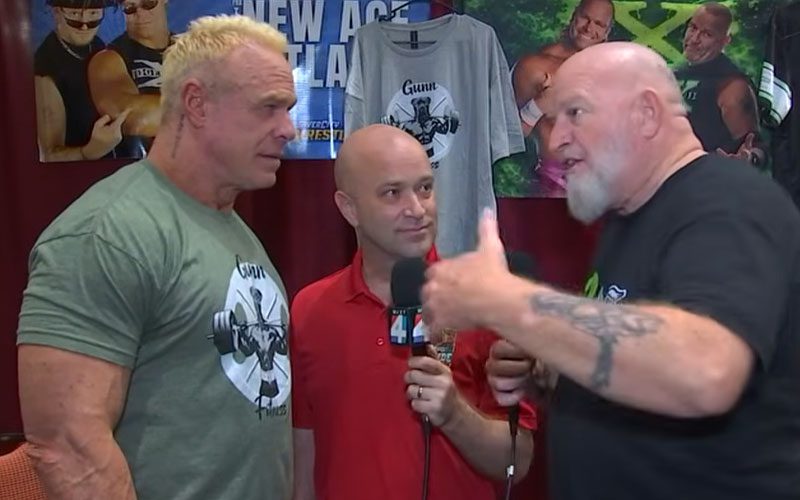
Billy Gunn is still the most improbable success story in wrestling history

The Man Who Refused to Fade Out
Billy Gunn shouldn't be here. By every traditional logic of the professional wrestling business, a man who debuted as a literal cowboy in 1993 should be long retired, perhaps making occasional appearances at regional conventions to sign 8x10s of the Smoking Gunns. Instead, at age 60, Gunn is arguably more popular than he was during the peak of the Attitude Era.
His current run in AEW alongside The Acclaimed isn't just a nostalgia act. It is a masterclass in career longevity and reinvention. While his contemporaries have moved into coaching, podcasting, or retirement, Gunn is still taking bumps and looking like he was sculpted out of granite. He is the bridge between the cartoonish 90s and the hyper-athletic modern era.
But to understand the 'Daddy Ass' phenomenon, you have to look back at the friction that defined his early career. Gunn recently reflected on his time in WWE, specifically mentioning that he often found himself in hot water with Vince McMahon. It is a recurring theme for a man who made his name by breaking the rules on and off the screen.
The Trouble with Being a Bad Ass
The transition from Sunny's cowboy partner to the 'Bad Ass' of D-Generation X was the turning point for Gunn's career. It was during this period that his sense of humor often clashed with the corporate structure of the WWE. Gunn noted that one of the funniest moments of his career actually got him in significant trouble with McMahon.
While he didn't specify the exact incident in his recent comments, anyone who watched the 1998-1999 run knows the list of suspects. Whether it was the literal mooning of the audience or the chaotic 'DX invades WCW' segments, Gunn was always the loose cannon. He lived the gimmick in a way that often made management nervous.
That rebellious streak was essential for the New Age Outlaws' success. Road Dogg handled the microphone, but Billy was the physical powerhouse. He provided the athleticism that allowed the team to hold the tag division together while Stone Cold and The Rock handled the main events. He was the workhorse of the most popular faction in history.
The 1999 Misstep and the Ceiling of Stardom
However, no career is without its flaws, and Gunn's solo push remains a point of contention for historians. Winning the 1999 King of the Ring should have been his ticket to the main event. Instead, it became a case study in how not to build a top-tier star. The momentum was there, but the booking was hollow.
The follow-up feud with The Rock exposed Gunn's limitations at the time. He was a phenomenal athlete, but he couldn't match the charisma of 'The Great One' on the mic. The infamous 'God, it's me, Billy' promo from The Rock effectively ended Gunn's chances of becoming a world champion. It was a brutal, public dismantling of his character's credibility.
This is where the critical eye must land. For all his physical gifts, Gunn often struggled when the spotlight was solely on him. He was a world-class tag team wrestler who felt like a fish out of water in the heavy-weight singles landscape. The 'The One' Billy Gunn era in 2000 was a generic, uninspired attempt to fix what had already been broken.
The Reinvention and the Pink Trunks
If the 1999 push was the floor, the 2002 run as part of Billy & Chuck was the redemption. It was a risky, controversial angle that required Gunn to lean into a completely different persona. Wearing the bleached blonde hair and the coordinated outfits, he showed a level of character work that many thought he lacked.
The duo's victory at Judgment Day 2002 for the tag titles was a high point, but the 'wedding' segment on SmackDown remains a polarizing moment in TV history. It was a stunt that didn't age well, yet it proved Gunn was willing to do anything for the job. He was a corporate soldier who was still getting in trouble for the sake of entertainment.
After leaving WWE, Gunn's journey through the independent circuit and TNA was standard veteran fare. He could have easily coasted on his name. Most wrestlers from his era did. But Gunn stayed in the gym, stayed sober, and waited for the right opening to prove he wasn't finished.
The Acclaimed and the Third Act
When AEW launched, Gunn was brought in primarily as a coach. It made sense. He had years of experience in the WWE system and a wealth of knowledge to share with the younger roster. But the fans didn't want him behind the curtain. They wanted the man who could still hit a Fameasser with the same snap as he did in 1998.
Pairing him with Max Caster and Anthony Bowens was a stroke of genius. It gave the young team a legendary enforcer and gave Gunn a new identity. The 'Daddy Ass' moniker started as a joke, but it quickly transformed into a legitimate marketing machine. The trios match at All In 2023 was the culmination of this bizarre, brilliant journey.
Walking out in front of 81,035 fans at Wembley Stadium, Gunn looked like he belonged. He wasn't a relic being trotted out for a cheap pop. He was an integral part of the match, moving with a fluidity that mocked his 60 years of age. When they won the Trios Championships, it felt earned rather than gifted.
The Technical Edge of a Veteran
Watching Gunn work today is an education in economy of movement. He doesn't waste steps. His tilt-a-whirl slam is still one of the most aesthetically pleasing moves in the business. He knows exactly when to tag in, how to sell for a smaller opponent, and how to milk a crowd reaction for everything it's worth.
His finisher, the Fameasser, is a perfect example of his reliability. It's a move that requires timing and trust. Gunn has hit it thousands of times without injuring a single opponent. In an era where 'work rate' is often measured by how many dangerous head-drops a wrestler can take, Gunn's safe, impactful style is a breath of fresh air.
He also understands the 'big man' psychology better than most. He doesn't try to be a cruiserweight. He uses his height and reach to dominate, making the eventual comeback of the babyface feel significant. It's the kind of veteran presence that you can't teach in a warehouse; it has to be lived through decades of road loops.
The Necessary Critique: Is There a Limit?
Despite the success, there is a valid criticism to be made about the 'Daddy Ass' gimmick. At what point does the comedy overshadow the wrestling? There have been weeks where the segments felt repetitive, leaning too heavily on the scissoring catchphrase and not enough on the stakes of the division. The Acclaimed run has occasionally stalled because the act is so focused on the entrance that the matches feel like an afterthought.
There is also the question of when to step away. Wrestling history is littered with legends who stayed three years too long. While Gunn looks incredible, the physical toll of a thirty-year career is unavoidable. Using a veteran to get young talent over is the right move, but it shouldn't come at the cost of the division's competitive fire.
The booking of the Trios titles has been inconsistent at best. Gunn's presence adds star power, but it also creates a vacuum where other young teams struggle to find airtime. It's a delicate balance that AEW has struggled to maintain as the roster continues to expand with younger, faster performers.
The Legacy of the Outlaw
Billy Gunn is a survivor. He survived the drug-fueled chaos of the 90s, the corporate restructuring of the 2000s, and the shifting tastes of the modern audience. He is one of the few men who can claim to have been a top star in both the Attitude Era and the current AEW revolution.
His recent admission about getting in trouble with Vince McMahon is a reminder of why we liked him in the first place. He was never the 'chosen one' like John Cena or Triple H. He was the guy who stayed up late, made the jokes he wasn't supposed to make, and worked harder than anyone else to stay relevant.
Whether he's mooning a crowd in 1998 or scissoring a tag partner in 2024, Billy Gunn remains a constant. He is proof that if you stay in shape, keep your sense of humor, and ignore the people telling you to retire, you can find a second life in the most unpredictable business in the world. He is the Bad Ass, the One, the Cowboy, and finally, the legend he was always meant to be.
Funko Pop! WWE: "The American Nightmare" Cody Rhodes #152
The heir to the throne, ready to finish the story on your shelf.
Frequently Asked Questions
When did Billy Gunn first debut in professional wrestling?
Why did Billy Gunn often get into trouble with Vince McMahon?
How did the feud with The Rock impact Billy Gunn's career?
What is Billy Gunn's current role in AEW?
What role did Billy Gunn play within the New Age Outlaws?
More Coverage

Brock Lesnar and Oba Femi are playing with fire before SummerSlam
an hour ago
Top 10: The Definitive Ranking of Mid-Year 2026 Wrestling Moments
an hour agoWWE RAW Hit-and-Miss: Bron Breakker Demolishes, But Promo Parades Need to Die
an hour ago
Danhausen's WWE status sparks wild speculation after RAW appearance
an hour ago
Steve Maclin and Sami Callihan are leaving TNA and AEW is ready to pounce
an hour ago
Top 10: Defining Wrestling Moments of the Modern Era
an hour agoMore Match Reports
Billy Gunn is still outrunning time while the Outlaws legacy hits a dead end
2 months, 3 weeks ago
Simon Gotch and Billy Gunn are about to show the cost of staying in the ring
3 days, 13 hours ago
Billy Gunn just killed the dream of a New Age Outlaws reunion
2 months, 3 weeks agoFTR vs Gunn and Rhodes at Dynasty is going to steal the damn show
3 months, 3 weeks ago