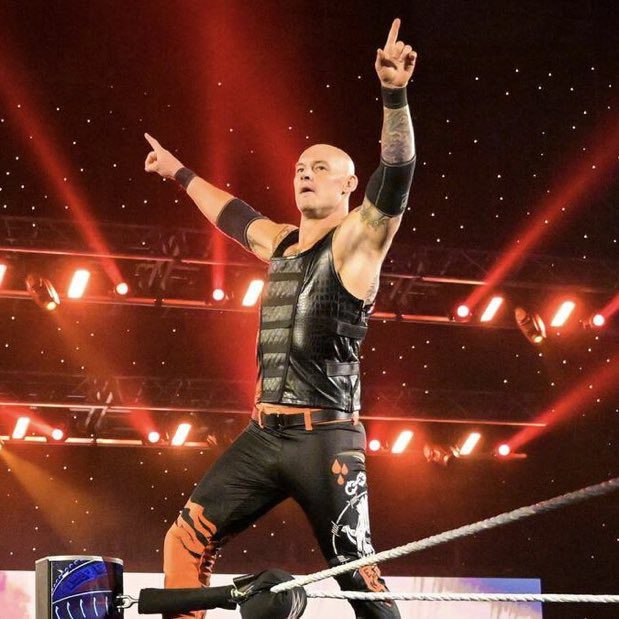
Life outside the WWE bubble
There is a stark contrast between the bright lights of Allegiant Stadium and a local gymnasium floor. In exactly 23 days, WWE will roll into Las Vegas for WrestleMania 41. The card is stacked. The production will be immaculate. Tom Pestock will not be there.
Instead, the man formerly known as Baron Corbin spent his week competing on the mat. He didn't just compete. He dominated.
According to WrestleTalk, Pestock recently captured his second championship in a Brazilian Jiu-Jitsu competition. He did it quietly. There were no pyro entrances or scripted promos. It was just a massive athlete applying heavy top pressure and securing submissions.
This is the reality of life after the WWE machine. For some, the release is a death knell. For others, it is an immediate return to their athletic roots. Pestock has clearly chosen the latter.
The hidden pedigree
It is easy to forget who Pestock actually is. WWE television spent a decade telling you he was a cowardly heel, a disgruntled constable, or a down-on-his-luck gambler. The presentation actively worked against his reality.
Before he ever stepped into the Performance Center, he was an offensive lineman. He spent time with the Indianapolis Colts and the Arizona Cardinals. You do not survive in an NFL training camp without elite footwork and explosive power.
He was also a three-time Golden Gloves boxing champion. That legitimate striking background was rarely utilized in his wrestling matches. Instead, he threw standard working punches and relied on typical heel offense.
His transition to BJJ makes perfect sense. Standing at six-foot-eight and weighing over 270 pounds, his physical attributes are a nightmare for opponents in the super-heavyweight divisions. He holds a tremendous mechanical advantage. Once he establishes side control, escaping is physically exhausting.
Translating the squared circle to the mat
Look at his signature professional wrestling offense. The End of Days requires immense core strength to pop an opponent up and pull them down simultaneously. The Deep Six relies entirely on hip torque and rotational balance.
Those aren't just flashy moves. They are biomechanical indicators of a strong grappling foundation. When you watch a big man hit a fluid Deep Six, you are watching someone who understands weight distribution.
In competitive BJJ, that translates directly to takedown defense and scrambling ability. Pestock isn't going to pull guard. He is going to force you backward, tie up your upper body, and drag you to the floor.
The psychology of the Deep Six
Consider the mechanics of the Deep Six. In a traditional WWE match, it is used as a transition or a near-fall. But watch how Pestock executes it. He steps across the opponent's body, trapping their arm.
He uses his hips as a fulcrum to launch them into the air. In a real grappling exchange, that exact footwork translates to an Osoto Gari or a Harai Goshi. The muscle memory is already there.
For years, fans complained that his matches lacked pacing. But his pacing was entirely dictated by producers yelling into the referee's earpiece. They wanted him to slow down, apply a generic chin-lock, and wait for the babyface to rally.
Real grappling doesn't have a comeback spot. When Pestock takes you down in a BJJ tournament, he doesn't pause for dramatic effect. He immediately starts hunting for the collar or isolating an arm. This fundamental difference in philosophy explains why he always felt slightly out of place during the climax of a WWE main event.
Where creative failed
This BJJ success highlights a glaring flaw in modern WWE character development. They had a legitimate heavyweight fighter on the roster. They chose to dress him in a fedora and suspenders.
The original "Lone Wolf" gimmick of his early NXT and main roster run had potential. He looked like a killer. He moved like a killer. Then the corporate rebranding began.
Making him "Constable Corbin" was a tactical error. It stripped away his athletic menace. It forced him to wrestle in a button-down shirt and dress pants. You cannot sell a man as a dangerous combatant when he looks like a shift manager at an Applebee's.
The "Sad Corbin" storyline was entertaining television. Pestock fully committed to the bit. He wore stained shirts and begged for money. But it permanently damaged his credibility as a main-event threat.
Think back to his feud with Seth Rollins in 2019. It was a tedious, meandering storyline that culminated in a mixed tag team match. Pestock was positioned as a generic heel. He yelled at the crowd. He used cheap tricks.
Imagine if WWE had allowed him to use his Golden Gloves background to legitimately batter people in the corner, followed by a high-level Judo throw. They built a system where a legitimate badass had to pretend to be a coward. That is the ultimate indictment of WWE's creative process during that era.
The lineage of the shoot-style big man
Professional wrestling has a long, complicated history with legitimate combat sports. The bridge between the two is narrow. Very few massive men cross it successfully.
Brock Lesnar is the obvious gold standard. He utilized his Division I amateur wrestling pedigree to shatter the UFC heavyweight division. Bobby Lashley followed a similar path, relying on explosive double-leg takedowns to build a respectable MMA record.
Pestock is walking a slightly different path. He isn't stepping into a cage to trade four-ounce gloves. He is putting on a gi, or competing no-gi, in the highly technical world of Brazilian Jiu-Jitsu.
This requires a level of patience that is entirely foreign to the scripted pacing of a WWE match. In wrestling, you are taught to give your opponent space. You bump, you feed, you create visual separation.
In competitive grappling, space is your enemy. You suffocate the opponent. You remove the very gaps that professional wrestling relies on. The fact that Pestock can rewire his brain to suppress a decade of sports entertainment habits is remarkable.
The reality of cross-training
Wrestling full-time for WWE destroys the body. The travel schedule is brutal. The bump card fills up fast. Finding time for legitimate martial arts training is nearly impossible while on the road four days a week.
This is why you rarely see active WWE stars competing in legitimate tournaments. The injury risk is too high. The time commitment is nonexistent.
Pestock's immediate success in BJJ suggests he was likely training in secret during his final years with the company. Or, more impressively, he picked it up rapidly during his recent NXT stint where the travel schedule was significantly reduced.
Grappling requires a different kind of cardio. Professional wrestling is about explosive bursts and pacing. BJJ is about sustained isometric tension. Transitioning between the two energy systems at his size is incredibly demanding.
A look at the heavyweight division
Heavyweight BJJ is not always pretty. It often devolves into slow, grinding matches dictated by whoever secures the first takedown. Sweeps are rare.
For Pestock, his strategy is likely simple but devastating. Use his NFL-honed base to prevent takedowns. Snap the opponent down. Secure top half-guard. Pass to mount.
Once a man that large flattens you out, the match is effectively over. He doesn't need complex leg locks. He just needs gravity and wrist control.
What comes next?
The timing of these BJJ victories is fascinating. The independent wrestling scene is thriving. Promotions are constantly looking for recognizable names who can still deliver in the ring.
AEW Dynasty is just 3 days away. While it is highly unlikely Pestock shows up in Kansas City, the broader point remains valid. The market for talent is incredibly hot right now.
AEW has built an entire division around physical, hard-hitting matches. The Continental Classic tournament proved that fans crave gritty, sport-based presentations. A reinvigorated Pestock, utilizing a heavy grappling style, would fit seamlessly into that environment.
Alternatively, the resurgence of GCW's Bloodsport events offers a tailor-made platform. Josh Barnett has curated an environment where professional wrestling and mixed martial arts bleed together.
Pestock stepping onto that canvas, stripped of the WWE gloss, would be a massive draw. Imagine him competing with no ropes, utilizing actual judo throws and Kimura traps.
There is also the international market. New Japan Pro-Wrestling loves massive foreigners with legitimate combat credentials. A tour of Japan could completely revitalize his career. He could follow the path of men like Matt Riddle or Samoa Joe, blending stiff strikes with grounded submission wrestling.
The final verdict
It is easy to dismiss Baron Corbin as a relic of the Vince McMahon era. Many fans view him as a big man pushed solely because of his size. That narrative is entirely false.
Pestock is a high-level athlete who survived a decade in the most cutthroat wrestling promotion on earth. Now, free from the constraints of scripted television, he is proving his physical legitimacy.
Winning two BJJ championships back-to-back is not a fluke. It requires immense discipline, massive ego-death, and a willingness to be tapped out by smaller men in the gym.
He walked away from the bright lights and found his competitive fire on a padded floor. The wrestling business hasn't seen the last of him. If he brings this grappling-heavy style back to the ring, he will be a massive problem for anyone standing across from him.
My prediction is simple. He signs a short-term deal with a major independent promotion by the end of May. He will debut a completely new, grounded submission style. The fans who mocked his WWE run will suddenly realize exactly how dangerous he has always been.