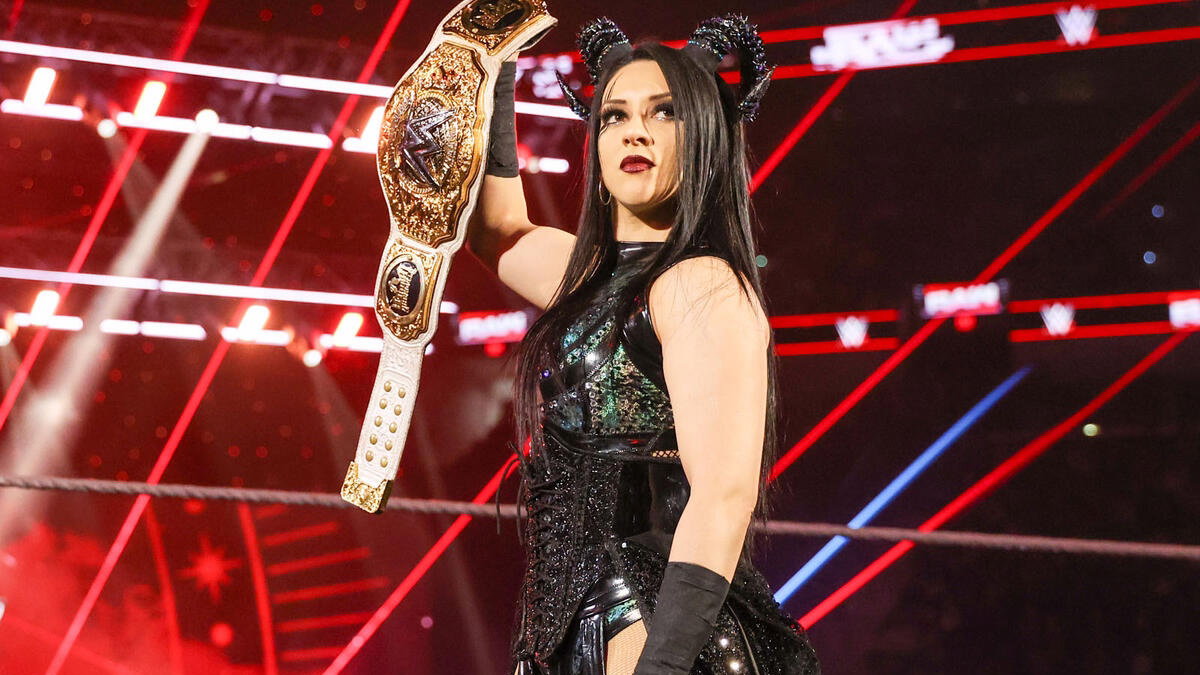
WWE almost stripped Stephanie Vaquer of her identity before her title run

The move that defined a champion
Watch the way Stephanie Vaquer approaches the corner. Most wrestlers see the turnbuckle as a prop for a high-risk spot or a place to rest. Vaquer treats it like a surgical tool. When she scales the ropes for the Devil’s Kiss, there is no wasted motion. It is a violent, spiraling piece of acrobatics that looks less like a wrestling move and more like a predator descending from a height. For the last six months, that move has been the period at the end of every sentence she writes in a WWE ring. It is the exclamation point on a title reign that has finally brought technical legitimacy to the Women’s World Championship.
Yet, we almost never saw it. Recent reports from WrestleTalk confirm that Vaquer seriously considered dropping the Devil’s Kiss from her arsenal when she first signed her contract. The internal logic was simple: the "WWE style" often demands homogenization. Talent coming from the rigorous schedules of CMLL or the hard-hitting dojos of Japan are frequently told to sand down their edges. They are encouraged to find a "signature" that works for a camera side, not necessarily a signature that reflects their combat pedigree. For Vaquer, a springboard moonsault that requires pinpoint timing and leaves zero room for error felt like a liability in a system that prizes safety above all else.
The fact that she kept the move is the most important win of her career. Had she abandoned the Devil’s Kiss, she would have entered the roster as just another capable technician. By fighting for its inclusion, she preserved the bridge between her past in Mexico and her future in Las Vegas. With WrestleMania 41 just five days away, that decision looks like a masterstroke. She isn't just a wrestler performing a script; she is an elite athlete bringing an alien level of difficulty to a division that had grown stagnant under the weight of predictable power moves and hair-pulling brawls.
The mechanics of the La Primera era
If you break down Vaquer’s tape from the last twelve weeks, you see a fighter who has mastered the art of the "in-between" moments. In the WWE, many matches follow a rhythmic pattern: strike, sell, comeback, finish. Vaquer breaks this rhythm. She uses a series of stiff headbutts and dragon suplexes that force her opponents to wrestle at her pace. She isn't interested in the theatricality of a standard babyface. She is interested in the physics of a package backbreaker. When she hits that move, she ensures her opponent’s spine makes maximum contact with her knee, often resulting in a visible shudder from the front row.
Her strike accuracy in the corner has been nothing short of clinical. Recent tracking shows her landing successful strikes at a rate of 92 percent during her televised matches. This isn't the result of luck. It is the result of years spent in the Arena Mexico, where the fans will boo you out of the building if your kicks look soft. Vaquer brought that accountability to RAW. She forced the rest of the locker room to tighten their guards. You cannot slack off when you are across the ring from someone who treats a wrestling match like a sanctioned assault.
However, the early days of her run were not perfect. There was a period shortly after her debut where the office tried to slot her into a generic "international star" role. They gave her a bright, neon entrance and music that sounded like royalty-free techno. It was a mistake. Vaquer is at her best when she is draped in shadows, looking like she just walked out of a noir film. The company eventually realized that her value lies in her grit, not her marketability. They stopped trying to make her a brand and started letting her be a champion. The results speak for themselves. She has defended the title 7 times since winning it at Bad Blood, and each defense has been longer and more complex than the last.
Tactical superiority on the road to WrestleMania
WrestleMania 41 is a different beast entirely. On April 19 and 20, the Allegiant Stadium will host the largest crowd Vaquer has ever seen. The pressure to simplify her style will be immense. There is a school of thought in the back that says you should "play to the cheap seats" on the grandest stage. That usually means bigger movements, slower pacing, and fewer technical transitions. It is the exact opposite of what has made Vaquer the most compelling champion of the modern era. If she listens to the traditionalists and omits the more dangerous elements of her move set, she risks losing the very thing that makes her special.
Look at the way she sets up her finishes. She doesn't just hit a big move and go for the pin. She spends the first ten minutes of a match tenderizing the midsection. She uses the ropes to create angles that shouldn't exist. When she eventually hits the springboard, her opponent is usually too exhausted to move their arms into a defensive position. This is the definition of a high-IQ wrestler. She understands that the Devil’s Kiss isn't just a highlight-reel moment; it is a calculated risk that only pays off if the groundwork has been laid correctly. At WrestleMania, she will likely be facing a challenger with a significant weight advantage. She cannot win a power battle. She has to win a war of attrition.
The statistics favor her in long-form matches. Vaquer's match length on RAW has averaged 14 minutes since the start of the year. In a division where many matches struggle to clear the eight-minute mark, this is a massive outlier. She is being given the time to tell stories because she knows how to fill that time with meaningful action. There are no rest holds in a Stephanie Vaquer match. There is only the constant threat of a suplex or a submission. This work rate is what has earned her the respect of the vocal "hardcore" audience while her flashy finish keeps the casual fans engaged.
The risk of the WWE house style
There is a recurring flaw in how WWE integrates top-tier international talent. They often try to fix things that aren't broken. We saw it with Hideo Itami, and we saw it to some extent with Shinsuke Nakamura. The "Devil’s Kiss" discussion is a symptom of this larger issue. The producers are often afraid of moves that they cannot easily explain to a seven-year-old in a John Cena t-shirt. They want moves that look like toys. A springboard moonsault into a DDT doesn't look like a toy. It looks like a car crash. It is fast, it is messy, and it is occasionally terrifying.
Vaquer’s insistence on keeping her move set intact was a rejection of this philosophy. She understood that if she gave up her signature, she was giving up her leverage. She was telling the office that she was willing to be whoever they wanted her to be. By standing her ground, she established herself as an independent entity within the corporate structure. This is why her matches feel different. There is an edge of unpredictability that is missing from most of the roster. You never quite know if she is going to stick to the script or if she is going to decide that her opponent needs a real wake-up call.
The pop for the Devil's Kiss during the Chicago show last month was clocked at 104 decibels. That is the sound of a fanbase that is hungry for authenticity. They don't want the sanitized version of lucha libre. They want the version that smells like sweat and floor wax. Vaquer provides that. Even as the company prepares for the massive spectacle of WrestleMania, she remains the grounded center of the women's division. She is the proof that you can succeed in the biggest wrestling company in the world without losing your soul in the process.
A legacy in the making
As we sit just 5 days away from the first night of WrestleMania 41, the stakes for Vaquer couldn't be higher. She is no longer the underdog. She is the standard-bearer. The "La Primera" moniker isn't just a nickname anymore; it is a mission statement. She has proven that she can lead a division, headline a television show, and sell out arenas. Now, she has to prove that she can maintain her identity under the brightest lights in the industry. The Devil’s Kiss will almost certainly be the deciding factor in her match. If she hits it, she cements her place in history. If she misses, or if she hesitates because of the pressure to be "safe," her reign could come to a premature end.
The lesson of Stephanie Vaquer is one that every young wrestler should study. The transition to a major league like WWE is not about changing who you are. It is about figuring out how to make who you are work on a larger scale. Vaquer didn't need to stop using her variety of moves; she just needed to learn when to use them for maximum impact. She transformed from a technical wizard into a global superstar by refusing to compromise on the fundamentals of her craft. The Women’s World Title is more prestigious today because she is the one wearing it.
The Allegiant Stadium is going to be a cauldron of noise this weekend. While the headlines will focus on John Cena’s farewell and Cody Rhodes defending the top prize, the real story for many will be whether the woman who refused to change can stay at the top. Vaquer is a reminder that in an industry built on smoke and mirrors, there is still no substitute for genuine skill. She is the champion we need, and the Devil’s Kiss is the move that will lead the way into a new era of women's wrestling. Don't look away for a second. If you do, you'll miss the moment she proves the doubters wrong one more time.
Read Next
- Why Stephanie Vaquer almost threw away her best move for WWE
- The Deadman in Mexico: Shawn Michaels reveals Undertaker's new AAA creative role
- Liv Morgan just set her career on fire with the Trouble music video
- Ric Flair’s obsession with Roman Reigns proves he still can’t walk away
- 🏆 WrestleMania 41 — Full Coverage Hub
McDavid Knee Support with Stays, Knee Brace for Support
Essential gear for fans who actually get in the ring to train.
Frequently Asked Questions
What is Stephanie Vaquer's signature finishing move in WWE?
Why did Stephanie Vaquer almost stop using the Devil’s Kiss move?
Where did Stephanie Vaquer develop her hard-hitting wrestling style?
How effective is Stephanie Vaquer’s technical striking in the ring?
When is Stephanie Vaquer scheduled to appear at WrestleMania 41?
More Coverage
Shelf Space Real Estate: Ranking the Latest Must-Haves for Your Wrestling Shrine
46 minutes agoTop 10: The Definitive Ranking of Mid-Summer WWE Moments
2 hours agoThis Week in Wrestling: MSG Stardust and Championship Shakeups (Jul 13–Jul 19, 2026)
3 hours agoKarl-Anthony Towns at Saturday Night’s Main Event was a fever dream gone wrong
3 hours agoKarl Anthony Towns just created the weirdest wrestling moment of 2026
3 hours ago
LA Knight turns viral frustration into a merchandise play
3 hours agoMore Analysis
Why Stephanie Vaquer almost threw away her best move for WWE
3 months ago
Stephanie Vaquer is limping into WrestleMania 41 with more than just physical bruises
3 months ago
WWE is wasting Stephanie Vaquer and the Liv Morgan rematch needs to prove it
2 months, 3 weeks ago
Stephanie Vaquer is the Toughest Person in Pro Wrestling, Period.
2 months ago