The Autumn Shift and the Loss of the Summer Safety Net
Professional wrestling booking relies on pacing, tension, and the threat of sudden interruption. When WWE announced that the 2026 edition of Money in the Bank would head to the Smoothie King Center in New Orleans on October 10, the immediate reaction focused on the city. New Orleans is a historic wrestling market, but the calendar placement is the real story here.
Moving this event to October represents the first time it has run after SummerSlam rather than before it. This structural change alters the entire second half of the year, dismantling the summer safety net that has defined the main event picture for a generation.
For more than a decade, the briefcase holder has served as a constant shadow over the summer champions. When the champion defends the title in a grueling physical contest, the threat of an immediate cash-in keeps the audience engaged. The contract holder can wait for the perfect moment of physical vulnerability.
We saw this strategy executed perfectly at SummerSlam last year. Seth Rollins waited until CM Punk was completely spent before cashing in his contract to take the World Heavyweight Championship. Now, that immediate threat is gone for the summer championships.
This scheduling change directly impacts the upcoming two-night SummerSlam in Minneapolis on August 1 and 2. Roman Reigns will defend his World Heavyweight Championship against Seth Rollins in a highly anticipated singles match. Under the previous calendar structure, the victor of this match would immediately have to scan the entry ramp.
The physical toll of a 25-minute championship match would normally leave the winner vulnerable to a fresh challenger. Without a contract holder in play, Reigns and Rollins can wrestle without defensive caution, which changes the psychology of the main event entirely.
The champion on the other brand benefits from this scheduling gap as well. Sami Zayn captured the Undisputed WWE Championship at Night of Champions on June 27, 2026. He won a triple threat match against Cody Rhodes and Gunther by rolling up Rhodes when the champion tried a high-risk maneuver.
The rollup pinfall occurred at the 22-minute mark of a highly physical encounter. Zayn is a champion who thrives on survival, but his high-impact style leaves him open to injuries and exhaustion.
The October scheduling delay gives Zayn a four-month grace period where he does not have to worry about a surprise cash-in. This safety net makes his reign feel less precarious, which hurts the weekly tension on SmackDown.
Historically, the threat of a cash-in has been used to cover booking dead ends. When a champion runs out of fresh challengers, the briefcase provides an instant narrative reset. By pushing the ladder matches to October, the creative team has left themselves without a fallback plan.
If Reigns or Zayn suffers an injury in August, there is no contract holder ready to step in and stabilize the title picture. This scheduling choice is a booking gamble that WWE did not need to take.
The Architecture of the Ladder Match: Risk vs. Efficiency
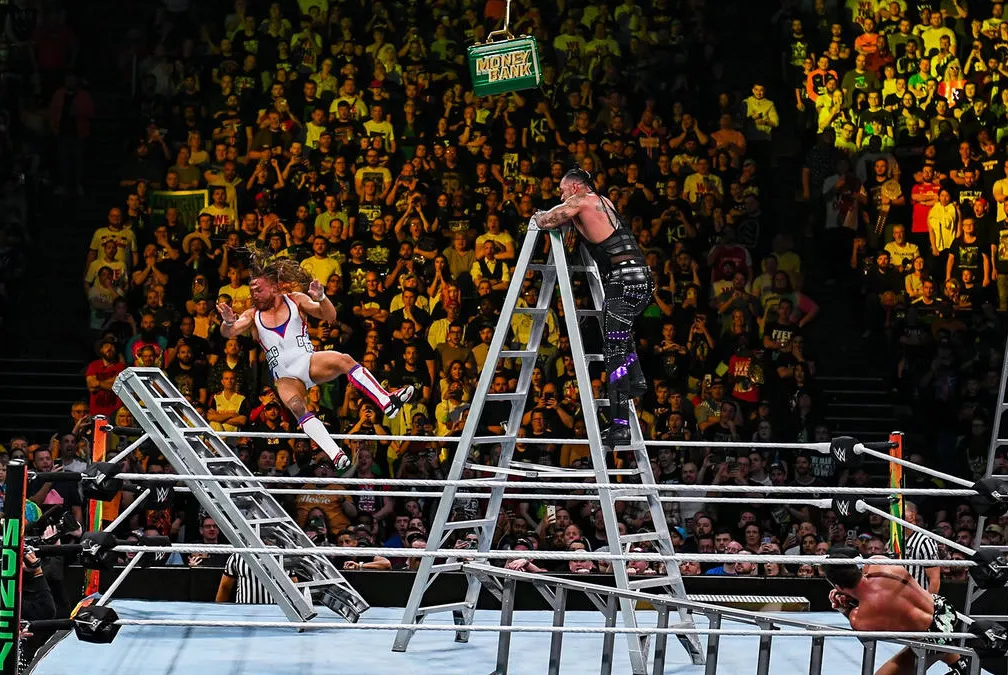
Writers and fans often treat ladder matches as mere exhibitions of high-flying stunts. They focus on the visual impact of the falls while ignoring the tactical structure of the match itself. As BodySlam's breakdown of the concept explains, the rules are simple: climb a ladder and retrieve the suspended briefcase.
But executing this simple objective in a ring filled with six or eight competitors requires disciplined pacing and strict space management. The match is won or lost in the recovery windows between high-impact spots.
Let's look at the numbers. Across the last ten men's ladder matches, the average duration has been exactly 24 minutes of active ring time. In those matches, competitors attempted an average of 4.2 climbs before the winning retrieval.
Wrestlers who attempt to climb the ladder during the first 12 minutes of the match have a success rate of zero percent. These early climbs are physically taxing and strategically useless. They serve only to draw defensive reactions from opponents, resulting in high-risk bumps that shorten a wrestler's active career.
The optimal strategy in a multi-man ladder match is defensive containment. A competitor should let their opponents take the high-risk falls on the floor while they control the center of the ring. A major tactical error in modern ladder matches is the premature clearing of the ring.
When all competitors spill to the outside to perform dives, the canvas is left empty. A disciplined wrestler will remain inside the ropes, using a smaller ladder as a physical barrier to block the climbing path. By wedging a ladder in the corner, a defender can isolate one half of the ring, forcing opponents to climb from a single, predictable angle.
A critical observation of recent matches is the breakdown of defensive positioning. Too often, wrestlers stand idle on the floor while an opponent climbs the rungs. This visible hesitation breaks the illusion of a competitive struggle.
The best ladder matches are structured around rapid transitions and desperate saves. When a climber reaches the top, the defender must strike immediately rather than waiting for a cue. A rolling elbow or a low dropkick to the base of the ladder is far more efficient than attempting to climb up and swap punches at the top.
We also need to consider the physical toll of these matches on the roster. The steel ladders used in WWE are reinforced structures that do not absorb impact well. A single fall from a ten-foot ladder can cause micro-fractures, concussions, or ligament tears.
With the event scheduled for October, any injury sustained in New Orleans will directly impact the preparation for the winter schedule. The road to the Royal Rumble begins shortly after, leaving injured superstars very little time to recover.
The SummerSlam Fallout and the New Contenders
The shift to October means the fallout from SummerSlam will determine the entrants for the ladder matches. Traditionally, the ladder matches help build momentum for the summer. Now, they will serve as the fallout shelter for wrestlers who fail at SummerSlam.
For a detailed look at how these dates connect, you can review the 2026-27 premium live event calendar. This scheduling shift creates a different set of favorites for the briefcases.
In the men's division, Cody Rhodes and Gunther are the most prominent names without a clear path back to the title. Rhodes was pinned by Sami Zayn at Night of Champions, ending his pursuit of the Undisputed Championship. Gunther was also kept out of the finish in that triple threat match.
Both men need a guaranteed title shot to force their way back into the championship picture. However, their physical styles are poorly suited to the chaos of a ladder match.
Gunther is a classical heavyweight who relies on linear attacks. He wins matches by wearing down opponents with heavy chops and submissions. In a match where you cannot win by pinfall or submission, Gunther's primary weapons are neutralized.
He cannot make an opponent tap out to a sleeper hold to win the match. He must climb the ladder, which is a slow and vulnerable process for a man of his size. Gunther's lack of lateral speed makes him a target for faster, high-flying wrestlers who can use the ladder as a launching pad.
Cody Rhodes has more experience in high-stakes ladder environments. He understands how to manage his recovery time on the floor while others take the heavy bumps. Yet, Rhodes also has a history of taking unnecessary physical risks.
His willingness to perform high-angle suplexes off the ladder puts his health at risk. If Rhodes enters the match, he will have to balance his desire for a crowd-pleasing moment with the tactical necessity of winning the contract.
On the women's side, Iyo Sky is the obvious favorite. Sky won the Queen of the Ring tournament on June 27, defeating Liv Morgan in a technical encounter. She is scheduled to challenge Morgan for the Women's World Championship in Minneapolis.
If Sky fails to win the title due to interference, the October ladder match becomes her primary target. Sky is an exceptionally efficient climber. Her low center of gravity and background in gymnastics allow her to scale the rungs faster than anyone else on the roster.
Her primary competition will likely come from Jade Cargill. Cargill is a physical powerhouse who can control the ring through strength alone. Cargill can pick up a ladder with an opponent on it and tilt it over, neutralizing multiple threats at once.
However, Cargill lacks experience in matches that require climbing and object retrieval. Her offensive arsenal is built around powerbombs and slams, which do not help her unhook a briefcase. This lack of specialized experience could prove costly in a fast-paced environment.
A Confident Prediction for New Orleans
Wrestling analysts must make clear predictions and stand by them. For the Men's Money in the Bank match on October 10, the smart money is on Gunther adjusting his tactics. Instead of trying to scale the ladder early, Gunther will use the steel as a weapon to systematically disable his opponents.
He will isolate the high-flyers, using the ladder to trap their legs and limit their movement. Once the field is physically broken, Gunther will make a slow, uncontested climb. We predict Gunther will retrieve the briefcase in the 26th minute of the match, setting up a brutal championship rematch with Sami Zayn.
For the Women's match, the prediction is equally clear. Iyo Sky will fail to capture the championship at SummerSlam due to outside interference. This defeat will motivate her to enter the ladder match in New Orleans with single-minded focus.
Sky will let powerhouse competitors like Jade Cargill clear the ring. While Cargill is occupied with defenders on the floor, Sky will utilize her speed to scale the ladder unnoticed. We predict Iyo Sky will unhook the briefcase, securing her path back to the championship by late autumn.
Moving the event to October is a questionable decision that disrupts the established rhythm of the booking year. It removes the tension from SummerSlam's historical role as the peak of the wrestling year. However, it also creates a fresh set of tactical challenges for the competitors.
The wrestlers who adapt to this new autumn slot will dominate the road to the winter championships. The ones who rely on old summer strategies will find themselves falling from the ladder empty-handed.
Read Next
- Why moving Money in the Bank to October completely rewires WWE's title picture
- Why the Royal Rumble is still wrestling's ultimate booking cheat code
- CM Punk's Raw title win is a massive gamble WWE has been planning for months
- WWE is relying on cheap returns to save SummerSlam 2026
- 💰 WWE Money in the Bank 2026 — Full Coverage Hub