The Big Picture
Robert Marella was a giant of a man who cast a shadow over professional wrestling that still lingers today. Most fans know Gorilla Monsoon as the affable, slightly exasperated voice of their childhoods, forever trying to keep Bobby "The Brain" Heenan in check. But the reality of his influence runs much deeper and carries far more weight than a few nostalgic catchphrases.
A newly released book has peeled back the curtain on just how much power Marella yielded behind the scenes during the most volatile periods of the industry. According to reports from WrestlingNews.co, Monsoon at one point owned a massive 25% of the WWF. As the report plainly states:
"Gorilla Monsoon Owned 25% Of WWE, Was The Heir Apparent, And Called McMahon 'Vinny' To His Dying Day."
He wasn't just an employee drawing a paycheck from the McMahon family; he was the legitimate heir apparent to Vince McMahon Sr. He was also one of the few men on earth who called the ruthless current boss "Vinny" right up until his death. Let's rank the top 10 moments, facts, and milestones that define the complicated, towering legacy of Gorilla Monsoon.
The Rankings
10. The Ali Airplane Spin (1976)
Before he was seated behind the commentary desk, Monsoon was a terrifying super-heavyweight attraction. When boxing legend Muhammad Ali decided to test the waters of professional wrestling ahead of his bout with Antonio Inoki, he foolishly stepped into the ring with the 400-pounder.
Monsoon grabbed the heavyweight champion of the world, hoisted him onto his shoulders, and delivered a dizzying airplane spin before dumping him unceremoniously to the mat. It was a spectacular crossover moment that generated massive mainstream press. More importantly, it proved wrestling's giants weren't to be trifled with.
9. The Birth of "Will You Stop!"
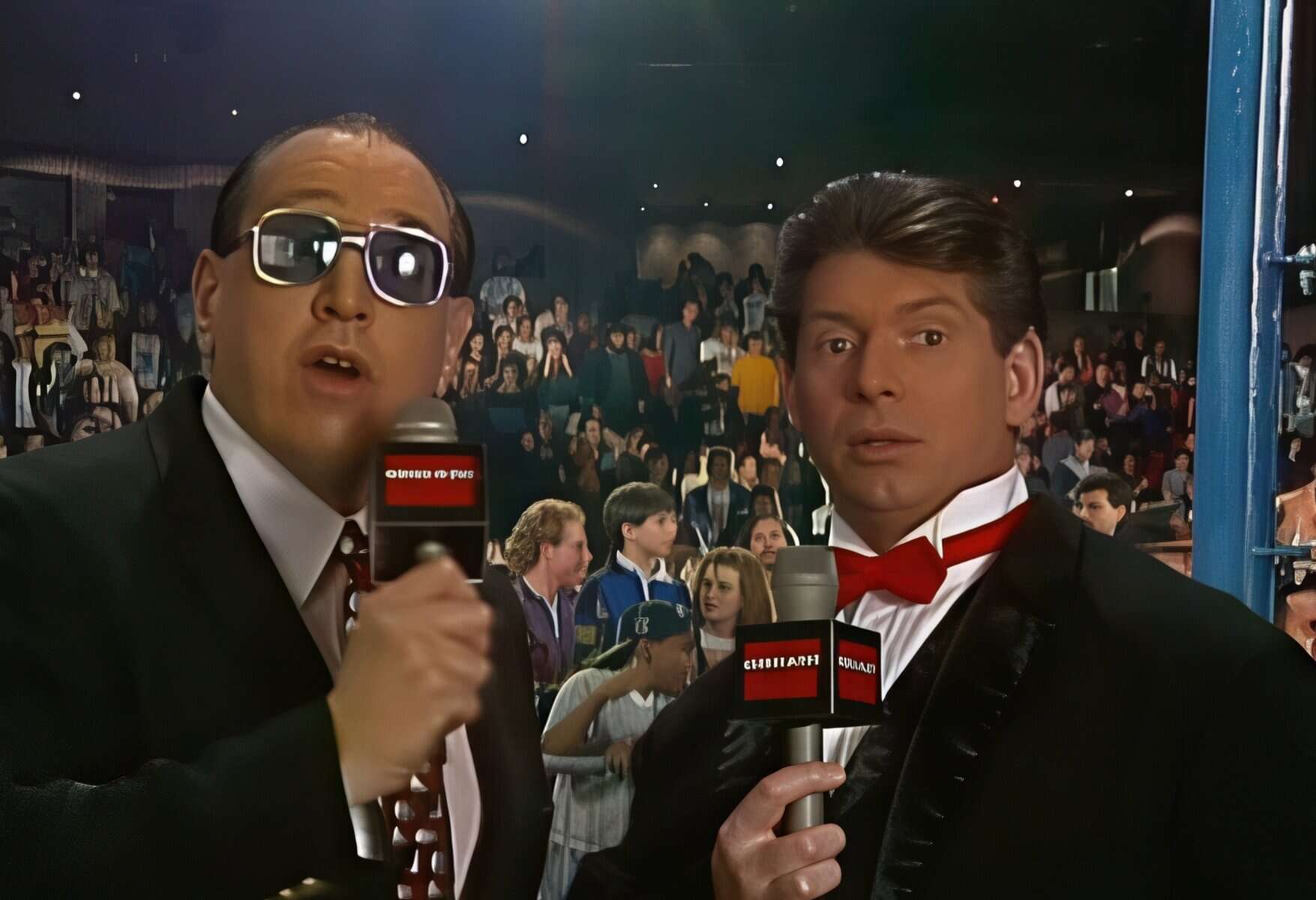
You simply cannot talk about Gorilla Monsoon without talking about Bobby Heenan. Their dynamic is the gold standard by which all commentary teams are still judged. Heenan would spin the most outrageous, intellectually dishonest defenses of the worst villains, justifying blatant cheating with spectacular linguistic gymnastics.
Monsoon's exasperated "Will you stop!" became the soundtrack of the 1980s wrestling boom. It wasn't just a catchphrase; it was the voice of the frustrated fan at home, begging the bad guy to finally get his comeuppance. The timing between the two men was impeccable.
8. The Lexicon of Monsoonisms
To be brutally honest, Gorilla wasn't a great technical play-by-play man. He often ignored the actual mechanics of a match to tell his own story, and he would completely bury heel psychology if it suited him. His babyface bias was sometimes overwhelmingly grating, completely ignoring blatant rule-breaking by fan favorites.
But he made up for his technical shortcomings with a bizarre, enduring vocabulary. Wrestlers didn't just get hit; they were struck in the "occipital protuberance." Kicks were delivered by "highly educated feet." An unlikely kickout was a "miscarriage of justice." He invented a strange anatomical vernacular that shaped how an entire generation processed simulated violence.
7. Suspending Shawn Michaels (1995)
When Monsoon transitioned into the role of on-screen WWF President in the mid-90s, he brought a level of legitimate gravitas the role desperately needed. The company was struggling creatively, but Monsoon's presence offered a steady hand. In late 1995, after Shawn Michaels was legitimately attacked outside a nightclub in Syracuse, the company needed a believable way to write him off television.
Monsoon was the one who delivered the grim news, stripping Michaels of the Intercontinental Championship in the center of the ring. The segment felt uncomfortably real, lacking the usual cartoonish bombast of the era. When Gorilla spoke, with real sorrow in his voice, you believed it wasn't just another storyline.
6. Taking the Fall for Vader (1996)
Vader's WWF run is largely viewed as a colossal disappointment today, mishandled by a booking committee that never understood his appeal. But his debut was undeniably impactful, and Monsoon was the primary catalyst. After Vader attacked the WWF President following a match, Monsoon didn't just cower.
He stood his ground, took off his jacket, and threw some stiff, surprisingly fast chops at the Mastodon before eating a devastating Vader Bomb in the corner. For a man of his advanced age and failing health to take a bump like that was staggering. It put Vader on the map as a terrifying monster immediately.
5. The End of Prime Time Wrestling (1993)
Prime Time Wrestling was a chaotic, beautiful mess of a television program. It was essentially a bizarre talk show hosted by Monsoon and Heenan, loosely wrapped around a standard wrestling broadcast. The final episode in early 1993 featured a surprisingly poignant, quiet sign-off.
The era of localized studio shows was rapidly dying, making way for the sleek, live format of Monday Night Raw. Watching Monsoon pack up the set alongside his greatest foil felt like watching the door officially close on the 1980s wrestling boom. It was the end of an era, delivered with a quiet dignity that the wrestling business rarely affords its aging stars.
4. Kicking Out The Brain (1993)
Bobby Heenan's departure from the WWF in late 1993 was a massive blow to the product, leaving a void at the commentary desk that was arguably never filled. But the exit was handled brilliantly on television. Heenan, complaining loudly, was physically tossed out of the building by a fed-up Gorilla Monsoon.
As Heenan clutched his bags and screamed in protest on the concrete floor, Monsoon slammed the heavy arena door on him. The irony is that the two were incredibly close friends in real life, and behind the scenes, the moment was deeply emotional for both men. On screen, however, it was the ultimate, satisfying comeuppance for the biggest weasel in the history of the business.
3. The WrestleMania III Call (1987)
Hulk Hogan slamming Andre the Giant is the most replayed clip in the history of professional wrestling. But the moment is infinitely amplified by the brilliant commentary of Monsoon and Jesse "The Body" Ventura. Monsoon's sheer, unadulterated disbelief as Hogan lifted the 500-pound giant is infectious.
He didn't scream, he didn't rely on manufactured shock, and he didn't try to get himself over. His genuine astonishment sold the impossible nature of the physical feat perfectly. In a business built entirely on hyperbole, Monsoon found the exact right emotional register for the biggest main event in wrestling history.
2. The Power Behind The Throne
The recent revelations about Monsoon's actual corporate standing completely recontextualize his entire career. He wasn't just a beloved, loyal employee who read off a monitor; he was a legitimate power broker behind closed doors. According to the newly published details, he held a massive 25% stake in the WWF and was the assumed, hand-picked successor to Vince McMahon Sr.
The fact that he stepped aside to let "Vinny" take the reigns, and remained a loyal soldier through the steroid trials and the Monday Night Wars, speaks volumes about his character. He traded the corporate throne for the announcer's desk, and in doing so, became the voice of the empire he helped build.
1. The Gorilla Position
His ultimate legacy isn't a match, a brilliant call, or a famous catchphrase. It's a highly stressed piece of real estate. The small area directly behind the entrance curtain is universally known in the industry as the "Gorilla Position." It's the nerve center of the broadcast, where the chaos of the backstage area violently meets the reality of the live crowd.
It's where Vince McMahon sat furiously for decades, directing traffic through a headset. Naming the most important operational space in the building after Robert Marella isn't just a polite tribute. It's a permanent acknowledgment that, in many ways, Gorilla Monsoon was the structural, emotional foundation of the company.
Honorable Mentions
- His brutal, hour-long time limit draws with Bruno Sammartino in Madison Square Garden during his prime.
- The brief, incredibly bizarre run managing the Giant Machine in 1986.
- His final, heartbreaking public appearance at WrestleMania XV, receiving a massive standing ovation as a judge for the ill-fated Brawl for All tournament just months before his death.