The Ace Returns to Chicago
There was an incredible amount of pressure riding on All Out 2026. After a weirdly disjointed summer of inconsistent television and a couple of pay-per-views that felt strangely skippable, AEW needed a massive jolt.
The Elite storyline had dragged out far too long, the midcard titles felt like a complete afterthought, and the live crowds were visibly getting restless. They got their fix in the form of Jon Moxley bleeding buckets all over the United Center canvas.
When the Death Rider music hit, the pop in the building was completely deafening. You could physically feel the tension release in the arena. He walked out looking entirely unhinged, marching straight down to the ring without the usual crowd interactions or posing.
For the next thirty-odd minutes, Moxley essentially grabbed the entire main event scene by the scruff of the neck and dragged it back into the mud.
This wasn't just another title defense or a standard grudge match. This was a statement of intent from a guy who has repeatedly had to put the company on his back whenever things start going off the rails.
We saw it after the Brawl Out incident, we saw it during the pandemic era, and we are seeing it again right now.
Dragging Okada Down
The decision to book Moxley against Kazuchika Okada in a Chicago Street Fight was a massive risk on paper. Okada is undeniably a generational talent, but his entire aura is built around being the untouchable Rainmaker.
He works clean, pristine main events. Putting him in a garbage match against a guy who regularly bleeds in CZW offshoots seemed completely insane. But that massive contrast in styles was exactly why the match worked so beautifully.
The action was incredibly jarring in the best way possible. The opening sequence where Moxley immediately launched a steel trash can at Okada's head before the bell even rang set a shockingly aggressive tone.
There was no feeling out process, no beautiful wrist-lock counters. Just raw aggression. Watching the usually perfectly groomed Okada forced to fight out of a bulldog choke while covered in his opponent's blood was a visual that will stick with me for a long time.
That said, it wasn't a flawless performance by any stretch. The booking down the stretch was genuinely baffling.
Having the Young Bucks run down to interfere at the 22-minute mark felt incredibly forced and completely took the air out of the building. We've seen that exact interference spot a dozen times this year alone. It cheapened the visceral violence that had just occurred and made Okada look like he couldn't handle his own business without help.
A Masterclass in Violence
Despite the frustrating overbooking, Moxley's sheer performance was the glue that held the chaotic mess together. He's undeniably slowed down a step since his prime. There were a couple of spots where the timing between him and Okada was visibly off.
A sequence on the ring apron looked dangerously close to going terribly wrong, and a suplex to the floor almost ended in disaster. But Moxley's ability to cover those botches with pure, unfiltered intensity is unmatched in modern wrestling.
What makes Moxley so vital to this company right now isn't his crispness or his work rate. It's his absolute, unshakeable aura. In an era where so many top guys feel heavily produced and overly choreographed, he just feels like a legitimate threat.
He wrestles like a guy who might actually hurt you, or himself, and genuinely does not care which happens first.
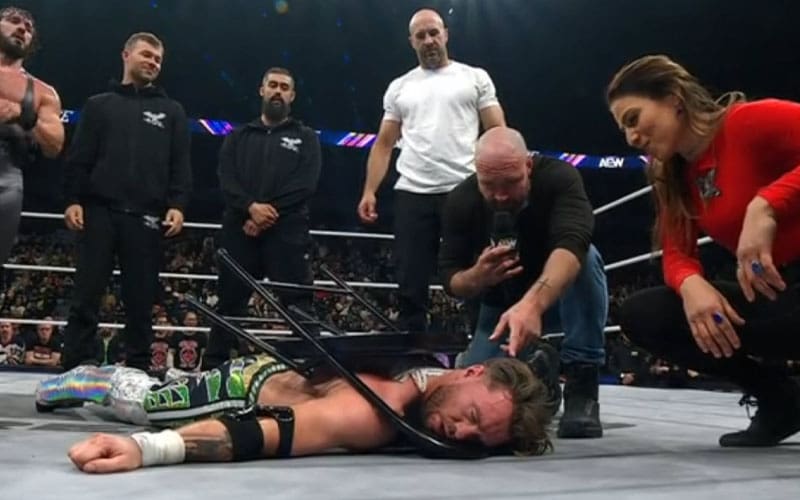
The finish was as brutal as anyone could have expected. A top-rope Death Rider onto an open steel chair looked like it legitimately knocked the wind out of both men.
It was ugly, it was deeply uncomfortable to watch, and it was exactly the kind of gritty, definitive finale the feud demanded.
The September Statement
Look at the post-match angle. There was no long, winded monologue in the center of the ring. There was no convoluted explanation of his deep inner motivations.
He just grabbed the microphone, told the locker room to step up or get out of his way, and spiked it into the mat. It was thirty seconds of pure reality. The bleeding forehead and the exhausted stare communicated significantly more than a heavily scripted fifteen-minute promo ever could.
This was a crystal clear message to the rest of the roster. The lazy summer vacation is officially over. The standard has been forcibly reset.
If you want to be in the main event picture in AEW right now, you have to be willing to go to the dark, violent places that Moxley goes. And looking at the current locker room dynamics, very few guys seem genuinely ready to make that trip.
Is this extreme level of violence sustainable? Absolutely not. You simply cannot rely on your top star to bleed to death every single pay-per-view just to paper over the glaring cracks in your creative direction.
Tony Khan still has a massive problem with building compelling secondary feuds that don't rely on cheap heat or predictable interference. But for one night in September, Jon Moxley grabbed the steering wheel, kicked out the windshield, and reminded everyone why he's the one guy AEW truly cannot afford to lose.