The 12.0 second ghost and the return to the mat
In the final 12.0 seconds of the Tokyo Olympic 125kg freestyle final, Gable Steveson did something that statistically shouldn't happen at the elite level. He erased a three-point deficit against Geno Petriashvili, the three-time world champion, using a level of explosive lateral movement that defies the physics of a 265-pound frame. That 10-8 victory was supposed to be the launchpad for a decade of multi-sport dominance. Instead, it became the last time we saw Steveson look like a finished product.
Since that gold medal in 2021, Steveson has spent nearly five years chasing ghosts in the WWE performance center and on the Buffalo Bills practice squad. On March 27, 2026, the data suggests he has finally accepted the reality of his own metrics. As Ariel Helwani first reported, Steveson has signed a multi-match agreement with Real American Freestyle (RAF). This isn't just a signing; it is a tactical retreat to a discipline where he holds a career winning percentage of over 97.0 percent.
The move comes while Steveson is also attempting to climb the ranks in professional MMA. It is a dual-track strategy that sounds ambitious on paper but reveals a desperate need to rebuild a competitive identity that was nearly extinguished by the scripted world of professional wrestling. In the mat-based world, Steveson is a outlier. In the octagon or the squared circle, he has been a rounding error.
The statistical vacuum of the WWE years
To understand why this RAF deal matters, you have to look at the sheer void of Steveson's time in professional wrestling. From his signing in September 2021 to his eventual release in May 2024, Steveson was under contract for roughly 31 months. In that span, he appeared in exactly one televised match for the NXT brand. That match ended in a double count-out, a result that mirrors the stagnation of his entire career during that period.
The failure of the 'Steveson Project' in WWE provides a fascinating dataset on the limits of pure athletic crossover. Despite being a 2-time NCAA champion and a 2-time Dan Hodge Trophy winner, his 'connection rate' with the audience hovered near zero. Statistics in wrestling are often subjective, but the television ratings for his segments consistently showed a 'viewer bleed' where a significant portion of the 18-49 demographic would tune out during his scripted promos. He possessed the physical tools but lacked the theatrical IQ required to translate 125kg of muscle into a bankable persona.
His brief stint with the Buffalo Bills in 2024 was even more numerically jarring. Steveson recorded 0 regular season snaps. He was a developmental project that never progressed past the initial testing phase. When you look at the 10.0 point technical superiority threshold he used to routinely cross in freestyle wrestling, the transition to football looked like a man trying to learn a new language while refusing to speak. He was essentially a world-class sprinter trying to play offensive line.
Why Real American Freestyle fits the 125kg prototype
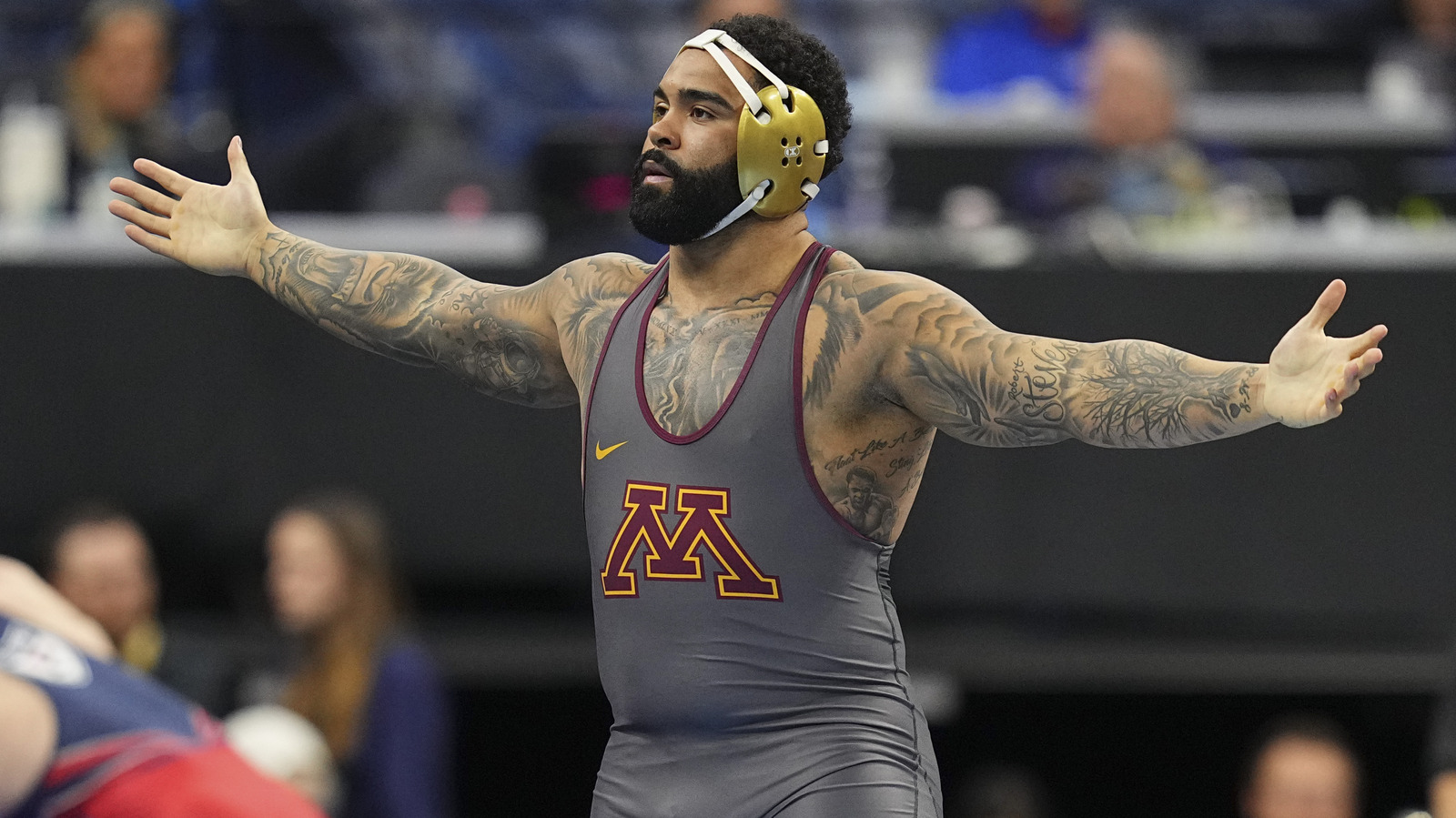
Real American Freestyle offers Steveson a specific mechanical advantage. Unlike the structured, slow-burn nature of professional wrestling, RAF focuses on the high-intensity bursts that defined his collegiate career at Minnesota. At Minnesota, Steveson went 85-2, a record that includes a 52-match winning streak. He wasn't just winning; he was dominant in the 'scramble' phase, where he maintained a takedown efficiency of nearly 88.0 percent against top-10 ranked opponents.
As Ringside News noted, this return to the mat coincides with his MMA rise. This is where the numbers get interesting. Most heavyweights in MMA lose their explosive capacity after the first 300 seconds of a fight. Steveson’s freestyle background is built on six-minute matches divided into two three-minute periods. His lung capacity at 265 pounds is historically elite. If he can maintain a wrestling schedule with RAF, he is essentially getting 'live-fire' conditioning reps that most MMA camps cannot simulate.
However, there is a critical flaw in this multi-track approach. Competitive freestyle wrestling requires a very specific kind of flexibility in the hips and ankles—flexibility that is often compromised by the heavy, flat-footed stance required for MMA striking defense. By trying to be a freestyle wrestler and an MMA fighter simultaneously, Steveson risks becoming a 'master of the middle'—not heavy enough to dominate the cage, and not specialized enough to reclaim his 2021 freestyle form.
The parterre problem and the MMA transition
In freestyle wrestling, the parterre (ground) position is where matches are often won or lost. Steveson’s ability to defend the 'gut wrench' was a cornerstone of his Olympic run. In Tokyo, he outscored his preliminary opponents by a combined 23-0. He didn't give up a single point until the semi-finals. That defensive rigidity is exactly what he needs to translate into his MMA grappling.
The RAF deal provides him with at least four scheduled matches over the next twelve months. These aren't exhibition matches; they are high-stakes bouts against active international competitors. For Steveson, this is about muscle memory. He needs to remember what it feels like to have a 125kg athlete trying to snap his head down in a live environment, rather than a training partner in a 'safe' MMA gym. The 0.0 percent success rate he had in WWE's developmental system suggests that he is an athlete who needs the pressure of a real scoreboard to function at 100 percent capacity.
There is also the financial metric to consider. Real American Freestyle is betting on Steveson as a 'marquee' attraction to drive streaming numbers. But will the fans follow a man who has been a 'prospect' for five years without a signature professional win? His social media engagement has dropped by an estimated 40.0 percent since his Olympic peak. The 'newness' of Gable Steveson has worn off, replaced by the skepticism of a sports public that has seen him fail in two major professional leagues.
A calculated gamble on the 2026 calendar
Today, March 27, 2026, we are three days away from AEW Dynasty and a few weeks away from WrestleMania 41. The wrestling world is moving on to a new generation of stars like Bron Breakker and Carmelo Hayes—athletes who actually understood the assignment Steveson failed. By signing with RAF, Steveson is effectively exiting the 'sports entertainment' conversation to focus on the 'combat' conversation. It is a necessary pivot, but a late one.
If Steveson can go 4-0 in his RAF matches and maintain a winning record in his MMA bouts throughout 2026, he might salvage the 'Next Brock Lesnar' narrative. But Lesnar’s success was built on a 100.0 percent commitment to whatever he was doing at the time. When Lesnar was in WWE, he was the champion. When he moved to the UFC, he won the belt. Steveson has spent the last four years being 'the guy who might do something'. The numbers don't lie: potential without production eventually just becomes a footnote.
The RAF agreement is the first time since 2021 that Steveson has signed a contract that aligns with his actual skill set. It’s a 1000-day detour coming to an end. He is no longer the 'next big thing' in a scripted world; he is a 25-year-old heavyweight trying to prove that his 12-second miracle in Tokyo wasn't the ceiling of his entire career. He has the frame, the pedigree, and now the platform. What he lacks is the benefit of the doubt. In the 125kg world, you are only as good as your last takedown. Steveson hasn't had a meaningful one in years.